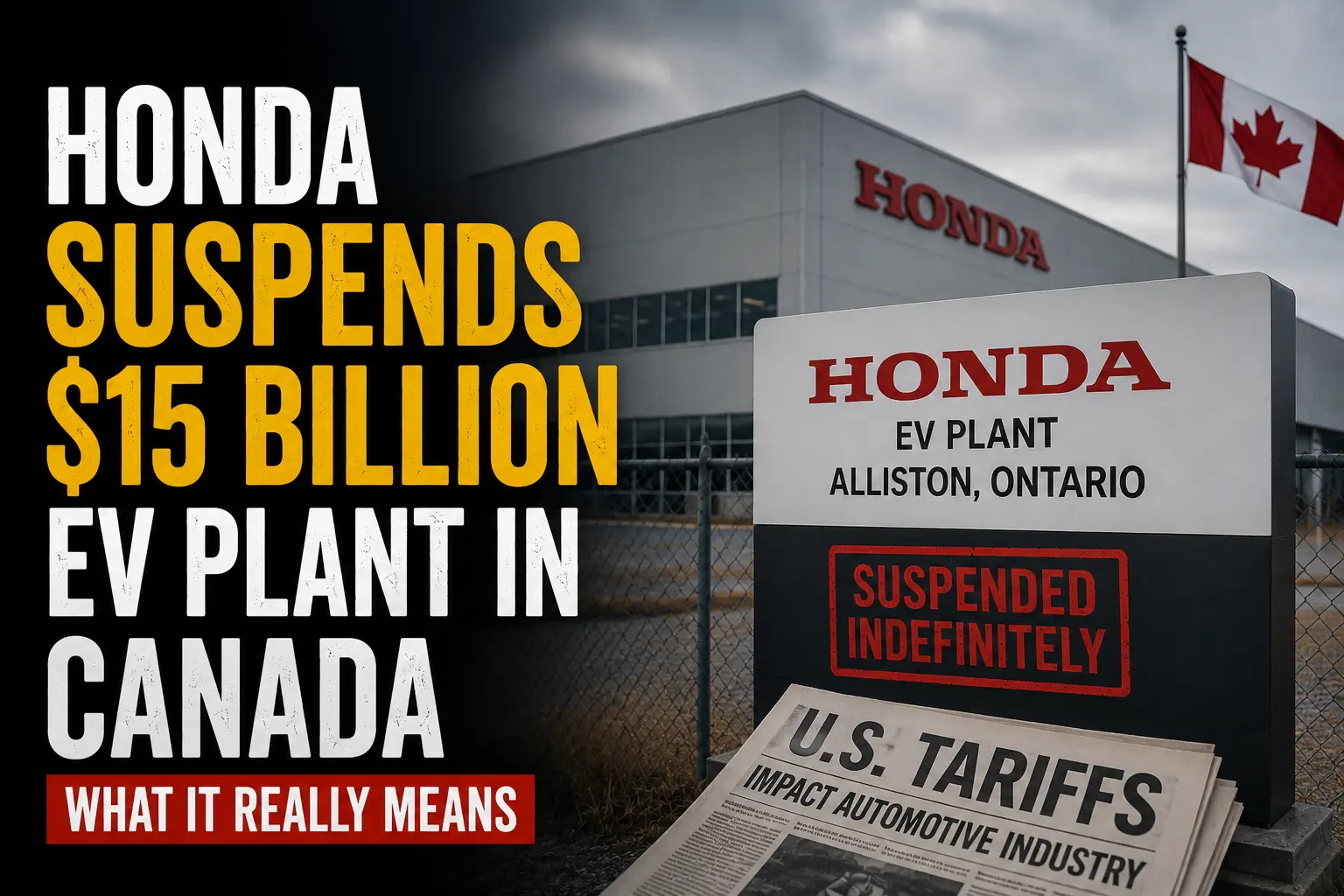
Honda just pulled the plug on one of the biggest factory projects in Canadian history. The Japanese carmaker announced on Thursday that its plan to build a massive electric vehicle plant in Ontario — worth about ₹1.25 lakh crore (roughly $15 billion) — is now “indefinitely suspended.” That means nobody knows if it will ever happen. And for thousands of workers and families in Canada who were counting on those jobs, this is a very hard day. But here is the part that should make you think — this decision was not just about Canada. It was about falling demand for electric cars, Donald Trump's trade tariffs, and a global slowdown that could affect auto industries everywhere, including India's. So what exactly happened, and why does it matter to you?
- Honda has “indefinitely suspended” its planned $15 billion (about ₹1.25 lakh crore) EV plant in Alliston, Ontario, Canada — announced in April 2024.
- The plant was supposed to make up to 2.4 lakh electric vehicles every year and begin production by 2028.
- Honda blames two main reasons: slowing demand for electric cars in the US and Donald Trump's tariffs hitting the North American auto sector hard.
- This is the second major blow to Canada's EV industry in just a few months, after Canadian Prime Minister Mark Carney made EV manufacturing the centre of his government's big plan.
- No new date has been given for when — or whether — the project will restart. Workers and governments are waiting for answers.
- Indian investors watching global auto stocks should note: this signals that the EV transition is slower and harder than many predicted, and hybrid cars are gaining ground instead.
The Story That Led to This Moment
Just a little over a year ago, this was a dream project. Back in April 2024, Honda made a big announcement — it would build a giant EV assembly plant and a battery factory right next to its existing facility in Alliston, Ontario. Canadian Prime Minister Justin Trudeau and Ontario Premier Doug Ford were both there, smiling and shaking hands at the Honda factory. Everyone was excited. Canada was going to be a major player in the global electric vehicle race.
The plan was huge. At full capacity, the site would make up to 2,40,000 electric vehicles every year — that is roughly as many cars as the entire city of Pune buys in a full year. The factory was also going to create thousands of direct jobs and tens of thousands of indirect ones. For Canada's auto workers — mostly in Ontario — this felt like a guaranteed future.
But now that dream is on hold. And the reasons behind this suspension are bigger than just one company's decision. So what actually went wrong?
What Actually Happened — The Full Story
Honda made the official announcement on Thursday, 22 May 2025. The company said its plans for the Ontario EV and battery factories are now “indefinitely suspended.” The word “indefinitely” is important — it does not mean cancelled forever, but it does mean there is no plan, no timeline, and no guarantee it will ever happen.
- $15 billion investment paused: This is roughly ₹1.25 lakh crore — enough money to fund India's entire railway budget for nearly two full years. That is how big this project was.
- Production start pushed to unknown date: The plant was originally set to start making cars by 2028. That deadline is now gone completely.
- 2,40,000 vehicles per year — gone for now: The plant would have been one of the biggest EV factories in North America. Those production numbers are now just a plan on paper.
- Trump's tariffs are a key reason: The United States put heavy new taxes (called tariffs) on cars imported from Canada and Mexico. Since Canada and the US share a deeply connected auto industry — parts cross the border multiple times before a car is finished — these tariffs hit Canada extremely hard.
- EV demand is slowing in the US: Americans are not buying electric cars as fast as companies expected. Many buyers are choosing hybrid cars instead — vehicles that use both a petrol engine and an electric motor. Honda itself is now focusing more on hybrids.
- Canada's EV strategy takes a hit: New Canadian PM Mark Carney had made EV manufacturing the centrepiece of his economic plan just in February 2025. This suspension is a direct blow to that plan, just months after he announced it.
Canadian opposition leader Pierre Poilievre wasted no time. He called Carney's auto industry strategy a “Liberal hallucination” after the Honda news broke. PM Carney, for his part, said his government will “continue to do what's necessary” for the auto sector — but he did acknowledge the “challenges” the industry is facing right now.
Honda itself did not officially confirm the Nikkei Asia report that first broke the story. The company said — and this is almost word for word — “The content of the article was not released by Honda.” But on Thursday, the suspension became official. The silence before that only made the news hit harder.
Why This Is Bigger Than One Factory in Canada
Here is the thing most people miss. This is not just a Canada story. This is a signal — a very loud one — about where the entire global car industry is heading right now. Honda is not a small company. It is one of the top five carmakers in the world. When a company this big puts a ₹1.25 lakh crore project on hold, something serious is happening in the market.
Think about it from three different angles. First, the government angle: Canada's leaders bet big on EVs. They gave tax breaks, subsidies, and political promises to attract companies like Honda and Volkswagen. Now those bets are looking shaky. Second, the worker's angle: Thousands of people in Ontario were expecting jobs — good, stable, factory jobs that pay well and last decades. Those jobs may now not come for years, if ever. Third, the investor's angle: Companies around the world — including in India — that were pouring money into EV supply chains are now watching this closely. If demand in the US is weak, the ripple hits everyone.
And there is a bigger trend here too. Legacy automakers — meaning old, established car companies — are all pulling back on their EV plans right now. Ford, GM, and now Honda have all slowed down. The reason? Buyers in the US and Europe are choosing hybrid cars much more than expected. Pure electric cars are still more expensive, charging stations are still not everywhere, and many buyers are simply not ready to fully switch yet. Honda's own global strategy has now shifted — the company is putting more focus on hybrid technology rather than pure electric vehicles.
For Indian investors tracking global stocks, here is the direct point: companies in the EV battery supply chain — lithium, cobalt, and rare earth miners — could see lower demand forecasts. Meanwhile, companies in the hybrid space may get a boost. Keep an eye on how Indian auto giants like Tata Motors (NSE: TATAMOTORS) and Mahindra & Mahindra (NSE: M&M) respond to these global signals in their own EV road maps over the next two quarters.
How This Affects Real People — Not Just Companies
For an auto worker in Windsor or Alliston, Ontario, this news is devastating. These are people who maybe told their kids — “don't worry, there will be good jobs at the new Honda plant.” Now that promise is suspended along with the factory. Canada's auto sector is already bleeding because of Trump's tariffs, and this suspension makes the wound much deeper.
But what about you, sitting in India? Here is how this connects to your life more directly than you might think. First, if you or someone in your family works at or invests in Indian auto companies that supply parts to global carmakers, watch this space carefully. India has been trying hard to become a major auto parts exporter — companies in Pune, Chennai, and Gurugram supply parts to global car brands. A slowdown in EV factory buildouts globally means less demand for EV-specific parts. Second, if you are thinking about buying an electric car in India, this global story tells you something useful: the price of EVs may not fall as fast as expected, because the big investment in new factories is slowing down worldwide.
For a middle-class family in India thinking about whether to buy a petrol car, a hybrid, or an electric car in the next year or two — this global shift toward hybrids is relevant. Hybrid cars are getting more attention and investment from big companies right now. That means better hybrid options, possibly at better prices, could come to India sooner than full EVs do. So do not write off hybrids just yet.
If you are a student or young professional interested in the auto sector as a career or investment theme — take note. The EV gold rush that everyone was talking about in 2022 and 2023 has hit a speed bump. The companies that survive this slowdown will be the ones that are smart enough to read the market and adjust. Honda is doing exactly that — painful as it is for Canada right now.
What to Watch For Next
Right now, the big question is whether this is a pause or a permanent cancellation. Honda has not said the word “cancelled.” But “indefinitely suspended” without any new date is, in practice, very close to that. The Canadian government is expected to push Honda for a clear answer in the coming weeks — Ontario Premier Doug Ford's office has not yet given an official public response to the suspension, but pressure will build fast.
Three scenarios are possible from here. The best case: Trump's tariffs get reduced or renegotiated, US EV demand picks up by late 2025 or early 2026, and Honda quietly announces a revised timeline for the Ontario plant — maybe a 2030 start instead of 2028. The most likely case: Honda keeps the project on hold for at least 18 to 24 months, watching market signals, while quietly shifting more investment toward hybrid technology and its existing plants. The worst case: EV demand stays weak, tariffs stay high, and the Ontario project is quietly dropped altogether within the next year — with no replacement announcement.
Watch for Honda's next quarterly earnings call — that is where the company will give the clearest signal about which of these three paths it is really choosing. Also watch what Canada's PM Mark Carney does next. His government needs a win for the auto sector. If he cannot deliver one soon, this story will become a much bigger political problem for him back home. And keep an eye on whether other global automakers with planned EV factories in North America — like Volkswagen, which has its own Canadian battery plant deal — follow Honda's move or hold steady.
Frequently Asked Questions About Honda's Canada EV Plant Suspension
Why did Honda suspend its EV plant in Canada?
Simply put, Honda gave two main reasons. First, demand for electric vehicles in the United States is growing much slower than the company expected. Second, Donald Trump's trade tariffs have made it expensive and complicated to build and sell cars across the US-Canada border. Honda decided it made more sense to pause the project than to keep spending money on something that may not be profitable right now.
How big was the Honda EV plant project in Canada?
The short answer: very big. Honda's planned Ontario factory was a $15 billion project — roughly ₹1.25 lakh crore in Indian money. It was supposed to make up to 2,40,000 electric vehicles every year and start production by 2028. It would have been one of the biggest EV manufacturing sites in all of North America, creating thousands of jobs in Alliston, Ontario.
How does Honda's decision affect ordinary Canadians and Indians?
For Canadians — especially auto workers in Ontario — this means thousands of expected jobs are now on hold, with no clear timeline for when they might come back. For Indians, the impact is indirect but real: global slowdowns in EV factory investments can reduce demand for Indian auto parts exports and signal that EV price drops may happen more slowly than expected in markets like India over the next two to three years.
Is the Honda Canada EV plant permanently cancelled?
Here's the thing: Honda used the phrase “indefinitely suspended,” not “cancelled.” That means it could technically restart one day — but there is no timeline, no new date, and no guarantee. In the business world, “indefinitely suspended” without a backup plan usually means the project is in very serious trouble. Most industry watchers are treating this as a near-cancellation unless Honda says otherwise soon.
What does this mean for the future of electric vehicles globally?
Good question — this is the bigger picture. Honda's move is part of a wider trend where major automakers are slowing down their pure EV plans and shifting more focus to hybrid cars. Demand for fully electric vehicles in the US and Europe has been weaker than companies predicted back in 2022. This does not mean EVs are dead — but the timeline for full EV adoption is now expected to stretch well beyond 2030 for most big markets.