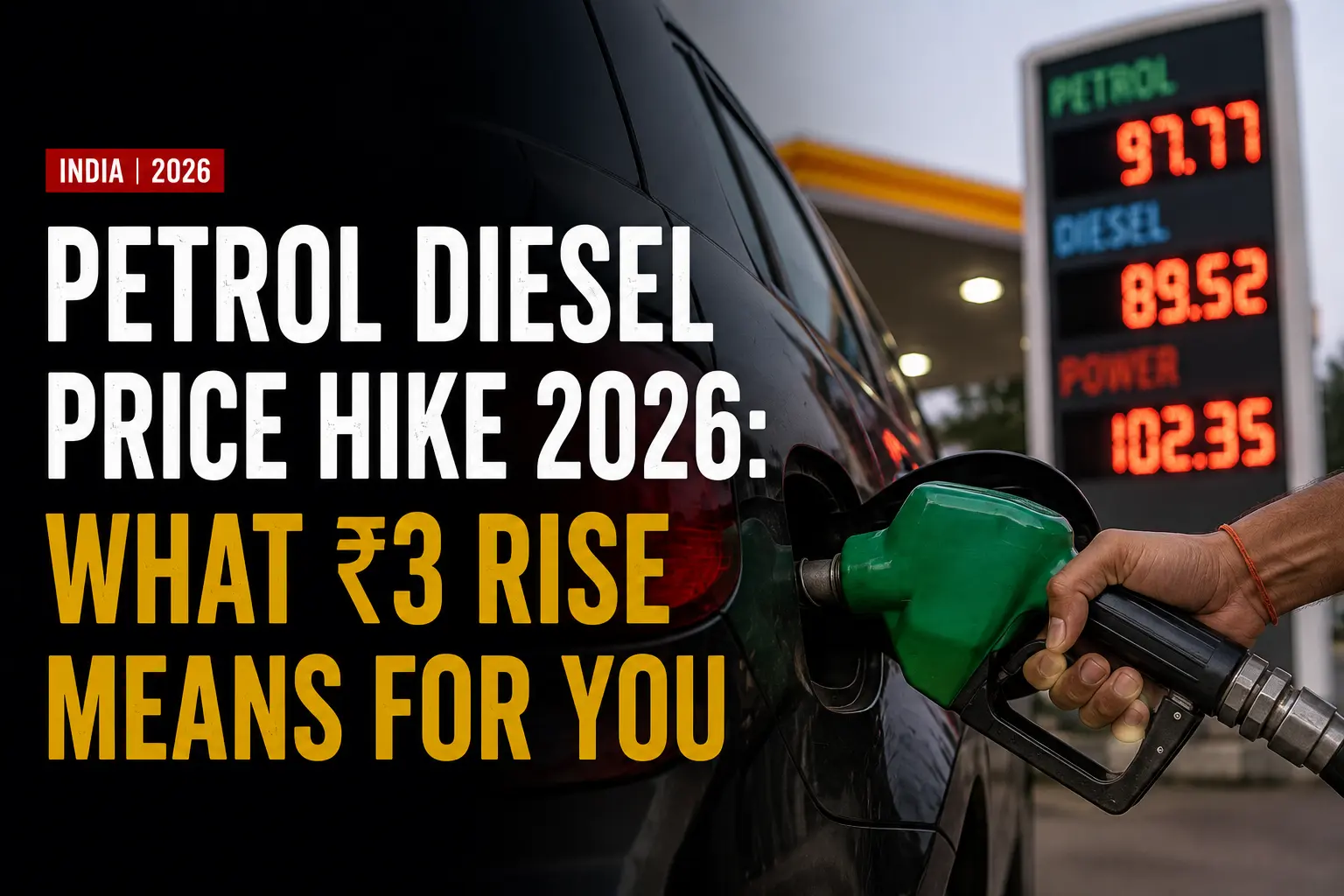
Nobody saw it coming this fast. On Wednesday, state-run oil marketing companies quietly raised petrol and diesel prices by ₹3 per litre — the first fuel price hike in nearly two years — and by Thursday morning, every petrol pump in India was charging more. If you filled your tank yesterday, you got lucky. If you fill it today, you're already paying extra. In Delhi, petrol now costs ₹97.77 per litre. In Mumbai, it's crossed ₹106.68. For the crores of Indian families who track every rupee in their monthly budget, this single announcement has changed things. But the government says it could have been far worse. Here is the full story — and what it actually means for your wallet.
- Petrol and diesel prices hiked by ₹3 per litre across India — first hike in nearly two years.
- New petrol prices: ₹97.77 in Delhi, ₹108.74 in Kolkata, ₹106.68 in Mumbai, ₹103.67 in Chennai.
- The hike is driven by rising global crude oil prices, partly due to the ongoing West Asia conflict.
- Government sources say they absorbed a larger shock — global price pressure was enough to justify a ₹8–10 hike, but only ₹3 was passed on.
- Diesel prices have also gone up by ₹3 per litre, affecting transport costs, vegetables, and everyday goods.
- Check your city's updated fuel price at the Indian Oil, BPCL, or HPCL website or app before your next fill-up.
Why Fuel Prices Were Going to Rise No Matter What
Let's go back a little — not far, just enough to understand why this was coming. India imports about 85% of the crude oil it needs. That crude oil is refined into petrol and diesel. When global oil prices go up, India has to pay more to buy that oil. Simple as that.
For the past several months, the conflict in West Asia (the Middle East) has been pushing global oil prices higher and higher. Every time there's a threat to oil supply routes in that region, prices jump on international markets. And India — which buys a massive amount of oil every single day — feels that pressure almost immediately.
State-run oil marketing companies like Indian Oil Corporation (IOC), Bharat Petroleum (BPCL), and Hindustan Petroleum (HPCL) are the ones who actually sell you fuel at the pump. These companies had been quietly bleeding money for months, absorbing the higher cost of importing crude without raising prices. According to sources inside the government, the financial stress on these companies had become serious enough that a price revision could no longer be delayed.
So the real question was never if prices would go up. It was always how much. And that is where the government's decision gets interesting.
What Actually Happened — The Full Breakdown
On the night of the announcement, oil marketing companies revised fuel prices across the country. The hike of ₹3 per litre came into effect immediately. Here is what the numbers look like city by city:
- Delhi — ₹97.77 per litre of petrol: Up from ₹94.77. Diesel also revised upward by ₹3. Delhi is the benchmark city for fuel pricing in India.
- Kolkata — ₹108.74 per litre of petrol: Kolkata consistently has some of the highest fuel prices in the country due to state tax structures.
- Mumbai — ₹106.68 per litre of petrol: Mumbai had already crossed ₹103 before the hike. It's now well past ₹106.
- Chennai — ₹103.67 per litre of petrol: Tamil Nadu's capital joins Mumbai and Kolkata above the ₹100 mark comfortably.
- Diesel — hiked by ₹3 per litre in all major cities: This matters even more than petrol for the common person because trucks, buses, and tractors run on diesel. Higher diesel = higher freight costs = costlier vegetables, groceries, and goods.
- Government sources confirmed that the actual pressure from global markets was large enough to justify a hike of ₹8 to ₹10 per litre. The decision to pass on only ₹3 was a conscious choice to protect consumers from the full shock.
The announcement didn't come with a big press conference. No minister stood at a podium. Oil marketing companies updated their price boards quietly, and by morning, every pump in the country had new rates. That is how fuel price changes work in India — no drama, just new numbers.
Government sources, speaking to journalists on background, made it clear that this was not a revenue-raising move. They described it as a partial pass-through of unavoidable cost increases. “We have been shielding citizens instead of passing on the full oil shock,” one source said, adding that the subsidy buffer the government had been providing could not last indefinitely.
The Real Picture Behind the Numbers
Here's something most people don't think about. A ₹3 hike sounds small. But multiply it across every litre of petrol and diesel sold in India every single day — and the numbers become enormous. India consumes roughly 22–23 lakh kilolitres of petrol and diesel every month. That is an almost unimaginable amount of fuel.
Now think about three different people and what this hike does to their life.
For Ramesh, an auto-rickshaw driver in Hyderabad, who fills about 4 litres of fuel a day, this hike means he's paying roughly ₹12 more every day. That's ₹360 extra per month. He can't easily raise his fares — passengers resist that. So either he absorbs the loss, or he starts skipping maintenance on his vehicle. Neither is a good option.
For a middle-class family in Pune with two-wheelers, the hike means about ₹60–90 more per month depending on how much they ride. Not catastrophic. But it comes on top of groceries that are already more expensive, electricity bills that have risen, and school fees that never go down.
For a truck driver carrying vegetables from Maharashtra to Delhi, the diesel hike directly increases his operating cost. Transporters typically pass this cost to wholesalers, who pass it to retailers, who pass it to you at the sabzi mandi. So even if you don't own a vehicle, this hike will reach you — inside a tomato or a packet of dal.
The opposition has been quick to criticize the decision. Several leaders from the INDIA bloc called the timing poor, arguing that ordinary families were already struggling with high food prices. But the government's counter is straightforward — the oil companies were running losses, global prices left no choice, and a ₹3 hike is far more responsible than a sudden ₹10 hike six months from now.
Historically, this pattern isn't new. India saw fuel prices frozen during election periods and then hiked after results. The last major revision was about two years ago. Experts who track energy policy have been warning since early 2026 that a course correction was overdue. The West Asia crisis simply made it urgent.
How Ordinary Indians Will Feel This First
Let's be honest about who gets hit hardest. And who barely notices.
If you're in a high-income household with a car, you'll pay more at the pump. An extra ₹150–200 per fill-up depending on your tank size. That stings, but it won't change your life. You'll grumble, forward a meme about petrol prices on WhatsApp, and move on.
But if you're a daily-wage worker who takes a shared auto or a state bus every day, here is your reality. Bus fares haven't gone up yet — but they will. State transport corporations are already in losses. Give it a few weeks. And if you ride a second-hand motorcycle to get to work, your monthly petrol spend just went up by ₹150–300 depending on distance.
Farmers are another group watching this closely. Irrigation pumps run on diesel in most of rural India. A ₹3 hike means higher farming costs. In a season where crop prices are already uncertain, that extra cost comes straight out of a farmer's income.
Small businesses — the chai stall owner who uses a gas cylinder for heating water, the bakery that runs a delivery bike, the small courier who uses a scooter — all of them will feel this differently but consistently.
So what should you do right now? A few practical things. First, if you have a fuel credit card, check whether your cashback or reward rate is still worth it after the price change — some bank offers become less valuable when base prices shift. Second, if you use a vehicle for daily commuting, this is a good moment to look at whether a monthly bus pass or metro card actually works out cheaper now. Third, if you run a small business that involves transport, update your cost sheets. Don't wait for the ripple effects to catch you off guard.
What Comes After This — And What to Watch For
The ₹3 hike is not necessarily the last one. Government sources have been careful not to promise stability. Global oil prices are still volatile. The West Asia conflict shows no signs of ending quickly. If crude oil prices keep climbing, India's oil companies will face fresh pressure.
There are three ways this could go from here. The best case — global crude prices stabilize or fall, the companies recover their losses gradually, and there's no further hike for the rest of 2026. That is possible, especially if the West Asia situation cools down. The most likely case — prices stay roughly where they are internationally, and India holds this new price level for six to nine months before another small revision. The difficult case — if crude oil spikes further, another round of hikes becomes unavoidable, possibly before year-end.
Watch for two specific things. One, what happens to global Brent crude oil prices in the next four to six weeks. If it crosses $90 per barrel and stays there, pressure on India builds fast. Two, what happens to state elections on the calendar. Historically, the government avoids fuel price hikes right before votes. If there are big state polls coming, hikes get delayed. If the electoral calendar is clear, revisions happen faster.
The one thing you can count on — your fuel price is not going to go back down anytime soon. Price cuts in India's fuel market are rare and small. Hikes are more common. So plan your monthly budget around today's rates, not yesterday's.
Frequently Asked Questions About the Petrol Diesel Price Hike 2026
Why did petrol and diesel prices go up in India right now?
Simply put, global crude oil prices have been rising because of the ongoing conflict in West Asia, which threatens oil supply routes. India imports 85% of its crude oil, so when global prices rise, Indian oil companies pay more. These companies had been absorbing losses for months, and a price correction became unavoidable by mid-2026.
How much will I pay extra for petrol after this hike in major cities?
Here's the thing: petrol now costs ₹97.77 per litre in Delhi, ₹108.74 in Kolkata, ₹106.68 in Mumbai, and ₹103.67 in Chennai — all up by ₹3 per litre. If your bike tank holds 12 litres, you're paying ₹36 more per fill-up. For a car with a 40-litre tank, that's ₹120 more every time you fill it completely.
Does the diesel price hike affect people who don't own a vehicle?
In plain words, yes — and quite directly. Trucks and buses run on diesel. When diesel costs more, transporters charge more to move goods. That extra cost reaches vegetable vendors, grocery stores, and market traders. So even if you don't own a vehicle, expect prices of daily groceries and transported goods to nudge upward over the coming weeks.
Did the government have to hike prices, or was this a choice?
Good question — the government says it was unavoidable, but the scale was a choice. According to government sources, global oil price pressure was large enough to justify a hike of ₹8–10 per litre. Only ₹3 was passed on to consumers. The rest was absorbed by the government and oil companies to reduce the financial shock on ordinary families.
Will petrol and diesel prices go up again in 2026?
The short answer: it depends on global crude oil prices. If West Asia tensions continue and Brent crude stays high, another revision is possible before the end of 2026. Government sources have not promised a freeze on prices. Watch global crude oil price movements and upcoming state election schedules — both strongly influence when India revises fuel prices next.