A landmark quantum technology agreement between India and Japan signals a seismic shift in how two Asian tech powers are collaborating to shape the next decade of computing innovation. Beyond the ceremonial handshakes and diplomatic statements, this partnership represents something far more tangible: a direct challenge to Western dominance in quantum computing, and a bet that India's mathematical talent combined with Japan's manufacturing precision can accelerate breakthroughs that will touch everything from healthcare diagnostics to cybersecurity protocols protecting your bank account.
Why This Quantum Technology Deal Matters for India Right Now
India has long punched below its weight in cutting-edge semiconductor and quantum research, despite producing world-class computer scientists. The country imports most of its advanced computing hardware and remains dependent on foreign quantum expertise. This agreement flips the narrative. By formalizing research partnerships with Japan—a nation that has already invested heavily in quantum infrastructure—India gains access to laboratory facilities, technical knowledge, and collaborative networks that would otherwise take decades and billions of rupees to build independently. For Indian startups and research institutions, this opens doors.
The stakes are enormous. Quantum computers will eventually crack today's encryption standards, rewrite drug discovery timelines, and optimize everything from power grids to traffic systems. Nations that lead here won't just lead in technology; they'll lead in economic power and strategic autonomy. India's IT sector, which employs 5.4 million people, stands to gain tremendously if Indian engineers help pioneer quantum applications rather than simply implementing them.
Key Details of the India-Japan Quantum Technology Partnership
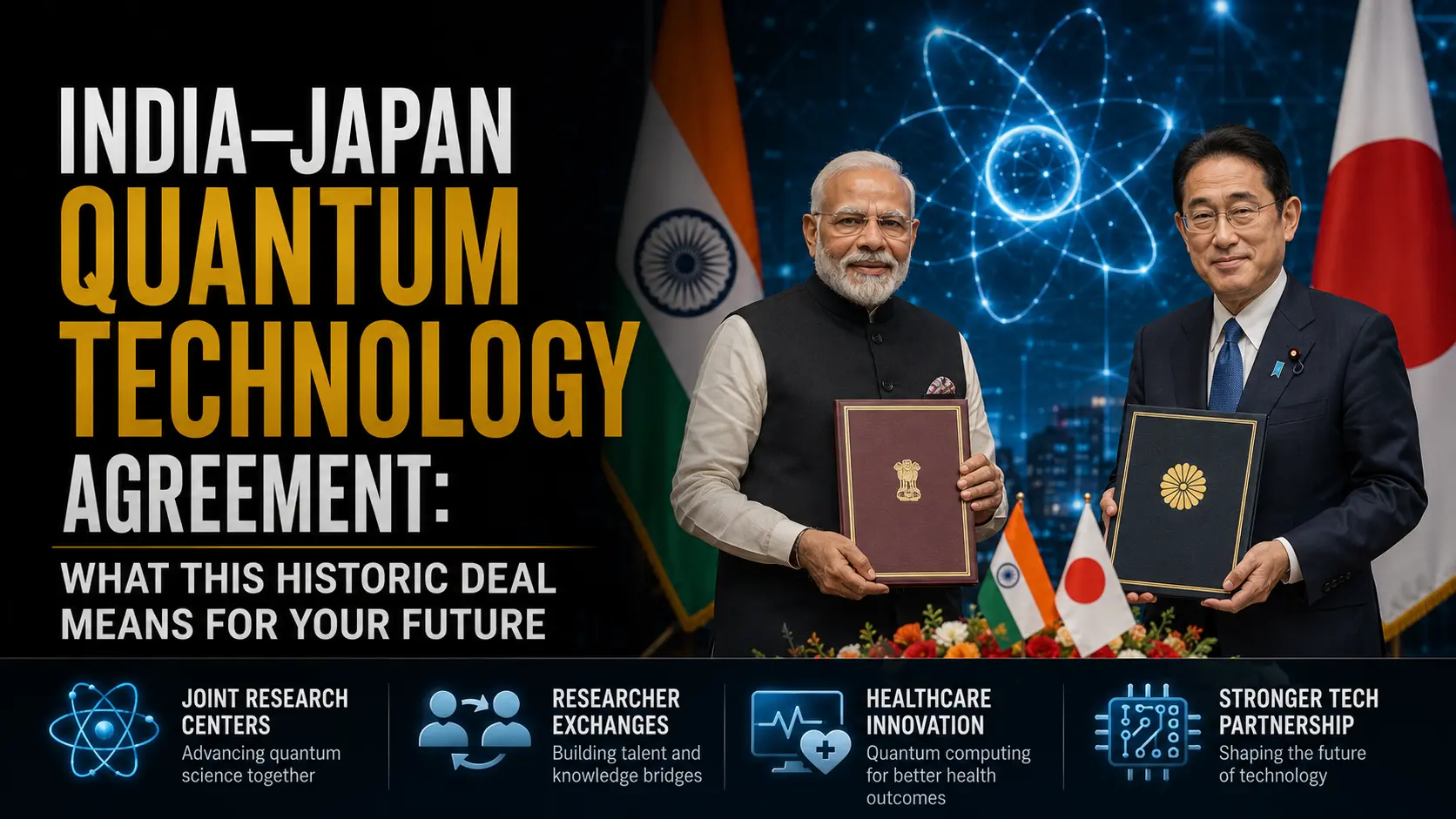
The formal agreement, finalized in early May 2026, extends far beyond press releases. Both nations have committed to concrete mechanisms: joint research laboratories, student and researcher exchange programs, and a shared roadmap for developing quantum algorithms suited to industrial applications. Japan brings institutional experience—it has been developing quantum tech since the early 2000s—while India contributes its deep bench of mathematics graduates and software engineers eager to work on frontier problems.
The health research component deserves special attention. Quantum computing promises revolutionary breakthroughs in drug modeling and genetic sequencing. For a nation like India, where healthcare costs remain a burden for millions and infectious disease threats are ever-present, quantum-enabled drug discovery could mean cheaper, faster development of treatments tailored to Indian populations and diseases prevalent in tropical climates.
Here's what the agreement actually covers:
- Joint Quantum Research Centers: Facilities in both nations where Indian and Japanese teams will work side-by-side on quantum algorithm development and hardware optimization, with India hosting at least two centers in tech hubs like Bangalore and Delhi.
- Technology Sharing Framework: Japanese companies like Sony and Hitachi will share quantum computing patents and technical documentation with Indian institutions, removing barriers to Indian companies developing indigenous quantum applications.
- Researcher Exchange Program: 200+ Indian scientists per year will spend 6-12 months in Japanese labs, while Japanese experts rotate through Indian research centers, creating a two-way knowledge pipeline.
- Healthcare & Biotech Focus: Dedicated workstreams targeting quantum applications in drug discovery, genomic analysis, and disease modeling—particularly for conditions like tuberculosis, dengue, and cardiovascular disease prevalent in South Asia.
- Quantum Cybersecurity Protocols: Joint development of quantum-resistant encryption standards tailored for Indian government and financial sector needs, protecting against future threats from quantum-capable adversaries.
- Educational Pipeline: Curriculum development for quantum computing at IIT and IISC level, ensuring India builds homegrown quantum talent rather than importing it.
Real Impact: What This Means for India's Tech Ecosystem
Let's be direct about impact. India currently has roughly 50 researchers actively working on quantum computing—a number that sounds larger than the reality. Contrast this with China (estimated 500+) and the US (1,000+), and you see why India has felt left behind. This agreement provides scaffolding to grow that number to 300+ within five years. More researchers means more startups, more patents filed from Indian soil, and more high-paying tech jobs that won't require emigration to Silicon Valley or Beijing.
The agreement also shields Indian institutions from the tech sanctions and export controls that have hampered research before. By developing quantum tech jointly with a trusted ally like Japan, India reduces its vulnerability to restrictions imposed by the US or other Western powers seeking to limit quantum capabilities in Asia. For India's defense and intelligence agencies, this is strategically invaluable—quantum encryption and quantum computing capabilities have obvious national security implications. Additionally, Indian pharmaceutical companies stand to benefit enormously; Cipla, Dr. Reddy's, and Sun Pharma could leverage quantum-powered drug modeling to reduce R&D costs by 30-40% and time-to-market by years.
What Comes Next: Timeline and Practical Implications
The agreement isn't a one-time handshake. Implementation began immediately, with the first joint research center operational by late 2026 in Bangalore's tech corridor. By 2028, expect to see Indian companies filing quantum-related patents backed by this partnership. By 2030, the first quantum-enabled drugs or medical diagnostic tools developed in India-Japan labs could enter clinical trials. Students finishing their master's degrees in computer science right now have a genuine shot at building quantum careers in India rather than abroad.
Practically speaking, if you work in Indian tech, healthcare, or government cybersecurity, pay attention. Job postings for quantum specialists will multiply. Indian universities will expand their physics and computer science programs to accommodate demand. Startups will emerge in Bangalore, Hyderabad, and Pune focusing on quantum applications for Indian businesses. This is a multi-year technological and economic momentum shift, not a one-year news story.
Frequently Asked Questions
What exactly is quantum technology and why does India need it?
Quantum computers use quantum bits (qubits) that exploit quantum mechanics to process information exponentially faster than classical computers for specific problems. India needs it because quantum breakthroughs in drug discovery, cryptography, and optimization will reshape competitive advantages across healthcare, finance, and defense—sectors critical to India's economic future.
How will ordinary Indians benefit from this quantum technology agreement?
Benefits will arrive gradually: cheaper medicines developed faster through quantum drug modeling, stronger cybersecurity protecting your financial transactions, better healthcare diagnostics, and improved infrastructure optimization. Additionally, high-skilled job creation in research and tech will boost employment and economic growth in Indian cities.
Is India falling behind China and the US in quantum computing?
Yes, currently. But this Japan partnership is explicitly designed to accelerate India's catch-up. Japan's established infrastructure and India's talent pool create a complementary advantage. Within 5-7 years, India could move from observer to active participant in global quantum competition.
When will quantum computers be available to Indian businesses?
Practical quantum computers for commercial use are still 3-5 years away. However, cloud-based quantum computing access is already available now. This agreement will make such access cheaper and more India-optimized by 2027-2028.
How does this agreement compare to India's ties with the US on technology?
This is different in character. The US relationship is stronger but subject to geopolitical constraints and export controls. The Japan partnership is more reciprocal—both nations benefit equally—and less likely to face sanctions or restrictions, making it strategically valuable for India's long-term technological independence.