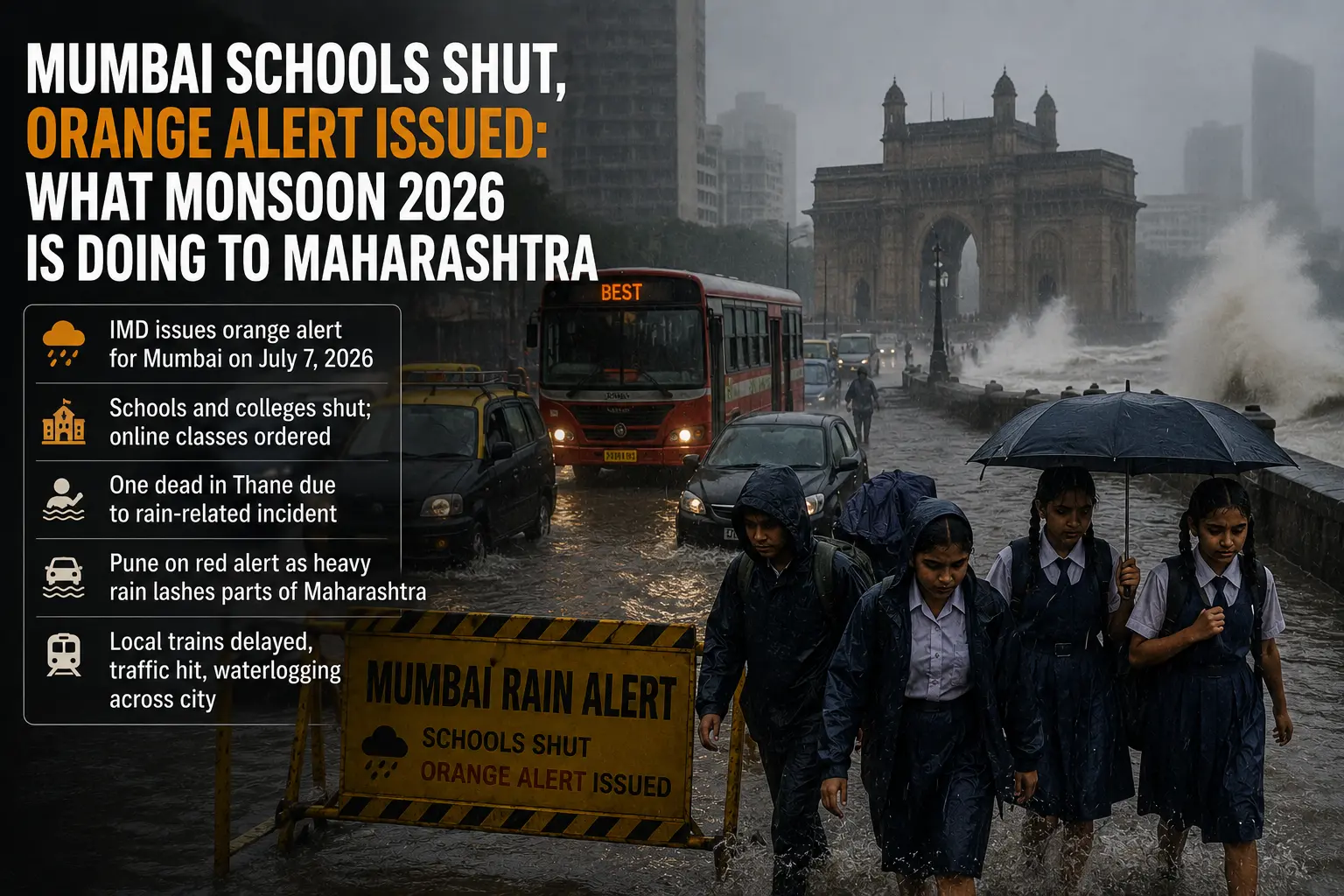
By Monday morning, the rain had already made the decision for everyone. Schools locked. Colleges dark. Trains crawling. And a 17-year-old boy — whose name nobody in the press briefings bothered to mention — had drowned in a river in Thane district the night before, swept away while the rest of Mumbai was still arguing about whether the alert was serious enough. It was. The India Meteorological Department issued an orange alert for Mumbai on Monday, July 7, 2026, forecasting heavy to very heavy rainfall with strong winds across the city and neighbouring districts. The Brihanmumbai Municipal Corporation acted within hours — all government, private, and BMC-run schools and colleges in Mumbai were declared closed for the day. Pune got a red alert. Thane, Palghar, and Navi Mumbai were already counting casualties.
- IMD issued an orange alert for Mumbai on July 7, 2026, forecasting heavy to very heavy rainfall with strong winds.
- The BMC declared a full holiday for all government, private, and civic-run schools and colleges in Mumbai — affecting lakhs of students across the city.
- Pune received a red alert — one level above Mumbai's orange — prompting the Pune district administration to shut all schools there too.
- A 17-year-old boy drowned in a Thane-district river on Sunday night; two others were injured when a balcony collapsed at Ram Niwas Building in Vashi, Navi Mumbai.
- Thane and Palghar districts reported the worst on-ground damage, with structural collapses and flood-level waterlogging reported overnight.
- If you live in Mumbai, Thane, or Pune — check the BMC's official Disaster Management Control Room updates at 1916 before stepping out.
Why Mumbai Shuts Down Every Monsoon — and Why This Year Feels Different
Mumbai and the monsoon have a long, brutal, and very well-documented relationship. The city gets hammered every year. Everyone knows this. The difference in 2026 is the speed and the scale of it — the rains arrived fierce, and they did not ease up.
July is historically the wettest month for Maharashtra. The IMD's Pune centre, which monitors rainfall across the state, typically issues colour-coded alerts — green (watch), yellow (warning), orange (alert), red (danger) — based on expected rainfall intensity over 24 hours. An orange alert means 64.5 mm to 115.5 mm of rain in a single day. A red alert means more than 204.4 mm. Pune hit red on July 7. Mumbai hit orange. Both are serious. Neither is routine.
What makes this week's alerts worth watching is that the IMD's forecast for the broader Maharashtra coastline shows no significant let-up through Tuesday. So the closures, the alerts, and the warnings are not a one-day story. They are the opening chapter of what could be a difficult mid-monsoon stretch for the state's two biggest urban centres.
So who pays the real price when the alerts go out and the city locks down?
What Actually Happened on Sunday Night and Monday Morning
The trouble started before the official alerts. Sunday night — July 6 — brought torrential rain to Thane and Palghar districts. By the time government offices opened on Monday, the damage was already done.
- One death, Thane district: A 17-year-old boy drowned after being swept into a swollen river. His identity was not released in official statements reviewed at the time of reporting.
- Balcony collapse, Vashi (Navi Mumbai): A concrete slab from a second-floor balcony at Ram Niwas Building in the Vashi area gave way. Falling debris struck a man and a woman standing below. The injured woman was rushed to a nearby private hospital.
- Orange alert, Mumbai: The IMD's Regional Meteorological Centre in Mumbai issued the orange alert for July 7, 2026, warning of heavy to very heavy rainfall accompanied by strong winds across the Mumbai Metropolitan Region.
- Red alert, Pune: The IMD Pune centre issued a red alert — the highest warning level — for Pune district, signalling extremely heavy rainfall that could cross 204 mm in 24 hours.
- School and college closures: The BMC declared a full holiday for all schools and colleges in Mumbai. The Pune district administration followed with a blanket closure order for all schools across the district.
- Thane and Navi Mumbai closures: Both Thane and Navi Mumbai administrations also announced precautionary holidays, keeping students off the roads and out of flood-prone routes.
The BMC's statement, issued through official channels on Monday morning, cited student safety as the primary reason for the closure. “In view of this forecast and keeping the safety of students in mind,” the civic body said, all educational institutions would remain shut for the day. Offices, however, were not given a holiday — which meant parents still had to navigate the same flooded roads that had been declared dangerous enough to keep children home.
That contradiction — schools shut, offices open — is something Mumbai lives with every monsoon season. And every year, the same question comes up: why does the city not have a clearer, faster protocol for both?
The Real Picture Behind the Numbers and the Alerts
Orange and red alerts sound alarming. But do they actually change anything on the ground? That depends on where you are standing.
For the BMC — which manages a budget of over ₹59,954 crore for 2025-26, making it one of the richest municipal bodies in Asia — a monsoon alert triggers a standard emergency response. Pumping stations go on standby. Disaster management teams deploy to low-lying areas. The Brihanmumbai Electric Supply and Transport (BEST) adjusts bus routes. But the machinery, however well-funded, has limits. Mumbai's drainage system was designed decades ago for a city far smaller than what it has become. The city now holds roughly 2.1 crore people across its municipal limits. The drains were not built for this.
Experts who track urban flooding — including researchers at the National Institute of Disaster Management (NIDM), New Delhi — have consistently pointed out that colour-coded alerts work best when they are paired with hyper-local communication. A red alert in Pune means very different things in Koregaon Park and in the low-lying settlements along the Mula-Mutha river. The IMD alert is a broadcast. What it needs to be, in practice, is a targeted message.
Compare this with Chennai, which — after the catastrophic 2015 floods — rebuilt parts of its early-warning communication system to push ward-level alerts to residents' phones. Mumbai, despite its budget and its exposure to monsoon damage, has not yet achieved that level of granularity at scale. The result: people in safe areas stay home unnecessarily. People in genuinely dangerous areas sometimes do not get out in time.
And then there is Pune. The red alert there is not just a number — it reflects the fact that Pune sits at the foot of the Western Ghats, downstream from catchment areas that fill faster than the city's rivers can drain. The Mula, the Mutha, the Pavana — all three run through urban Pune, and all three have flooded in recent years. The 2019 floods in Pune affected over 3 lakh residents across the city. The infrastructure conversation has moved slowly since.
Who Gets Hit First — and Who Should Be Worried Right Now
Here is the honest answer: if you are a student or a parent in Mumbai, Thane, Pune, or Navi Mumbai, today's closure is a relief — and a signal. Do not underestimate the next 48 hours.
For a daily-wage worker in Dharavi or Kurla, a school holiday does not mean a work holiday. It means finding someone to watch the children while you head out into the same rain the BMC called dangerous. That's the gap the alerts don't fill — and it is a real one. Mumbai's informal economy does not pause for orange alerts. Vegetable vendors, construction workers, domestic help, auto drivers — they are out in it regardless. The holiday announcements reach the parents of schoolchildren. They do not reach the people who have no choice but to move.
For a commuter — say, a government employee in South Mumbai whose office did not declare a holiday — Monday morning meant navigating waterlogged roads, delayed local trains on the Central and Western Railway lines, and the possibility of being stranded mid-route if rainfall intensifies through the afternoon. The Mumbai local train network carries roughly 75 lakh passengers on a normal weekday. An orange alert day is not a normal weekday.
For students appearing for exams this week — the University of Mumbai or its affiliated colleges may have exam schedules running — the holiday announcement brings immediate relief but also logistical complications. Rescheduled exams mean revised timetables, changed hall tickets, and the anxiety of not knowing when the make-up date will be. The university's exam schedule had not been officially revised at the time of this report.
Practically speaking — if you are in Mumbai or Pune right now — stay off the roads between 12 PM and 6 PM on days when the IMD has issued an active alert. That is historically when rainfall intensity peaks during active spells on the Konkan coast. Check the IMD's official website (imd.gov.in) or the BMC's Disaster Management helpline at 1916 before you step out. And if you live near a river, a nullah, or a low-lying area — take the alert seriously. The 17-year-old in Thane did not get a second chance.
What Comes Next — The Dates and Decisions That Matter
The IMD's forecast, as of Monday July 7, 2026, showed continued heavy to very heavy rainfall for the Mumbai Metropolitan Region and Pune through at least Tuesday, July 8. The forecast window for the broader Maharashtra coast extends into mid-July, with no significant break in the active monsoon phase expected before July 12-14.
Three things to watch in the coming days. First, whether the IMD upgrades Mumbai's alert from orange to red — that would trigger a higher level of civic response, including possible suspension of local train services on vulnerable stretches, as happened during the July 2021 floods that killed over 35 people across Maharashtra in a single week. Second, whether the Maharashtra government activates its State Disaster Response Force (SDRF) teams beyond Thane and Palghar — both districts where teams were reportedly on standby as of Sunday night. Third, the Pune district collector's decision on schools beyond Monday — a rolling closure order, rather than a day-by-day announcement, would give parents and teachers more certainty.
The worst-case scenario — an upgrade to red alert in Mumbai while the Ulhas and Mithi rivers are already running high — would put large parts of eastern Mumbai and Thane at serious flood risk within hours. The most likely scenario, based on IMD's track record with similar patterns, is continued heavy rain with localised waterlogging through Tuesday, followed by a partial easing by mid-week. The best case is that the active spell breaks earlier than forecast and schools reopen Wednesday without incident.
Watch the IMD's 6 AM and 5 PM forecasts on July 8 — those two bulletins will determine whether Tuesday looks like Monday, or worse.
Frequently Asked Questions About Mumbai Orange Alert and School Closures 2026
Why are Mumbai schools closed today — what does an orange alert actually mean?
Simply put, an orange alert from the IMD means heavy to very heavy rainfall — between 64.5 mm and 115.5 mm — is expected within 24 hours. The BMC declared a holiday for all Mumbai schools and colleges on July 7, 2026, because that level of rainfall creates dangerous road conditions, flash flooding risk in low-lying areas, and real safety concerns for students travelling across the city.
Is there a difference between the orange alert in Mumbai and the red alert in Pune?
Here's the thing: yes, and it's a big one. A red alert — issued for Pune on July 7 — signals extremely heavy rainfall above 204.4 mm in 24 hours, putting rivers and low-lying settlements at serious flood risk. Orange is one step below that. Both trigger school closures, but a red alert demands faster evacuation of flood-prone zones and greater SDRF deployment.
How does the Mumbai monsoon alert affect daily commuters and office-goers?
In plain words, offices were not given a holiday — only schools and colleges were. That means Mumbai's roughly 75 lakh daily local train commuters had to navigate waterlogged tracks, delayed services, and diverted bus routes on Monday. Commuters on the Central and Western Railway lines should expect delays on orange-alert days and check the railway helpline 139 before leaving home.
What should Mumbai and Pune residents do during an active IMD alert?
Good question — the most practical steps are: avoid travel between noon and 6 PM when rainfall typically peaks; stay away from rivers, nullahs, and low-lying areas; call the BMC Disaster Management helpline at 1916 if you see flooding or structural damage near your building; and check imd.gov.in for the 6 AM and 5 PM forecast updates, which give the most current picture of what the next 12 hours will bring.
When will Mumbai schools reopen — what is the latest update?
The BMC's holiday declaration was specifically for Monday, July 7, 2026. As of this report, no blanket closure order has been extended to Tuesday, July 8. However, the IMD forecast shows continued heavy rainfall through at least Tuesday, so another closure announcement is possible. Parents should check the BMC's official Twitter handle and the school's communication channels before 7 AM on Tuesday morning.