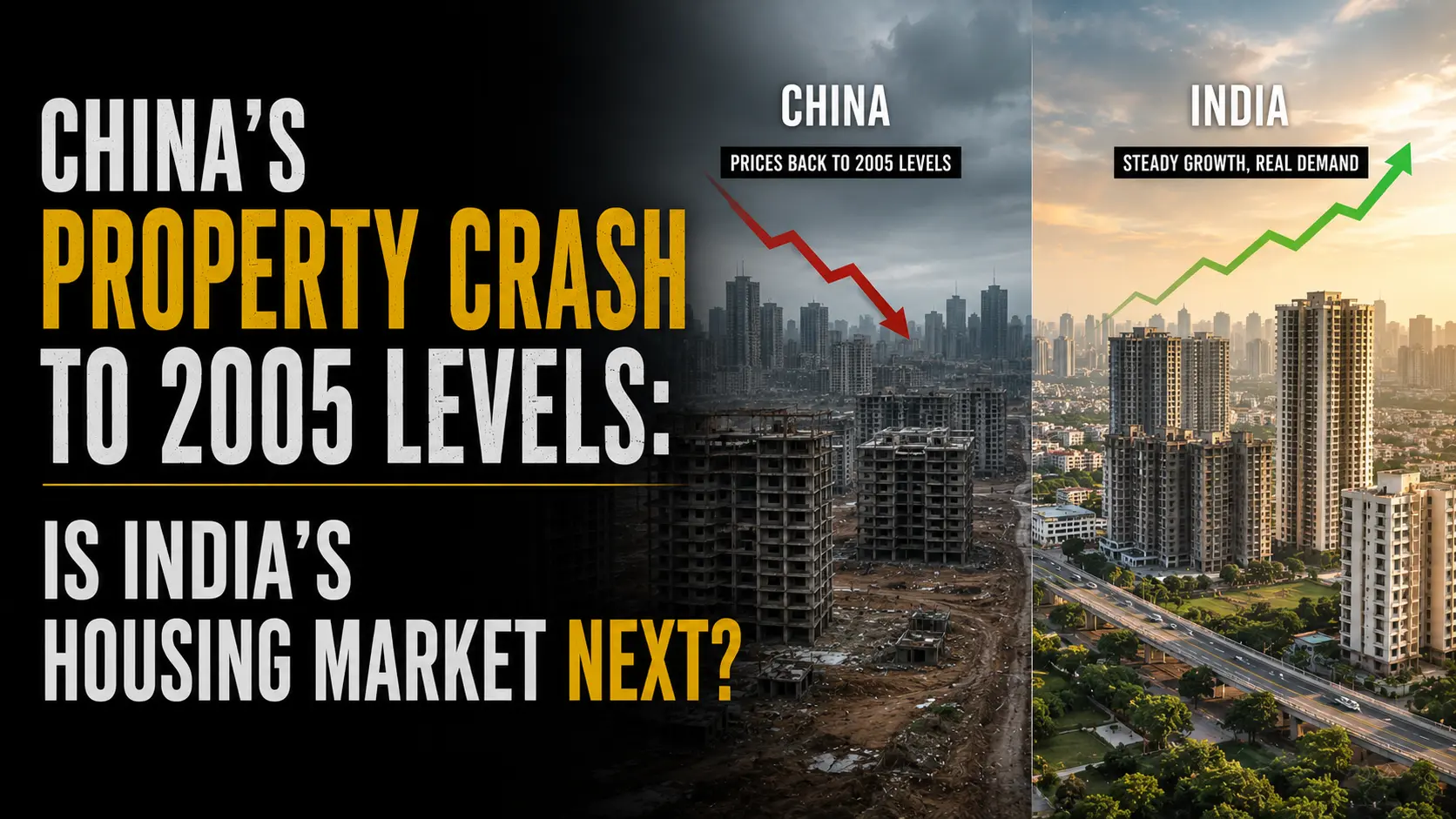
China's property prices have plummeted to 2005 levels, marking one of the most dramatic real estate collapses in modern economic history. The question haunting Indian property investors, developers, and policymakers is whether a similar housing market crash could unfold across India's residential and commercial sectors. With China accounting for nearly 30% of global real estate transactions and India increasingly integrated into global capital flows, understanding the parallels—and critical differences—between the two markets has become essential reading for anyone with skin in the game.
Why China's Housing Crisis Matters to Indian Property Buyers
China's property market has historically served as a barometer for global real estate sentiment. When Chinese developers sneeze, international investors catch a cold. Over the past two decades, China's housing sector grew into an economic juggernaut, absorbing trillions in capital and driving construction across Asia. That momentum masked structural vulnerabilities: oversupply, speculative buying, and unsustainable debt levels among major developers. Today, cities across China sit half-empty while prices spiral downward, raising legitimate concerns about contagion effects.
India's housing sector, meanwhile, displays both strength and warning signs. The country boasts strong fundamentals—a young demographic profile, rapid urbanization, and genuine housing shortage in major metros. Yet Indian real estate also carries risks: unregulated micro-markets, shadow financing, and rising home loan interest rates that have already begun cooling buyer enthusiasm. Understanding how India differs from China is the first step toward protecting your property investments.
How China's Property Collapse Unfolded: The Timeline
The story of China's housing crisis isn't new, but its severity has shocked observers. Beginning around 2020, Chinese regulators tightened lending rules to combat speculation. Developers faced capital restrictions, mortgage lending became stricter, and property purchase restrictions in major cities deterred investors. The trigger was meant to cool an overheated market, but instead it triggered a free fall that has now lasted three years with no clear bottom in sight.
Major Chinese developers like Evergrande, Country Garden, and Sunac China Holdings collapsed or neared insolvency, leaving thousands of construction projects abandoned. New home prices across major cities fell 15–25% between 2021 and 2024. Tier-2 and Tier-3 cities faced even steeper declines. The psychological shift—from viewing property as a guaranteed investment to fearing capital loss—has fundamentally altered purchasing behavior. Chinese families, who once competed fiercely for apartments, now hesitate to buy, creating a self-reinforcing downward spiral.
- Price Collapse: Major Chinese cities saw property prices retreat to 2005 valuations, erasing nearly two decades of gains for many homeowners.
- Developer Defaults: Over 300 Chinese real estate firms have defaulted or faced severe financial distress since 2021.
- Supply Overhang: Estimates suggest 60–80 million unoccupied residential units exist across China, far exceeding natural demand.
- Consumer Sentiment Shift: Home purchase intent among Chinese citizens dropped below 30%, a historic low.
- Government Stimulus Failures: Multiple rate cuts and liquidity injections by the People's Bank of China have failed to reignite demand.
- Ripple Effects: Steel, cement, and construction machinery industries have shed hundreds of thousands of jobs as building activity collapsed.
Can India's Housing Market Weather a Similar Slowdown?
The short answer: India's property market operates on fundamentally different structural foundations than China's, offering some protection against a comparable crash. However, complacency would be dangerous. India faces its own set of vulnerabilities that could trigger a prolonged slowdown, if not a full-blown correction. The key distinction lies in demand dynamics. While China built aggressively ahead of demand—creating ghost cities and speculative bubbles—India continues to grapple with genuine housing shortage. India's urban population will increase by 250–300 million over the next two decades, creating sustained residential demand that China no longer enjoys.
Yet Indian property prices in major metros like Mumbai, Delhi, Bangalore, and Hyderabad have already climbed to levels that strain affordability for middle-class families. A report by property research firm Knight Frank noted that residential affordability has deteriorated sharply in Indian metros, with home prices rising 8–12% annually while incomes grew just 3–5%. If interest rates remain elevated and lending tightens further, aspiring homebuyers could face genuine affordability challenges. RERA (Real Estate Regulation and Development Act) oversight has improved transparency but also exposed dormant inventory and unfinished projects in several states, particularly Maharashtra and Uttar Pradesh. Should market sentiment shift suddenly—as it did in China—Indian developers heavily leveraged for growth could face liquidity crunches.
What Indian Property Owners and Buyers Should Know Now
First, resist panic. India's housing market lacks the speculative excess that doomed China. The National Housing Bank reported that only 3–4% of residential units in Indian metros are investor-owned purely for speculation, compared to estimated 20–30% in major Chinese cities. This means demand remains anchored by genuine need, not bubble dynamics. However, several practical steps warrant attention. If you're considering a property purchase in the next 12–18 months, lock in financing while interest rates remain relatively stable, as future rate hikes could raise your loan burden by 1–2 crore rupees over 20 years. For current homeowners anxious about valuations, remember that property remains a long-term inflation hedge; short-term volatility should not trigger panic selling.
Developers and investors should diversify geographically. While tier-1 metros like Mumbai and Delhi face price pressures, tier-2 cities like Pune, Nagpur, and Indore continue to register healthy demand from first-time buyers and job migration. RERA compliance and transparent financial reporting matter more than ever; developers with strong balance sheets and completed projects will outperform overgeared counterparts. Finally, policymakers must resist the temptation to prop up prices artificially. China's repeated interventions only delayed inevitable adjustment. India would benefit from allowing modest price corrections in overheated markets while maintaining steady demand through affordable housing initiatives and regulatory clarity.
Frequently Asked Questions
Could India's property prices fall to 2005 levels like China's?
Highly unlikely. India's residential market is driven by genuine housing shortage and urbanization, unlike China's speculative bubble. However, correction of 15–20% in overheated metros is plausible if interest rates remain elevated and lending tightens sharply.
What percentage of Indian homes are owned by investors for speculation?
Approximately 3–4% of residential units in metro areas are investor-owned purely for speculative purposes, compared to 20–30% in major Chinese cities. This lower speculative base provides cushion against dramatic price crashes.
How will rising interest rates affect Indian home loan affordability?
If home loan rates rise another 1–2%, monthly EMI on a 50-lakh rupee, 20-year loan would increase by 8,000–12,000 rupees. This could reduce effective demand by 10–15% in price-sensitive segments.
Which Indian cities face the highest risk of price correction?
Mumbai, Delhi, and Bangalore have seen aggressive appreciation (8–12% annually) and stretched affordability ratios. These metros face moderate correction risk if sentiment shifts. Tier-2 cities remain relatively insulated due to affordability and migration demand.
Is RERA helping or hurting the Indian property market?
RERA has improved transparency and accountability, reducing fraud and speculative excess. While it has delayed some projects and raised compliance costs, it strengthens long-term market credibility by eliminating weak, unethical players.