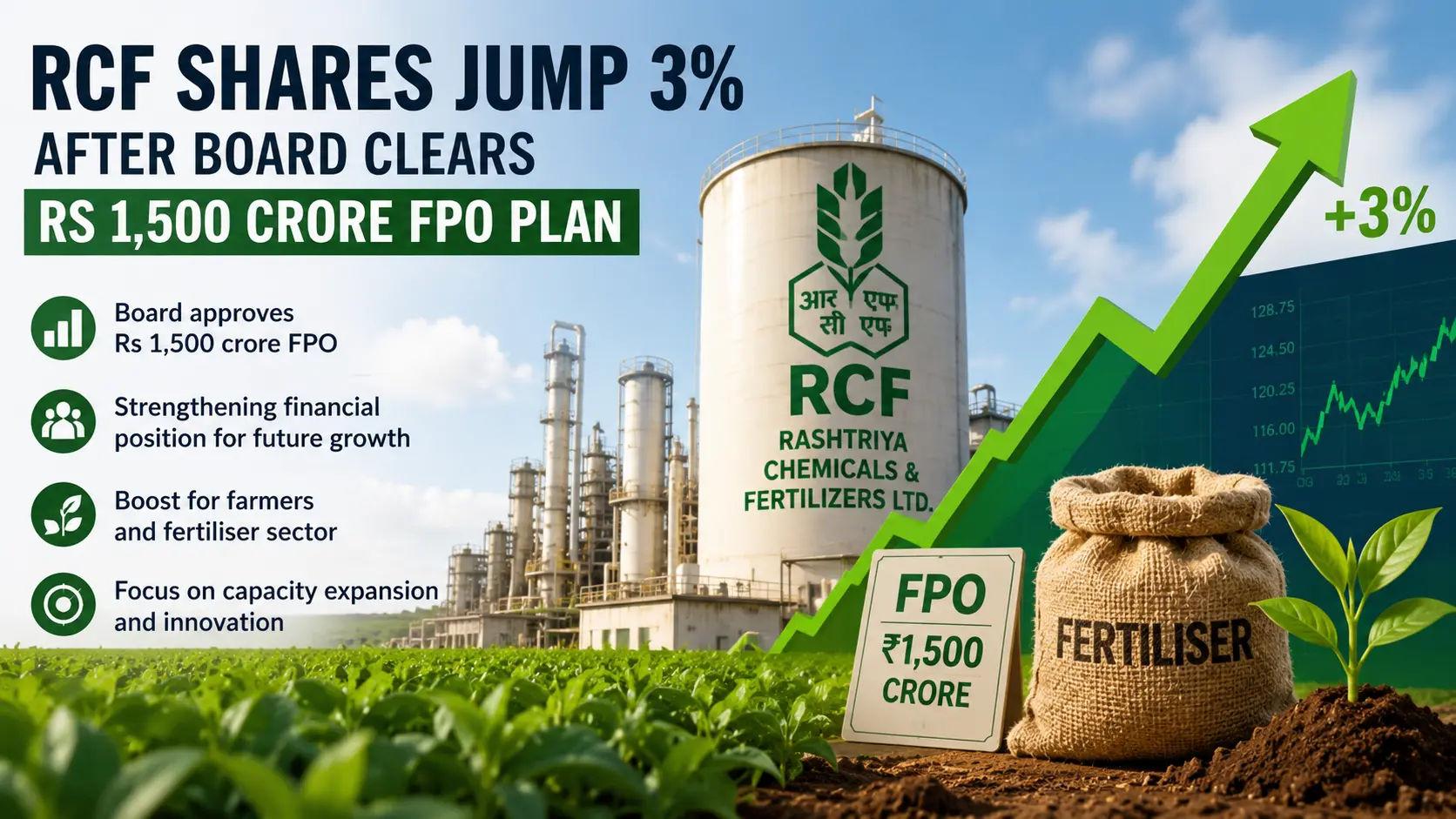
Title: RCF Shares Jump 3% After Board Clears Rs 1,500 Crore FPO Plan
Wednesday morning brought a quiet surprise for anyone watching the fertiliser sector. That's real. Rashtriya Chemicals and Fertilizers Limited — RCF, the state-owned company that makes the urea and complex fertilisers that millions of Indian farmers depend on — saw its stock climb about 3% after its board approved a plan to raise up to Rs 1,500 crore through a fresh share sale. Not small. And for a PSU that has been fighting rising input costs and aging plant infrastructure for years, the timing says something. The question worth asking is this: what does a government fertiliser company need Rs 1,500 crore for — and who actually gains from it?
- RCF's board approved a Further Public Offering (FPO) on Wednesday to raise up to Rs 1,500 crore through fresh equity shares.
- Shares of RCF (BSE: 524230 | NSE: RCF) jumped nearly 3% on Wednesday following the board's announcement.
- The FPO is subject to approvals from RCF shareholders, the Department of Fertilizers, the Government of India, and DIPAM — meaning it isn't a done deal yet.
- The proceeds are expected to strengthen RCF's balance sheet and fund business expansion, including asset modernisation.
- RCF also updated its Memorandum of Association and approved a new REIT-based asset monetisation framework — a notable structural shift for a PSU.
- Retail investors already holding RCF shares should watch for the DIPAM and shareholder approvals — those are the two gates this proposal must clear before anything moves.
Why a Fertiliser PSU Raising Money Matters More Than You Think
RCF isn't a company most people think about — until the urea price moves or a kharif sowing season goes wrong. No joke. Rashtriya Chemicals and Fertilizers Limited is one of India's largest state-owned fertiliser producers, with manufacturing plants in Mumbai (Trombay) and Taloja in Maharashtra. Huge. It makes urea, complex fertilisers, and industrial chemicals. The government of India holds a majority stake, and the company's fortunes are tightly linked to farm policy, international natural gas prices, and the annual fertiliser subsidy the Centre disburses — which crossed Rs 1.64 lakh crore in 2022-23, according to data from the Ministry of Chemicals and Fertilizers.
So when RCF's board meets and clears a Rs 1,500 crore equity raise, it isn't just a corporate finance event. Think. It touches the economics of farming. It affects what the government pays in subsidy. And for retail investors sitting on a PSU stock that has historically been range-bound, it's a signal — positive or cautionary, depending on how you read it — about where management thinks the company is headed. The bigger issue is this: India's fertiliser sector is running on infrastructure that, in several cases, hasn't been meaningfully upgraded in decades. Can fresh capital finally change that? That's the truth.
Period.
What the RCF Board Actually Decided on Wednesday
On Wednesday, July 9, 2025, the board of Rashtriya Chemicals and Fertilizers Limited passed a resolution approving the issuance of fresh equity shares through a Further Public Offering (FPO). The maximum amount to be raised: Rs 1,500 crore. This is new capital — not a sale of existing government shares — which means the money goes directly into the company, not the promoter's pocket.
But not for the reasons you'd expect.
- FPO size: Up to Rs 1,500 crore — all fresh equity, meaning new shares issued to the public rather than existing shares being offloaded.
- Purpose: Balance sheet strengthening and business expansion — the company has indicated the funds will go toward modernising assets and supporting growth plans.
- New MoA clauses: The board also updated RCF's Memorandum of Association to expand the company's stated business objects — a legal step that signals RCF intends to move beyond its traditional fertiliser-only identity.
- REIT-based asset monetisation framework approved: This is the part most analysts found interesting. RCF owns significant land and property assets. A REIT (Real Estate Investment Trust) framework would allow the company to unlock value from those assets without outright selling them.
- Approval chain still pending: The FPO can't proceed until RCF's shareholders vote in favour, the Department of Fertilizers gives the nod, the Government of India formally clears it, and DIPAM — the Department of Investment and Public Asset Management — signs off.
- Market response: RCF shares on the BSE (scrip code: 524230) and NSE (ticker: RCF) gained close to 3% on Wednesday, reflecting investor optimism about the capital raise and expansion signals.
The board meeting was held at RCF's registered office, and the resolutions were filed with the stock exchanges as per SEBI's listing obligations and disclosure requirements. The company hasn't yet announced a timeline for completing the regulatory approval process, but such multi-agency PSU approvals typically take several months.
What came immediately before this? RCF had been under pressure from high natural gas costs — gas is the primary feedstock for urea production — and had been navigating tight margins even as the government's fertiliser subsidy kept retail prices capped. The company's balance sheet needed room. This FPO is management's answer to that constraint. And that's big.
The Real Picture Behind the Rs 1,500 Crore Plan
Here's where it gets interesting. Unreal. An FPO from a PSU isn't the same as one from a private company. The government, as the majority shareholder, doesn't lose control — because this is a fresh issue, the government's absolute shareholding goes down slightly in percentage terms, but DIPAM manages that carefully. What this capital actually does is give RCF the financial headroom to invest without taking on more debt. That matters in a sector where input costs — especially imported LNG prices — have been volatile.
From the government's perspective, a well-capitalised RCF can produce more fertiliser domestically, which reduces India's dependence on imports and keeps the subsidy bill from ballooning further. Wild. India imports a significant portion of its DAP (Di-ammonium Phosphate) and potash requirements, and even a portion of urea in some years. Expanding domestic capacity is a stated policy priority of the Department of Fertilizers under the Ministry of Chemicals and Fertilizers.
From an analyst's perspective, the REIT framework is the more structurally novel move. True. RCF's Trombay plant sits on land in Mumbai — one of the most expensive cities in the world. A REIT structure would let RCF monetise that real estate value without selling the land outright, effectively turning a dormant asset into a recurring income stream. That's a sophisticated financial move for a PSU, and it suggests the management and board are thinking beyond the next budget cycle. Analysts tracking the PSU fertiliser space have noted that RCF's asset base has been significantly undervalued in traditional book-value calculations. And more.
Year-on-year context matters here. Yep. RCF's stock had underperformed the broader Nifty PSU index over much of the previous 12-month period, weighed down by margin concerns and the absence of a clear growth catalyst. Wednesday's 3% gain — while not dramatic — is meaningful precisely because it came on the back of a concrete board decision rather than market rumour. Compare this to NFL (National Fertilizers Limited) and Chambal Fertilisers, both of which have seen sharper re-ratings when capacity expansion plans were announced with funding clarity. RCF's board move puts the company in the same conversation. Read that again.
For retail investors watching the fertiliser space, the practical read is straightforward: the stock moved on news, but the actual value unlock depends on execution — whether the FPO clears all four regulatory gates, when it actually hits the market, what price it's priced at, and whether the capital gets deployed into the right projects. None of that is settled yet. And now?
Who Actually Feels This — and How
For a farmer in Vidarbha or coastal Andhra who buys a 45-kg bag of urea for Rs 266.50 — the government-controlled Maximum Retail Price — RCF's FPO seems distant. But it isn't, really. If RCF uses this capital to modernise its Trombay plant and expand capacity, India produces more fertiliser domestically. That reduces how much the government spends importing it, which in turn affects how sustainable the subsidy programme is long-term. The subsidy is what keeps that Rs 266.50 price tag stable — the actual production cost of urea is several times higher. So a healthier RCF is, indirectly, a more stable urea price for the farmer. Think about it.
For a retail investor in, say, Pune or Bengaluru who holds 500 shares of RCF bought at around Rs 140-160 a share — a reasonable entry point for many small investors — Wednesday's 3% jump is welcome but not conclusive. The result? The real question is: will the FPO dilute your existing shares? Yes, it will — a fresh equity issue always increases the total share count, which means your percentage ownership drops. Whether that's a bad thing depends on what RCF does with the Rs 1,500 crore. If the capital generates returns better than the dilution cost, the stock price follows. If it doesn't, you've just been diluted. That stings.
For PSU sector watchers and market analysts, the REIT framework is the one to track. RCF introducing a formal asset monetisation structure is a sign that PSU management is getting more financially sophisticated — and it's a template other asset-heavy government companies could follow. Think of it this way: if this works for RCF's Mumbai land assets, it could become a model for how India's PSUs unlock billions of rupees in dormant real estate value sitting on their balance sheets across the country. Nobody talks about this.
The practical advice right now: if you're a current RCF shareholder, watch the Department of Fertilizers and DIPAM approval timelines closely. If you're considering entering the stock based on Wednesday's move, be clear that you're buying into a multi-month approval process with uncertainty baked in — not an immediate capital raise. Key point.
Worth paying attention to.
What Comes Next — and When to Watch
The FPO is approved by the board. But board approval is just the starting line. Here is the actual sequence that needs to play out before Rs 1,500 crore enters RCF's books. First, RCF shareholders must vote on the resolution — this typically happens at an Extraordinary General Meeting (EGM) or through a postal ballot process, which can take four to eight weeks from the board decision. Second, the Department of Fertilizers must formally approve the equity issuance — as RCF's administrative ministry, this is a non-negotiable clearance. Third, the Government of India's approval at the Cabinet or Cabinet Committee on Economic Affairs (CCEA) level may be required depending on the deal size and dilution of government stake. Fourth and finally, DIPAM — the body that manages government equity in public sector enterprises — must sign off on the transaction structure.
Best case: all four approvals come through within six months, the FPO is launched in late 2025 or early 2026, and RCF's balance sheet gets the fresh equity it needs going into the next kharif season. Most likely case: the approvals take longer — eight to twelve months is the realistic window for a multi-agency PSU clearance of this scale — with the FPO hitting the market sometime in the first half of 2026. The risk scenario: one of the four approving bodies pushes back on the dilution structure or the deployment plan, forcing RCF to revise and re-submit. That could push the timeline to 2027, by which point market conditions may look very different. Not anymore.
The one date to circle: RCF's next quarterly board meeting, where management is likely to give an update on the regulatory approval progress. Keep an eye on BSE and NSE exchange filings — every material development in the approval chain must be disclosed within 24 hours under SEBI's listing obligations. Facts.
And that's just the beginning.
Frequently Asked Questions About RCF FPO 2025
What is the RCF FPO and why is the company raising Rs 1,500 crore?
Honestly — an FPO — Further Public Offering — is when an already-listed company issues new shares to the public to raise fresh capital. RCF's board approved raising up to Rs 1,500 crore this way to strengthen the company's balance sheet and fund business expansion, including plant modernisation and a new asset monetisation framework tied to its real estate holdings. This whole plan isn't just about cash, but about RCF's future strategy.
How does an FPO affect existing RCF shareholders?
Here's the thing: a fresh equity issue increases the total number of RCF shares in the market. That dilutes your existing ownership percentage. Whether it's good or bad for your investment depends entirely on what RCF earns from deploying the Rs 1,500 crore. Better returns than dilution cost means the stock benefits. Weaker deployment means shareholders absorb the dilution without the gain. It's a risk-reward calculation you'll want to watch carefully.
How does RCF's Rs 1,500 crore fundraise affect Indian farmers?
Here's the short version: indirectly, but meaningfully. RCF produces urea and complex fertilisers that farmers buy at government-controlled prices. A better-capitalised RCF can expand domestic production, which reduces India's fertiliser import dependency. That helps keep the government's fertiliser subsidy bill manageable — the same subsidy that holds your urea bag price at Rs 266.50 per 45 kg.
What approvals does the RCF FPO still need before it can go ahead?
Good question. The board approval is just step one. RCF still needs a green light from its own shareholders, the Department of Fertilizers, the Government of India, and DIPAM. All four must say yes before any fresh shares are issued. This multi-agency process typically takes several months, so the FPO isn't imminent — it's a 2025-26 milestone at the earliest.
What is the REIT framework RCF approved alongside the FPO?
Look — RCF also approved a structure to monetise its real estate assets — including land at its Mumbai Trombay plant — through a Real Estate Investment Trust model. Instead of selling the land, this approach lets RCF generate income from those assets while keeping ownership. For a PSU sitting on prime Mumbai land, this could unlock significant value over time, turning dormant assets into a steady revenue stream. It's a big deal for the company's financial health.