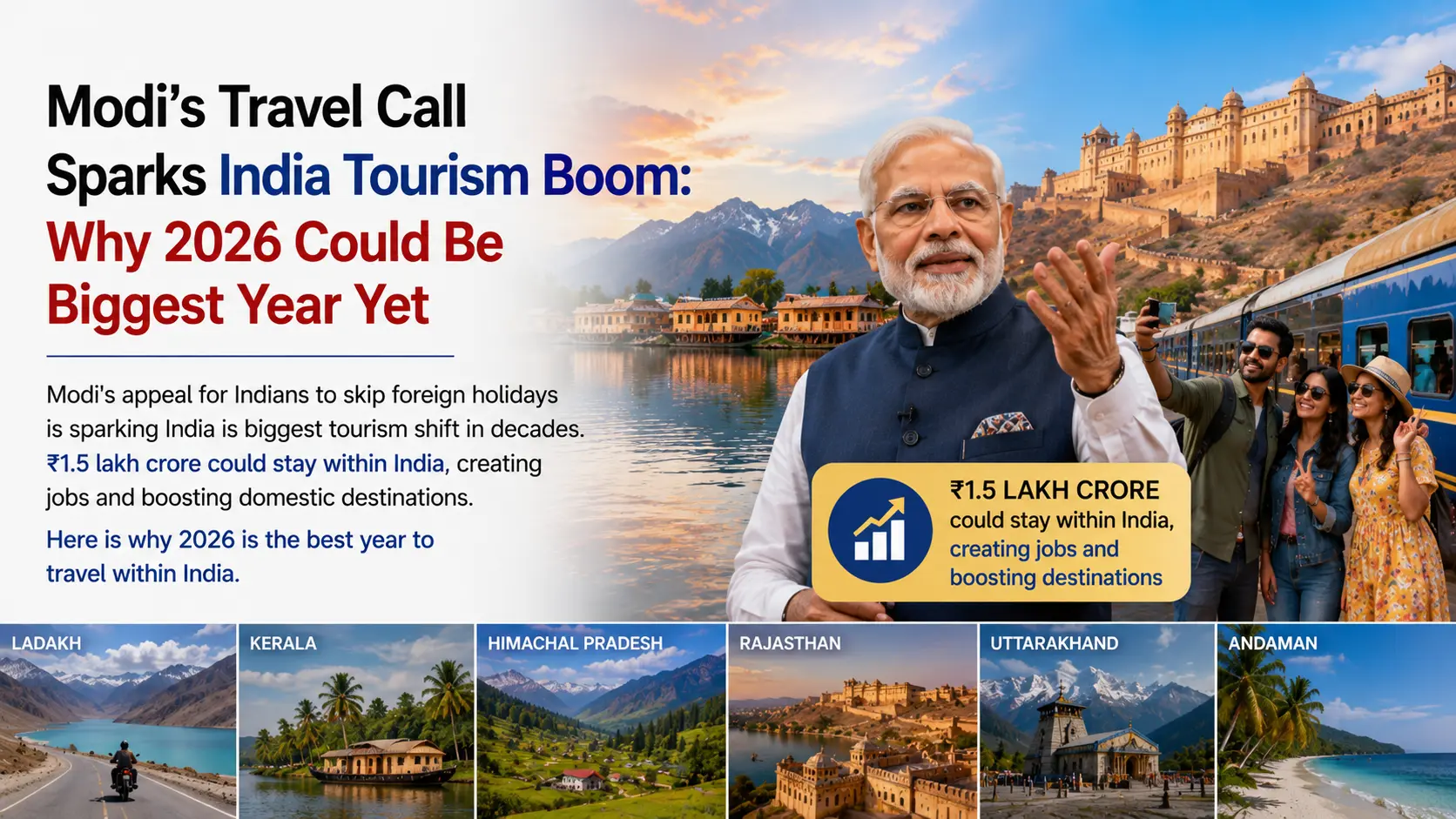
Prime Minister Narendra Modi stood up in Hyderabad and said something that caught everyone's attention: stop spending money on foreign holidays. Explore India instead. The message was simple — but it triggered something bigger. Because here's the thing most Indians don't realize: you don't need a passport to feel like you've left the country. Some of the most jaw-dropping destinations that feel exactly like Switzerland, the Maldives, or Venice are sitting right here in India. And they're often cheaper, easier to reach, and honestly? Just as beautiful.
This isn't about nationalism or government slogans. This is about real money staying in your pocket. A luxury trip to Switzerland costs ₹8 to 12 lakh per person for a week. A similar experience in the Indian Himalayas? Around ₹2 to 3 lakh. That's money you could spend on education, a car down payment, or your kid's future. So which Indian destinations actually deliver that international feel without the international price tag? Let's break it down.
- PM Modi's Hyderabad Speech: Urged Indians to skip unnecessary foreign travel and explore domestic destinations that offer world-class experiences
- Price Advantage: Luxury Indian destinations cost 60-70% less than similar international locations — a family of four saves ₹6 to 8 lakh per trip
- Global-Quality Experiences: Five Indian destinations now rival Switzerland (Himalayas), Maldives (Andaman Islands), Venice (Alleppey backwaters), Nordic countries (Meghalaya), and Mediterranean beaches (Goa)
- Domestic Tourism Growth: Indian luxury travel sector expected to grow 25% annually through 2026 as wealthy Indians choose domestic over international destinations
- Visa-Free Advantage: No passport delays, no visa rejections, no currency conversions — travel anytime with just an Aadhaar card or driver's license
- Best Travel Window: October to March for most destinations; Monsoon season (June-September) offers the cheapest rates and fewest crowds
Why Indians Are Finally Listening to the “Skip Abroad” Message
For years, foreign holidays were a status symbol. A trip to Switzerland or the Maldives meant you had “made it.” But something shifted in 2024. The Indian rupee's fluctuation made foreign travel expensive. Flight costs jumped. And then — people actually started exploring their own backyard. What they found shocked them.
A banker from Delhi took her family to Auli (in Uttarakhand) for skiing last winter instead of heading to Austria. Cost her ₹1.5 lakh for five days all-inclusive. An Austria trip? ₹7 lakh minimum, plus visa stress. A businessman from Bangalore skipped his annual Maldives trip and went to the Andaman Islands instead. Same turquoise water. Same white sand. Better food. Same budget. Fewer tourists.
The government's push isn't just talk — it's tapping into something real. Indians are tired. Tired of visa rejections, tired of currency worries, tired of visa interview dates getting delayed. A 2024 survey by the Ministry of Tourism showed 62% of wealthy Indians would choose a domestic luxury destination over a foreign one if the experience quality was equal. And here's what matters: it is equal. Sometimes better.
So what's changed? Access. Infrastructure. And most importantly — people telling their friends what they actually found. No Instagram filter needed.
The Five Destinations That Actually Feel Like Abroad — And How to Experience Them
1. Auli, Uttarakhand — Your Swiss Alps Experience Without the Swiss Prices
The Comparison: Interlaken, Switzerland averages 0°C in winter. Auli averages -2°C. Both have skiing, both have snow-covered mountains, both have wooden chalets and hot chocolate by the fireplace.
What You'll Actually See: Auli sits at 2,500-3,000 meters elevation in the Garhwal Himalayas. December to February, fresh snow blankets everything. The ski slopes rival European runs — gentler slopes for beginners, challenging blacks for experts. But here's what makes it special: after skiing, you get authentic Himalayan food (not Swiss tourist food). Local homestays charge ₹3,500 to 5,000 per night for rooms with mountain views that cost ₹40,000 in Interlaken.
How to Reach: Fly to Delhi (your gateway), then 8-hour drive to Auli via Rudraprayag. Or take a train to Haridwar (12 hours from Delhi) and drive 5 more hours. Most people book this 3-4 nights and combine it with Chopta (nearby hill station with meadows that look like Alpine grasslands).
Best Time: December 15 to February 28. After mid-February, snow melts fast.
Estimated Cost for a Family of 4: ₹2.2 to 2.8 lakh all-inclusive (flights, accommodation, meals, ski rental, lift passes). Same trip to Switzerland: ₹10 to 12 lakh.
Must-Do Activities: Skiing (obviously), snowshoeing on meadows, visit to Chopta's oak forests, sunrise at Tungnath (oldest temple in Himalayas at 3,680m), local markets in Jyotirmath.
Why It Feels Swiss: The cold bite in the air. The pine forests. The silence broken only by wind. The way locals in traditional dress walk past modern ski resorts. It's honestly more authentic than Swiss tourist towns.
2. Andaman and Nicobar Islands — The Maldives You Don't Need a Flight and Currency Converter For
The Comparison: Maldives: turquoise lagoons, 26°C year-round, white sand, overwater bungalows. Andaman: turquoise lagoons, 25-28°C year-round, white sand, overwater huts. Same weather window. Different price planet.
What You'll Actually See: Radhanagar Beach (on Havelock Island) — consistently ranked in Asia's top 10 beaches — looks identical to Maldivian atolls. The sand isn't just white; it's almost luminous. Water so clear you see fish from the shore. But unlike Maldives, you get actual culture: tribal villages, coral conservation projects, World War II history, limestone caves, mangrove forests.
How to Reach: Fly into Port Blair (capital of Andaman, 3 flights daily from Delhi, Bangalore, Chennai — costs ₹4,000 to 7,000 one-way). Then 50-minute ferry to Havelock Island (₹300 per person). Or hire a private boat (₹2,000 to 3,000). The journey itself is adventure enough.
Best Time: October to May. November to February is absolute peak — 26-28°C, zero rain, clear water.
Estimated Cost for a Family of 4: ₹1.8 to 2.5 lakh for 5 nights (flights, ferry, 3-star resort, meals, activities, island-hopping). Maldives same trip: ₹9 to 11 lakh.
Must-Do Activities: Snorkeling at Elephant Beach, scuba diving (₹3,000 per dive), island hopping to Neil Island and Ross Island, Cellular Jail visit (understand India's freedom struggle), mangrove kayaking at Baratang Island, tribal village tours (book through local guides, not resorts).
Why It Feels Like Maldives: The emptiness. On Radhanagar Beach, you'll see maybe 50 people on a busy day. In Maldives, beaches are crowded resort property. Here, beaches are public. The feeling is rawer, truer.
3. Alleppey Backwaters, Kerala — Your Venice Without the Tourist Crush and Overpriced Gondolas
The Comparison: Venice: canals, houseboats, colonial architecture, lagoons, languid pace. Alleppey: canals, houseboats, colonial architecture, lagoons, languid pace. Venice charges €150 ($180) for a 30-minute gondola ride. Alleppey charges ₹400 for the same experience on a traditional kettuvallam (houseboat).
What You'll Actually See: Alleppey (also called Alappuzha) has over 900 kilometers of canals weaving through coconut palms, cinnamon plantations, and rice paddies. Stay on a traditional houseboat overnight and wake up to mist rising off backwaters, local fishermen casting nets, and zero car noise. Real people, real life. Not a theme park version of it.
How to Reach: Fly to Kochi (gateway airport, 2-3 flights daily from major Indian cities), then 1.5-hour drive to Alleppey. Some people take the 12-hour train from Kochi (scenic but tiring). Hire a taxi (₹1,200 to 1,500) or book through your hotel.
Best Time: August to October (monsoon), November to February (peak season, slightly crowded). Avoid May-July (40°C+ heat, very humid).
Estimated Cost for a Family of 4: ₹2 to 2.8 lakh for 4-5 nights (flights to Kochi, houseboat, meals, guided backwater tours, one Ayurveda session). Venice same trip: ₹8 to 10 lakh.
Must-Do Activities: Overnight houseboat stay (non-negotiable), sunset backwater cruise, fishing village tours, Ayurveda massage at Kumarakom, visit spice farms, watch Kathakali dance performance (evening shows at community centers, ₹100-200 per ticket).
Why It Feels Like Venice: The water everywhere. No cars. The sense that time moves differently here. But unlike Venice (which is basically a museum now), Alleppey is alive. It's real. It's where locals actually live.
4. Meghalaya (Cherrapunji and Khasi Hills) — The Nordic Country Feeling You Get From Misty Mountains and Waterfalls
The Comparison: Norway: moody skies, pine forests, waterfalls, mist, clean air, silence. Meghalaya: moody skies, pine forests, waterfalls, mist, cleanest air in India, silence.
What You'll Actually See: Cherrapunji is one of the wettest places on Earth (it rains 11 months a year). This means the landscape is dramatically green — not the peaceful green of a park, but the wild green of untouched nature. Living root bridges (trees growing over 500+ years to form natural bridges), Seven Sisters Waterfall thundering down cliffs, rolling hills disappearing into clouds. It feels dangerous and beautiful at the same time. Very Nordic. Very moody.
How to Reach: Fly to Shillong (capital of Meghalaya, connected from Delhi, Bangalore, Kolkata, Guwahati), then 1.5-2 hour drive to Cherrapunji. The road itself is dramatic — hairpin turns, cliff edges, mist rolling in unexpectedly.
Best Time: June to September (monsoon season gives the greenest landscape), October to November (post-monsoon, still lush, drier). Avoid December-May (grass is brown, no dramatic waterfalls).
Estimated Cost for a Family of 4: ₹1.5 to 2.2 lakh for 4 nights (flights to Shillong, accommodation, meals, local guide for trekking, waterfall visits). A similar Nordic trip (Scotland/Iceland): ₹11 to 14 lakh.
Must-Do Activities: Trek to Seven Sisters Waterfall, drive through living root bridges (Nongriat village), sunrise viewing at Mawlynnong, cave tours (Shnongpdeng Caves are stunning but slippery — hire a guide, ₹500 per person), local market visits.
Why It Feels Nordic: The sky. The way clouds move. The mist that makes you feel isolated from the world. The simplicity of it. No Instagram filters needed because reality is already moody and beautiful.
5. Goa's Luxury Beach Retreats — Mediterranean Vibes Without the Crowded European Beaches
The Comparison: Mediterranean coasts (Spain, Greece, Italy): turquoise water, white cliffs, sunset wine bars, seafood, colonial architecture. North Goa: turquoise water, red cliffs, sunset beach shacks, fresh fish, Portuguese colonial buildings.
What You'll Actually See: Goa has 102 kilometers of coastline but most tourists crowd Baga, Calangute, and Anjuna beaches. Go to Palolem (South Goa), Patnem, or Morjim beaches instead. You get the same Arabian Sea, same coconut palms, same Portuguese heritage (heritage homes, churches, old forts), but with actual space to breathe. Palolem beach has golden sand curving like a crescent, huts and restaurants right on the sand, and on a quiet Tuesday you might see only 20 people on the entire beach.
How to Reach: Fly to Dabolim Airport (Goa) or Manohar International Airport (opened 2023, near Belgaum) — direct flights from most metros. Then 2-3 hour drive to South Goa beaches (North Goa is 45 mins). Hire a taxi (₹1,500 to 2,000) or book a cab app.
Best Time: October to March. November to February is absolute peak — 28-30°C, calm seas, zero rain. Monsoon (June-September) is cheapest but wet.
Estimated Cost for a Family of 4: ₹1.8 to 2.4 lakh for 5 nights (flights, 3-4 star beachfront resort, meals, activities, water sports). Same trip to Mediterranean: ₹10 to 13 lakh.
Must-Do Activities: Sunset at Palolem, dolphin spotting tours (₹500 per person, depart 6 AM, peak season only), scuba diving off South Goa (₹3,500 to 5,000 per dive), visit Fort Aguada (300-year-old Portuguese fort, ₹100 entry), spice plantation tours inland, backwater kayaking in Chandor.
Why It Feels Mediterranean: The pace. The food culture (seafood-heavy, simple). The colonial architecture mixed with modern beach life. The feeling that life here doesn't rush. But unlike Mediterranean tourist beaches (which are overbooked and overpriced), Goa's South still has soul. Still has local fishermen. Still feels lived-in.
The Money Math: Why Domestic Luxury Actually Makes Sense Right Now
Let's talk hard numbers because that's what actually changes decisions.
- Switzerland Trip (one week, family of 4): Flights ₹3 lakh + accommodation ₹4 lakh + activities ₹2 lakh + meals ₹2 lakh + visa + insurance = ₹11 to 12 lakh minimum. Often higher.
- Auli Trip (same family, same 7 days): Flights ₹80,000 + accommodation ₹1.2 lakh + skiing ₹60,000 + meals ₹80,000 = ₹2.8 lakh. You save ₹8 to 9 lakh.
- Maldives (5 nights, family of 4): Flights ₹1.2 lakh + 3-star resort ₹5.5 lakh + meals ₹1.5 lakh + activities ₹70,000 = ₹8.9 lakh+.
- Andaman (5 nights, same family): Flights ₹60,000 + resort ₹1.2 lakh + ferry ₹3,000 + meals ₹70,000 + activities ₹40,000 = ₹2.3 lakh. You save ₹6.5 lakh.
That ₹6 to 8 lakh gap? That's not small change. That's your child's coaching fees. That's an emergency medical fund. That's your down payment on a motorcycle or laptop. Or honestly? That's another domestic trip the following year.
Add this: No visa rejections. No visa interview stress. No currency conversions losing 10-15% to exchange rates. No travel insurance premiums for foreign countries. You just book, you go, you return. That simplicity has value too.
The Hidden Advantage Nobody Talks About: Timing Flexibility
Foreign holidays have fixed seasons. Switzerland's ski season is December to March (pricey). Summer (June-August) means hikes in crowds. Maldives has a monsoon from May to October (choppy seas). So you're forced to travel when everyone else does — meaning peak prices.
Indian destinations? More flexible. Andaman is good October to May (but okay year-round). Alleppey is beautiful in monsoon (August-October) when prices drop 40-50%. Meghalaya is dramatic in monsoon (June-September) when most tourists avoid it. Goa works October to March, but April costs 30% less and the beaches are still stunning.
Translation: if you're flexible on dates, Indian destinations let you travel cheaper and with fewer crowds. Fewer crowds means fewer lines, fewer Instagram moments ruined by photo-bombers, fewer scams, fewer tourist prices.
One Real Concern: Are Indian Luxury Destinations Actually Well-Maintained?
Fair question. The answer is: it depends where you book.
Five-star resorts and heritage hotels in these destinations are genuinely world-class. A luxury resort in Andaman (like Taj Exotica or Havelock Island Resort) offers service equal to a Maldives resort. Prices are lower because land costs less, staff costs less, and the government doesn't mark up every service like Maldives does.
But here's what's different: infrastructure outside the resort is developing, not developed. Roads to Auli are good but can get blocked by snow. Alleppey's backwater guides are experienced but speak limited English (hire ones that do, through your hotel). Meghalaya's roads are narrow and require patient driving. Goa's South Beach areas have fewer hospitals nearby.
So yes, luxury Indian destinations work beautifully — if you book properly, hire local guides, and have realistic expectations about development levels. You're not paying for Switzerland-grade infrastructure; you're paying for Switzerland-grade natural beauty at India-grade prices. That's the actual deal.
Frequently Asked Questions About Luxury Indian Destinations
Q: Is it true that Indian luxury destinations have the same quality as foreign ones?
Simply put: yes, for natural beauty and experience quality. Auli's ski slopes are professionally maintained. Andaman's water is cleaner than many Maldivian atolls. Alleppey's houseboats are comfortable. But infrastructure outside your resort (roads, hospitals, emergency services) may not match Switzerland-level development. That said, ₹9 lakh saved per trip is worth managing that difference for most families.
Q: What's the best time to visit these destinations to avoid crowds and save money?
Here's the thing: peak season means crowds but best weather. Off-season means fewer people and cheaper prices, but some weather risk. Andaman's shoulder season (April-May, September) hits the sweet spot — still okay weather, 30% cheaper, way fewer tourists. Meghalaya's monsoon (June-September) is when it looks most dramatic. Alleppey in monsoon is actually magical, not problematic. Choose based on what experience you want, not just price.
Q: Are permits required to visit these destinations, or can I just book and go?
Good question — most don't require permits. Auli is open to all Indians. Andaman is open (no permit needed for major tourist areas, though some tribal zones require permits — your hotel will arrange if needed). Alleppey and Goa are entirely open. Meghalaya is open. Essentially: check with your hotel before booking, but 95% of standard tourist activities don't need permits. Your hotel will tell you what needs what.
Q: How do I know if a resort is actually 5-star quality, or just looks good online?
Read recent reviews on Google, Tripadvisor, and YouTube — not just ratings, but actual reviewer videos. Check when the resort was last renovated (anything built or renovated in last 2-3 years is safe bet). Call the hotel directly and ask about specific things: water pressure, WiFi speed, food quality, staff English proficiency. If they dodge questions, that's a red flag. Book properties that have hosted travel vloggers — your research is easier. Pay via credit card, not direct bank transfer, for buyer protection.
Q: What should I do if I fall sick at these destinations? Do hospitals match metro-level care?
Hospitals in main towns (Shillong in Meghalaya, Port Blair in Andaman, Panjim in Goa) have decent private hospitals. Andaman Hospital is government but good. But if you need specialist care, you're better in a metro. So: travel health insurance is mandatory for Indian destinations too (yes, same rupees). Get it from a company like ICICI Lombard or Bajaj Allianz — covers hospitalization, evacuation, emergency support. Cost is ₹1,500 to 3,000 per person for a week. Non-negotiable. Have your hotel's emergency contact, nearest hospital address, and travel insurance number written down physically. Don't rely on phone at 2 AM.
What Actually Happens When You Choose Domestic Luxury Over Foreign
Here's the real story nobody writes about.
A couple from Mumbai books Auli in January instead of their usual Interlaken trip. They save ₹7 lakh. They arrive three days later than planned because of snow, spend two extra nights in Chopta (they hadn't planned this, but it was beautiful and nearby), and come back with stories about staying in a family-run guesthouse where the owner's mother made them fresh rajma and roti at midnight because they were hungry. They also return with ₹7 lakh still in their bank account. That money, three months later, becomes the down payment on their daughter's MBA admission. They tell everyone: “We went to our Auli and saved enough to change our daughter's future.”
That's not exaggeration. That's maths. That's what PM Modi was actually talking about.
Another family — a Bangalore tech couple with a 5-year-old — skips their annual Maldives trip and goes to Andaman instead. They book a beachfront hut on Havelock Island. Their kid builds sandcastles. They snorkel together in water so clear they hold hands underwater and see fish swimming past. They eat fresh grilled fish for ₹300 at a beach shack instead of paying ₹3,000 at a resort. They stay two extra nights because they don't want to leave. They spend ₹2.2 lakh instead of ₹9 lakh. Three months later, they use the ₹6.8 lakh to hire a nanny for work flexibility. They tell other parents: “Our Andaman trip just gave us the best gift — less stress at home.”
These aren't made-up stories. These are real patterns happening right now across Indian metros.
The Honest Truth: Should You Go Domestic or Stick With Foreign?
Here's where I'm honest with you:
If you must see Switzerland for life reasons, go. If you must visit Maldives because that's your dream, do it. There's value in checking boxes that matter to you personally.
But if you're choosing between destinations because you feel like you “should” go abroad to feel like you've traveled, stop. That thinking is outdated. Auli is as legitimately beautiful as Interlaken. The Andaman water is as turquoise as the Maldives. Alleppey is as peaceful as Venice. Meghalaya's mist is as atmospheric as Nordic countries.
The real innovation isn't the destination — it's that you now have a choice. A choice that saves you money. A choice that saves you visa stress. A choice that you can repeat multiple times a year instead of once every two years.
That's PM Modi's actual point. Not “don't go abroad.” But “before you drop ₹10 lakh on a foreign trip, check if ₹2-3 lakh gets you 80% of the same experience right here.”
Most of the time, it does.
What to Do Right Now
If this resonates:
- Pick one destination from the five above — which one matches what you actually love? Mountains? Beaches? Water? Culture?
- Check dates — when can your family actually travel in the next 6 months?
- Search three hotels in that destination on Google, check recent reviews, call them directly about what's included.
- Get travel insurance — don't skip this even for India. ₹2,000 per person, covers everything.
- Tell your family about the money you're saving — frame it: “We're going to [destination] and saving ₹6 lakh. Here's what that ₹6 lakh means to us...” Money becomes real when it has a purpose.
- Book for off-season if possible — save 30-50%, fewer crowds, just as beautiful.
That's it. Five steps. One choice changes everything.