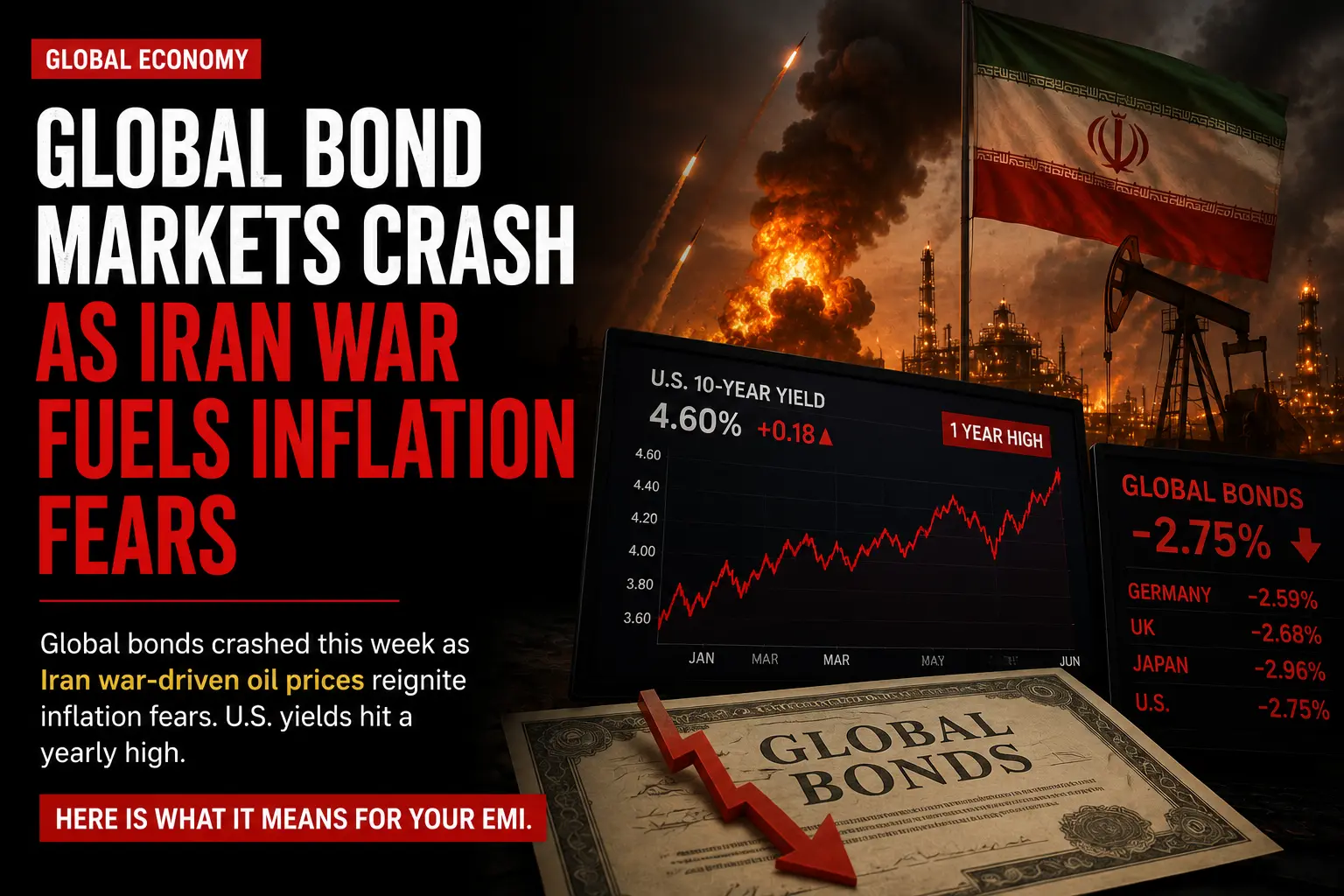
Global Bond Markets Crash as Iran War Fuels Inflation Fears
Something broke in the world's money system last week—a quiet financial earthquake that most people in India don't even know happened, with benchmark 10-year U.S. Treasury bond yields hitting their highest point in nearly a year on Friday. Wow. And just two days before that, America sold 30-year government bonds at the highest interest rate seen since 2007. Read that again. The reason is a war in Iran that's pushing up oil, which pushes up everything else, forcing central banks to consider hiking rates again. The story has flipped, and it's going to affect your EMI, your groceries, and maybe your job.
- On Friday, U.S. 10-year Treasury bond yields hit a one-year high, and 30-year bonds just sold at the highest yield since 2007.
- The Iran war is cranking global oil prices up, making inflation worse in nearly every country simultaneously.
- Look, central banks we all expected to cut interest rates are now being forced to think about raising them instead—a total reversal from just months ago.
- German Bund yields shot up almost 6 basis points to about 3.11%, and Italian 10-year bond yields rocketed 7.4 basis points to 3.86% in just one week.
- And Japan? Its bond yields hit all-time record highs after a shocking wholesale inflation report—so the Bank of Japan might actually hike rates now, too.
- If these global rates don't come down, home loan EMIs in India, corporate borrowing costs, and even stock market values could all face serious pressure.
And here's why that matters.
Why Bond Markets Matter — Even If You Have Never Bought One
Most people in India haven't ever bought a bond—and honestly, that's completely fine. Right? But here's the thing—bonds quietly control something that touches every single one of us: interest rates. Key point. When bond prices fall, yields (that's the return people get) go up, and when yields go up, banks all over the world start charging more for loans. Home loans, car loans, business loans—all of it gets more expensive. Is this really a surprise?
Think.
So think of it this way—imagine you borrowed money from your neighbour for a small chai stall, promising to pay back ₹100 after one year with ₹5 in interest. And? Now, imagine everyone else in your colony suddenly starts offering ₹8 or even ₹10 as interest. The result? Your neighbour starts wishing he hadn't lent money to you. That's exactly what happens when bond yields rise; old loans look cheap, old bonds fall in price, and new borrowing gets more expensive for everyone. That stings.
So why is this all happening now, all at once, across the entire world? Think about it. The answer is one word: Iran.
But not for the reasons you'd expect.
Here Is What Actually Happened Last Week
The global bond market had what traders quietly call a “bruising week.” And it wasn't just one event. No joke. It was a pile-up—one bad reading after another, every single day. Big shift.
- Iran war and oil prices: Look, the ongoing conflict in Iran has caused energy prices to spike. Oil is the fuel that runs everything—factories, trucks, ships, airlines. When oil gets expensive, everything from biscuits to bus tickets gets expensive too.
- U.S. Treasury 10-year yield at yearly high: America's most-watched bond hit its highest yield in roughly one year. Traders started betting the U.S. Federal Reserve—America's central bank—would now have to raise interest rates instead of cutting them.
- 30-year U.S. bond sold at highest yield since 2007: The U.S. government sold long-term bonds on Wednesday, and buyers only agreed to buy them at a very high interest rate—the highest since 2007. That was the year before the global financial crisis. Let that sit.
- Euro zone bonds under heavy fire: German, Italian, and French government bonds all fell sharply. Italian 10-year bond yields jumped 7.4 basis points in one week to around 3.86%. German Bund yields—usually the calmest in Europe—rose nearly 6 basis points to around 3.11%.
- Japan breaks records: Japanese bond yields hit all-time record highs. Japan had kept interest rates near zero for decades. Now even Japan is cracking—because its wholesale inflation numbers came in red-hot this week.
- U.S.-China meeting gave no relief: Investors were hoping a high-level meeting between the U.S. and China might produce some movement on calming the Middle East situation. It gave nothing. Markets responded by selling bonds even harder.
One market expert put it simply: “We are seeing a reset of the global bond risk premium because the market is just realising we are living in a much more volatile inflation climate.” Big deal. In plain words, investors are waking up to the fact that inflation isn't going away quietly. Facts. And they want more money to compensate for that risk. But who really benefits here?
Wow.
And the week ended with investors across America, Europe, and Japan all sitting on losses. Nobody came out looking clever. And now? The mood going into the weekend wasn't relief—it was pure worry about what next week brings.
The kind of thing most people miss.
The Real Picture Behind the Numbers
Here's the thing most news reports miss—this isn't just about bonds or interest rates as abstract financial concepts. That's the truth. This is about a fundamental shift in how the world sees inflation. And that's big. And that shift has been building for months.
Just a few months ago, markets were absolutely certain that central banks—especially the U.S. Federal Reserve—were about to start cutting interest rates. Some analysts were even predicting three or four rate cuts in 2025. Unreal. But inflation kept coming back, energy prices refused to fall, and now with a full-scale conflict in Iran keeping oil prices elevated, those rate cut dreams are fading fast. Not anymore.
Look at it from three different angles. On the government side, central banks like the Fed, the European Central Bank, and the Bank of Japan have one main job: keep inflation under control. If inflation stays high because of oil, they have almost no choice but to raise rates. And from the expert side—bond traders are now building in expectations that rates will stay “higher for longer,” meaning the cheap money era is over. And from the ordinary person's side? Higher rates mean higher EMIs and less money for jobs. And where does that leave the rest of us?
Period.
Compared to last year, when there was real hope of a global rate-cutting cycle beginning, this week's data marks a dramatic reversal. Japan is the starkest example—a country that kept rates near zero for over two decades is now being pushed toward hikes by its own inflation data. Wild. That isn't a small shift. That's a once-in-a-generation change.
Nobody is talking about this enough.
How This Hits Ordinary Indians Right Now
You might be wondering—this all sounds like it's happening in America and Europe. Why should I care sitting here in India? So what does this actually mean?
Because India doesn't exist in a bubble. Not anymore.
For a young couple in Mumbai trying to buy their first flat, here's what this means: if global interest rates stay high, foreign money that was flowing into Indian markets may start leaving. That's real. When foreign money leaves, the rupee can weaken against the dollar, and when the rupee weakens, oil gets even more expensive for India. Big. And when oil gets expensive here, the RBI faces pressure to keep Indian interest rates high too. That dream of your home loan EMI dropping by ₹3,000 or ₹4,000 a month? It moves further away.
For a small business owner in Surat who imports raw materials, a weaker rupee means every single order costs more. Margins shrink. True. Some orders might get cancelled. Yep. And employees may not get that Diwali bonus this year.
For someone invested in mutual funds—especially debt funds or gilt funds—rising global yields can hurt returns in the short term. Why? Because existing bond holdings lose value when yields go up. And more. And for anyone watching the stock market, the link is direct. When bond yields rise globally, stocks look less attractive, which can drag Indian indices down with them.
What should you do right now? First—don't panic. Second—if you were planning a big loan in the next three to six months, talk to your bank about locking in rates now, because they may not fall as fast as everyone hoped. Third—keep an eye on your mutual fund portfolio. Worth it.
And that's just the beginning.
What to Watch for in the Coming Weeks
The next few weeks will be critical. Here are the specific things that will tell us where this is all heading. But here's the real question — what happens next?
First—the U.S. Federal Reserve's next statement. If Fed officials use language suggesting rate hikes are back on the table, global markets will react sharply. Huge. Second—oil price movements. If Iran-related tensions ease, oil prices could pull back, taking pressure off inflation worldwide. And third? India's own inflation data. If imported inflation starts showing up in our numbers, the RBI may hold rates higher for longer. Not small.
Best case scenario: Iran tensions ease, oil prices stabilise, and central banks can hold off on further hikes. Most likely scenario: things stay uncertain for months, with bond markets remaining jumpy and rate cut hopes pushed into late 2025 or 2026. Worst case scenario? Oil spikes further, inflation gets worse, central banks raise rates again, and global growth slows—hitting India's exports and its stock market all at once.
Keep a close eye on the U.S. Federal Reserve's next statement and India's monthly inflation data release. Those two numbers, more than anything else right now, will shape what happens to your EMIs and your investments.
Frequently Asked Questions About Global Bond Market Crash and Inflation
What exactly is a bond yield and why does it going up hurt normal people?
Simply put, a bond yield is the return you get for lending money to a government. When yields go up, it means new loans must offer higher interest, pushing up borrowing costs everywhere—including your home and business loans.
How does the Iran war cause inflation in India?
The thing is, India imports a huge share of its daily oil. When a conflict like the Iran war threatens supply, global oil prices jump. We then have to pay more dollars for that oil. This problem gets worse if the rupee is weak, making it even more expensive. It's a chain reaction: higher fuel prices eventually push up the cost of food, transport, and nearly all goods across the country.
Will the RBI raise interest rates in India because of this global situation?
Honestly — not immediately, but the pressure is definitely building. The Reserve Bank of India watches global inflation and oil prices very carefully. If oil stays expensive, it could force the RBI to delay any planned rate cuts or even consider a future hike.
Should I delay taking a home loan or personal loan right now?
Good question. This is genuinely tricky right now. If you were holding out for rates to drop, that wait might be much longer than anyone expected a few months ago. Most experts suggest that if you really need the loan for an important purchase like a house, it's probably better to move forward now rather than waiting indefinitely. You should absolutely talk to your bank about fixed-rate options to protect yourself.
What is the latest situation in global bond markets as of this week?
Here's what you need to know: U.S. 10-year Treasury yields are at their highest in nearly one year, 30-year U.S. bond yields are at their highest since 2007, and Japanese bond yields have hit all-time record highs. Investors globally are pricing in a "higher for longer" interest rate world.