9 of Top 10 Firms Lose Rs 3.12 Lakh Crore in Market Value — Reliance Hardest Hit
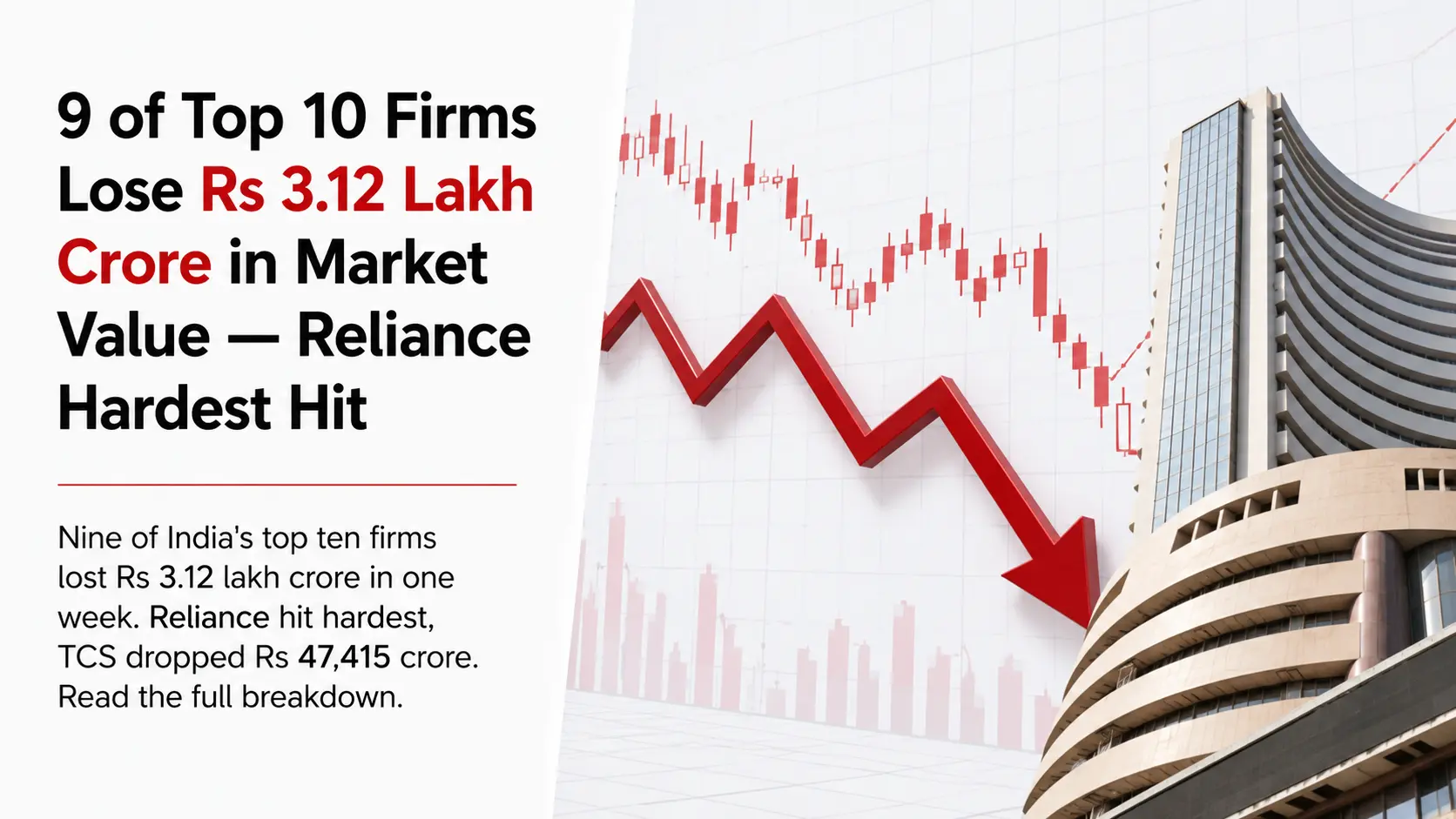
Last week, something quietly terrible happened to India's biggest companies—in fact, nine out of the ten most valuable firms lost a combined Rs 3.12 lakh crore in market value, and most people didn't even know. Big deal. How often do you see something like this? That number is so large it's hard to picture. No joke. Think of it this way: the Indian government's entire annual health budget is around Rs 90,000 crore; this loss was more than three times that. Gone. In just five days. And Reliance Industries took the hardest hit of all, with the pain spreading across IT giants, banks, and finance companies. So what does this actually mean?
- In just one week, nine of India's top ten firms saw a combined market cap loss of Rs 3.12 lakh crore.
- The single biggest loser was Reliance Industries, which absorbed the largest portion of the market cap decline.
- Tech giant TCS saw its value plummet by Rs 47,415.04 crore, ending at a new valuation of Rs 8,19,062.65 crore.
- Leading lender Bajaj Finance wasn't spared, dropping Rs 27,892.28 crore to a market cap of Rs 5,66,717.74 crore.
- And the broader market felt it, too: the BSE Sensex fell 953.64 points (1.14%), which pulled most major stocks down.
- For everyday investors, this likely meant a dip in portfolio value, but experts are clear: long-term holders shouldn't panic.
Wow.
Why This Week Was Particularly Painful for India's Stock Market
And here's why that matters.
Look, India's stock market has seen rough patches before—but something about this particular week really stood out. Wild. The mood on Dalal Street (that's the street in Mumbai where the BSE is) turned very gloomy, very fast. And now?
So the BSE Sensex, which tracks the 30 biggest and most traded companies in India, fell by 953.64 points during the week—a drop of about 1.14%. That stings. Doesn't sound like much? Right? But when you're talking about companies worth lakhs of crores, even a 1% dip wipes out thousands of crores in hours.
But this wasn't just one or two companies having a bad week; nine out of ten of India's most valuable firms all went down together. Facts. That kind of broad, across-the-board fall tells you the problem wasn't with any single company. True. It was the entire market feeling the pressure. So what was driving that pressure?
Weak global signals, concerns about trade tensions between big economies, and some profit-booking by large investors all played a role—a pretty big one, actually. Think. When big foreign investors pull money out of Indian markets, prices fall. And that's big. And that's exactly what seemed to happen here.
The kind of thing most people miss.
Here Is the Full Picture — Which Companies Lost How Much
So let's break down the damage, company by company, so you can see exactly where the money went. The result?
- Reliance Industries (RIL) — Biggest Loser: Mukesh Ambani's conglomerate—running everything from Jio to petrol refineries—took the biggest hit. It's no contest. RIL's market cap fell sharply, making it the undisputed biggest loser.
- TCS (NSE: TCS) — Rs 47,415.04 crore lost: India's largest IT company saw its market value fall to Rs 8,19,062.65 crore. And this is a company that employs over 6 lakh people. A fall like this doesn't mean the company's in trouble, but it definitely means investor confidence dipped.
- Bajaj Finance (NSE: BAJFINANCE) — Rs 27,892.28 crore lost: The company's market value dropped to Rs 5,66,717.74 crore. Here's the thing—Bajaj Finance is one of the most popular loan companies in India. Millions use it for everything.
- HDFC Bank — Rs 22,923.02 crore lost: The country's largest private bank saw its value drop to Rs 14,09,611.89 crore. HDFC Bank has crores of account holders—but don't worry, this fall affects share values, not the money in your account.
- Bharti Airtel — Rs 17,533.97 crore lost: So the telecom giant's value fell over Rs 17,000 crore, down to Rs 11,32,010.46 crore. And this is a company that serves over 50 crore mobile subscribers.
- Infosys, ICICI Bank, LIC, and Hindustan Unilever also saw their valuations fall, adding to the total damage across the top-ten list.
Only one company in the top ten managed to hold its ground or grow during this difficult week—a fact that shows that even in bad times, not every firm falls equally. Unreal. Is this really a surprise? Not anymore.
So what came right before this? Markets had already been under pressure from global signals, which isn't new. And? What followed was a wave of selling by large institutional investors—both Indian and foreign—which made prices drop even faster. Big shift.
Period.
The Real Picture Behind These Numbers — What Experts Are Seeing
Here's the thing about market cap—it sounds enormous, and Rs 3.12 lakh crore lost in a week is absolutely a huge number. That's the truth. But it doesn't mean these companies actually lost that much real money from their businesses. Not small.
Market capitalisation (or m-cap) is simply the total value of a company's shares at that moment—like a snapshot in time. If a company has 100 shares and each is worth Rs 10, the m-cap is Rs 1,000. Key point. If the share price falls to Rs 9, the m-cap drops to Rs 900. And that's big. The company itself hasn't changed. Its offices are still there. Its workers still showed up. But investors, for various reasons, decided to pay less for its shares that week.
So why did investors pull back? A few things were at play, but the main ones are pretty clear. Let that sit. First, there were worries about the global economy—especially trade disputes between big countries like the US and China. When those two giants fight, markets everywhere get nervous. And? Second, some investors who'd made big profits earlier decided this was a good time to sell and lock in gains. That selling created more selling.
From the retail investor's point of view—that's ordinary people like you and me who may have bought some shares—this kind of week feels very uncomfortable. Yep. But here's the real question: what happens next? Most financial experts say short-term market falls in fundamentally strong companies are a normal part of investing. Worth it. The key word there is “short-term.”
Compare this to a year ago: the same companies were riding high on strong quarterly results and foreign investor interest—a totally different world. And now? The contrast shows just how quickly market sentiment can swing, even when the underlying businesses haven't changed dramatically. Huge.
And that's just the beginning.
Who Actually Feels This — And How It Hits Ordinary Indians
Nobody is talking about this enough.
Let's be honest—most of the Rs 3.12 lakh crore loss was felt by large investors, big funds, and wealthy shareholders, not everyday people. And more. A retired professor in Pune who holds 50 shares of TCS definitely felt a dip in her portfolio value. True. But she didn't lose Rs 47,000 crore.
But here's who feels this more directly: anyone with a mutual fund SIP (a monthly investment many salaried Indians use to save). Nobody talks about this. Chances are, your fund holds shares of TCS, Reliance, HDFC Bank, or Bajaj Finance. A week like this one would show up as a small dip in your app or statement. Read that again. For someone investing Rs 5,000 a month, this might mean seeing their portfolio value go down by Rs 800 to Rs 1,500 temporarily.
Think.
For a young software engineer in Bengaluru who started a SIP two years ago, this kind of week feels scary—and it's completely understandable. Big shift. But here's what matters: if you keep investing every month no matter what the market does, you actually end up buying more units when prices are low. That's the truth. That's the whole point of a SIP; it removes the need to time the market.
Now, if you work at one of these companies—say, as an employee with stock options or an ESOP—this week would've stung a bit more. That stings. Your paper wealth (the value of the shares you own) went down. Right? But again, unless you were planning to sell right now, the actual damage depends entirely on what happens next.
So what should you do right now? Don't panic. Period. Don't sell in a hurry. And if you have some spare savings and a long-term view? Weeks like this can actually be a decent time to invest, because quality stocks are temporarily cheaper. Worth it.
But not for the reasons you'd expect.
What to Watch For in the Coming Weeks
So the market doesn't stay down forever. And it doesn't always bounce back quickly either. And why does this matter right now? Here are the real things to watch.
First, keep an eye on quarterly results, which are the real test of a company's health. TCS, Infosys, HDFC Bank, and Reliance will all announce earnings soon. Facts. If those numbers are strong—meaning the companies are making more money—investors will likely come back and prices will recover. The result? If results disappoint, another round of selling could follow.
Second, watch what foreign institutional investors (FIIs) do. These are big foreign funds—from the US, Europe, etc.—that put huge money into Indian stocks. Huge. When they buy, markets go up. When they sell, markets fall. And right now, many FIIs have been cautious. But who really benefits here? If global trade tensions ease, they may return.
Third, the Reserve Bank of India (RBI) and its decisions on interest rates matter a lot—probably more than most people think. Key point. Lower interest rates generally push investors toward stocks. Higher rates make bonds and fixed deposits more attractive, pulling money away from equities. Think about it.
Here's the most likely scenario: if global markets stabilize and quarterly results come in reasonably strong, most of these top-ten companies will recover a good chunk of their lost market cap within one to three months. Yep. That's not a guarantee. And that's big. But it's what the pattern of past recoveries suggests.
The one clear, specific thing to do right now? Check your SIP and long-term investment plan. Unreal. If they're set up correctly for your age and financial goals, don't touch them. Let them run. Big. The people who exit during falls are usually the ones who miss the recovery.
Worth paying attention to.
Frequently Asked Questions About India's Market Cap Fall
What does “market cap” or “m-cap” actually mean in simple words?
In plain words, market cap is the total price of all a company's shares added together. If a company has 10 shares at Rs 100 each, its m-cap is Rs 1,000. It's just a snapshot of what investors think the company is worth right now.
Why did nine of the top ten Indian companies lose value in the same week?
Here's the short version: when the overall market falls—driven by global worries or foreign investors selling—most big companies fall together. It wasn't that each company suddenly had a unique problem. Instead, investors got nervous about broad issues like global trade tensions and chose to sell shares across the board. Think of it like a falling tide that lowers all boats, not just one. This is what experts call a “broad market selloff.”
Should I sell my mutual fund or stocks when the market falls like this?
Honestly—don't. Selling during a fall is one of the biggest mistakes because it locks in your loss permanently. Financial experts nearly all agree: long-term investors should stay put during these dips and let their SIPs keep running. It's a classic rookie error.
How does Reliance Industries losing market cap affect common people in India?
Good question. It affects people in more ways than you'd think. Millions of Indians own Reliance shares, either directly or via mutual funds. But it goes deeper. Reliance runs Jio, Reliance Retail, and fuel stations that are part of daily life. So its financial health impacts jobs and the wider economy. A temporary m-cap fall doesn't shut down a store, but it reflects investor nervousness that can have ripple effects.
When will the Indian stock market recover from this fall?
Look—nobody has a crystal ball, but recovery hinges on two things: strong quarterly earnings results from major companies and global market stability. If giants like TCS and Reliance post good numbers, a bounce-back is very possible. The thing to watch is the next earnings season.