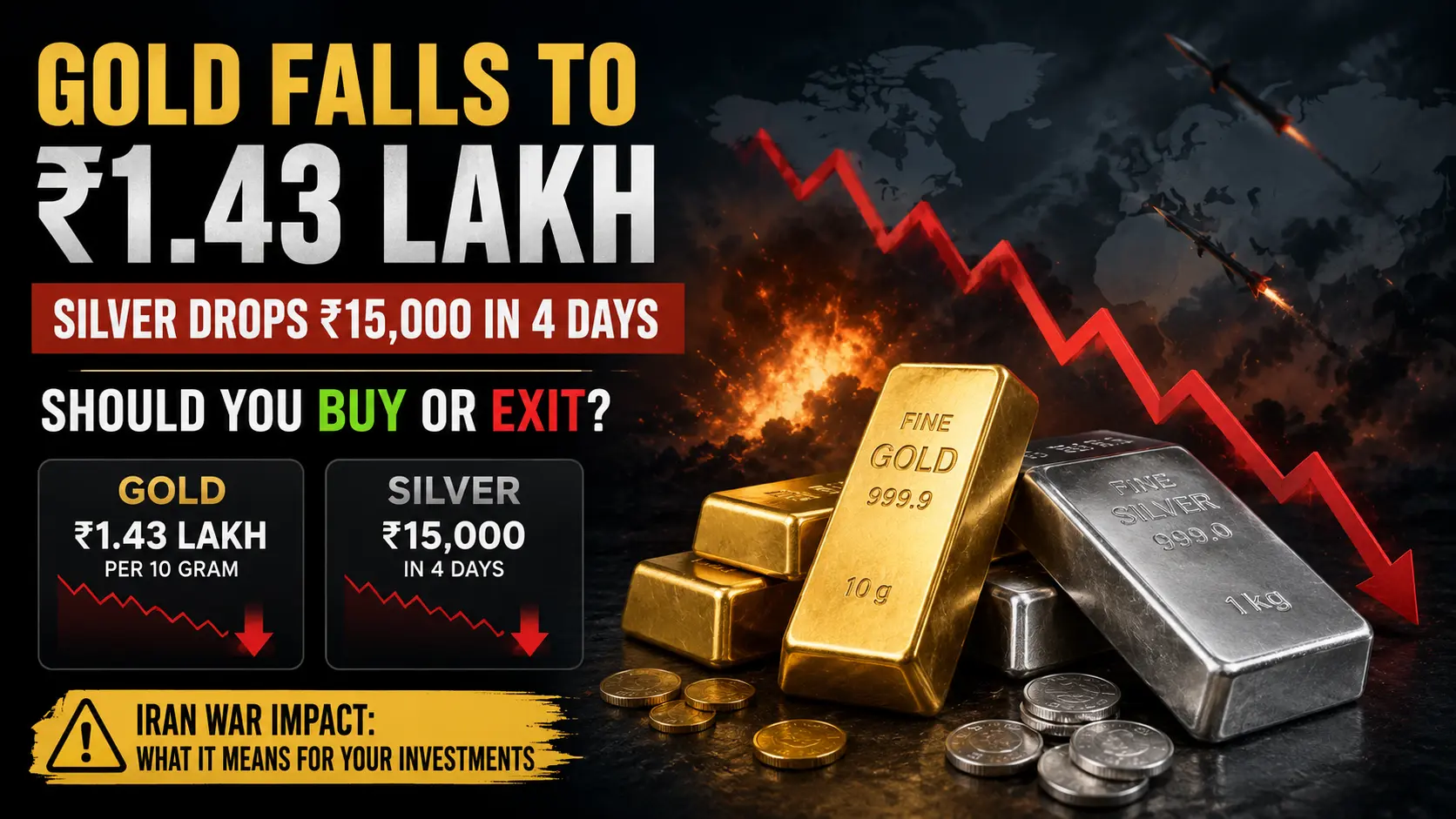
Title: Gold Falls to ₹1.43 Lakh, Silver Drops ₹15,000 in 4 Days — Should You Buy or Exit?
Gold just did something it almost never does during a war. It fell. Unreal. For four straight sessions, India's most trusted store of value has been bleeding — down to ₹1.43 lakh per 10 grams as of Thursday, while silver has shed ₹15,000 in just four days. That stings. The Iran war rattled global markets, sent oil prices surging, and lit up inflation fears worldwide. And yet, the yellow metal — which rose nearly 20% during the Gulf War in 1990 — kept sliding. Think about it. If you're sitting on a gold SIP, a sovereign gold bond, or a stack of physical jewellery bought at peak prices, this correction isn't abstract. It's your money. So the real question isn't just why gold is falling. It's what you should do about it right now.
- Gold prices in India have plummeted to ₹1.43 lakh per 10 grams after four consecutive sessions of losses.
- Silver, too, has dropped ₹15,000 in four trading days, reflecting the widespread pressure hitting precious metals globally.
- According to data from Mirae Asset Sharekhan, gold has lost $9 trillion in global market capitalisation — a staggering ₹133 lakh crore in domestic terms — since the US-Iran war's inception.
- Spot gold in international markets was trading at $4,726.64 per ounce, down 0.4%, as per The Hindu, after failed US-Iran diplomatic talks amplified downward pressure.
- Analysts expect continued volatility, advising investors to accumulate precious metals gradually during this correction, rather than exiting in a panic.
- Gold in India was priced at ₹1.59 lakh per 10 grams on February 27, 2026 — the day before the Iran war began — meaning prices have dipped nearly 8% since the conflict started.
Why Gold Is Doing the Opposite of What Every Textbook Predicted
Gold has one rule that most investors know by heart: when the world goes to war, gold goes up. Big. During the 1990 Gulf War, prices rose about 20% in the opening weeks. That's the playbook. That's what millions of Indian investors were counting on when the Iran war began. It didn't happen.
Here's what we know: gold in India was priced at ₹1.59 lakh per 10 grams on February 27, 2026 — the day before the war started, according to Bhaskar English. Yep. By March 21, the 22nd day of the conflict, it had already fallen nearly 8% to around ₹1.47 lakh per 10 grams. And it's kept falling since. This is the puzzle that analysts, retail investors, and market watchers are all trying to solve right now.
The answer has two parts. First, gold had already rallied strongly in the months leading up to the conflict, according to NDTV's market reporting. True. By the time the war broke out, a lot of the “fear premium” was already baked into prices. There was no new panic left to price in. Second — and this is the part that surprises most people — higher oil prices from the war mean higher inflation, and higher inflation means central banks keep interest rates elevated. Right? High interest rates make gold less attractive because gold pays no interest. So the very war that should've sent gold up has, through this chain of events, been pushing it down.
So why are investors still selling if they understand all this? Because inflation worries don't just affect gold's appeal — they trigger broader market sell-offs, forcing some investors to liquidate precious metal positions to cover losses elsewhere. That's real. That's the vicious cycle gold is caught in right now.
And here's why that matters.
What Has Actually Happened to Gold and Silver Prices
Let's put concrete numbers on the damage. Gold has dropped from ₹1.59 lakh per 10 grams at the war's start to ₹1.43 lakh per 10 grams as of Thursday — a fall of ₹16,000 per 10 grams in roughly seven weeks. No joke. Silver, meanwhile, has shed ₹15,000 in just the last four trading sessions alone. Both metals have now logged four straight days of losses.
- Gold at ₹1.43 lakh/10 grams: This is where the metal stands Thursday — nearly 8% below its pre-war price, continuing a slide that began when the US-Iran conflict started.
- Silver down ₹15,000 in four days: Silver typically moves faster than gold in both directions. Huge. This speed of decline reflects sharp selling pressure, not a gradual cooling.
- Spot gold at $4,726.64/ounce: According to The Hindu's April 13 report, international spot prices fell 0.4% after US-Iran diplomatic talks broke down — meaning no ceasefire is in sight, yet gold still fell. Wild.
- $9 trillion wiped from gold's global market cap: According to data shared by Mirae Asset Sharekhan and reported by the Times of India, that translates to ₹133 lakh crore in domestic market terms since the war began. To put that in context — India's entire annual GDP is roughly ₹300 lakh crore. Big deal.
- Failed US-Iran talks as trigger: According to The Hindu's reporting, the immediate catalyst for Thursday's drop was the collapse of diplomatic negotiations between Washington and Tehran — raising the prospect of a longer, more disruptive conflict.
- Oil prices rising: Higher crude costs are feeding directly into global inflation fears, which in turn put upward pressure on interest rate expectations — and that's bad news for non-yielding assets like gold.
This isn't a one-day blip. Every time there's a hint of diplomatic resolution, gold gets a tiny bounce. And? Every time talks fail — as they did most recently — the selling resumes. The pattern has been consistent across the four weeks of this correction.
Not something you see every day.
The Real Picture Behind the Numbers — What Experts and Markets Are Telling Us
Here is what makes this moment genuinely unusual. Most asset classes have bled during this period, as the Times of India noted. Equities are under pressure. Bonds are volatile. Oil is the only major asset that has moved the “expected” way — upward. Gold — the textbook safe haven — has joined the losers' column. That's big.
Analysts watching the gold market say this correction reflects three distinct pressures converging at once. The dollar has strengthened as investors flee to US assets, which makes gold more expensive in rupee terms for buyers outside the US — and less attractive globally. Key point. Inflation fears have kept rate-cut hopes off the table. And a pre-war rally had already priced in a lot of the crisis premium, leaving gold vulnerable to profit-booking once the initial shock wore off.
Yet most market analysts aren't sounding an exit alarm. The consistent message — from commentary tracked across multiple sources covering this correction — is to accumulate gradually during the dip, not to sell in panic. The logic: the same geopolitical instability that's currently pressuring gold through the inflation-rates channel could, at any moment, flip to pure fear-driven buying if the war escalates sharply. Gold's long-term structural demand from Indian households, central banks, and jewellery buyers hasn't changed. What's changed is the short-term macro backdrop. Period.
From a year-on-year lens, even at ₹1.43 lakh per 10 grams, gold remains dramatically higher than it was 18 months ago. This is a correction within a larger bull run — not a reversal of it. That context matters if you're deciding whether to stay in, add more, or walk away.
Think.
What This Means for You — the Investor Sitting at Home Right Now
For a middle-class family in Mumbai that bought gold at ₹1.55 lakh per 10 grams during the pre-war rally, this correction stings. That stings. On a 100-gram purchase — not unusual for a wedding trousseau — that's a paper loss of over ₹1.2 lakh in a matter of weeks. That's real money. And watching it fall further while a war rages, oil climbs, and markets wobble doesn't exactly inspire confidence.
But here's the thing: the families who sold gold during every previous geopolitical correction — the 2008 crisis, the 2020 COVID crash — and then watched it recover to new highs, almost all regretted it. Selling in a panic during a correction is usually how retail investors lock in losses that would've reversed. Nobody talks about this.
For someone holding sovereign gold bonds (SGBs), the picture is a bit different. SGBs pay 2.5% annual interest regardless of price movement, and their redemption is tied to gold prices at maturity. A short-term correction doesn't change that math if your holding period is five-plus years. For those in gold ETFs or mutual funds, the same principle applies — this is a dip, not a structural break. Read that again.
What should you actually do? Analysts advise accumulating in small tranches during this period rather than making one large purchase at any single price. If you were planning to buy gold for a wedding or festival and your budget allows, this correction has brought prices closer to a range where buying makes sense — but nobody is calling an absolute bottom yet. Avoid panic-selling existing holdings. And if you haven't already diversified — gold should be one part of a portfolio, not all of it.
For a salaried employee in Chennai who runs a monthly gold SIP of ₹5,000, this dip is actually doing exactly what a SIP is designed to do: buying more units at lower prices. Don't stop the SIP. Let it work.
And that's just the beginning.
What to Watch For Next — The Triggers That Will Move Gold
Gold right now is being driven by a single dominant variable: what happens with the US-Iran conflict. According to The Hindu's reporting, the most recent round of diplomatic talks has failed. That means the war continues, oil stays elevated, inflation fears persist, and the interest-rate ceiling remains in place. Until one of those things changes, the pressure on gold is unlikely to lift cleanly. Not small.
Three scenarios are worth tracking. In the best case — a ceasefire or credible peace talks — oil prices would fall, inflation fears ease, rate-cut expectations return, and gold would likely get a sharp bounce. In the most likely scenario, the conflict grinds on without major escalation, gold trades in a volatile range but doesn't crash further, and a gradual recovery begins as inflation data globally starts to soften. And now? In the worst case — a significant escalation involving more countries or critical oil infrastructure — pure fear-buying could drive a sharp spike in gold, as the “safe haven” instinct overrides the rate-pressure logic entirely.
Watch three specific signals: oil prices (a drop signals easing inflation fears, good for gold), any US Federal Reserve language about rate cuts (even a hint moves gold immediately), and the status of US-Iran diplomatic contacts. Those three variables, more than anything happening on Dalal Street, will tell you where gold goes from here. Worth it.
Silver investors should note that silver tends to move faster and further than gold in both directions — the ₹15,000 drop in four days is evidence of that. If gold recovers, silver typically leads the bounce. But if gold keeps falling, silver falls harder.
The numbers don't lie.
Frequently Asked Questions About Gold Price Fall in India 2026
Why are gold prices falling even though there is a war going on?
Honestly — gold had already rallied sharply before the Iran war began, pricing in much of the risk premium. The war also pushed oil prices up, which raised inflation fears. This, in turn, kept interest rate expectations high. Since gold pays no returns, high interest rates make it less attractive. That pressure has outweighed the safe-haven buying, creating a perplexing market dynamic.
Is it a good time to buy gold at ₹1.43 lakh per 10 grams right now?
Here's the thing: most analysts aren't calling this a definitive bottom. They advise buying in small portions over time — what's called averaging — rather than making one large purchase. If you were already planning to buy for a wedding or festival, the correction has improved value. But don't expect the price to stop falling immediately.
Should I sell my gold or hold on during this correction?
In plain words, panic-selling during a correction is usually the wrong call. Investors who held through past corrections — 2008, 2020 — saw prices recover to new highs. If you hold sovereign gold bonds or gold ETFs with a long time horizon, staying put makes more sense than selling at a loss right now.
How much has gold fallen since the Iran war started?
Good question. Gold in India was priced at ₹1.59 lakh per 10 grams on February 27, 2026, the day before the war began. By Thursday, it had fallen to ₹1.43 lakh per 10 grams — a drop of ₹16,000, or nearly 8%, over the course of the conflict so far. That's the truth. This decline reflects the unexpected market reaction to ongoing geopolitical tensions.
What will make gold prices go up again?
Look — the short answer: any combination of falling oil prices, easing inflation data, or signals from central banks about cutting interest rates could trigger a gold recovery. A ceasefire or peace deal in the Iran conflict would also remove the inflation-pressure logic currently dragging gold down and could send prices bouncing sharply upward.