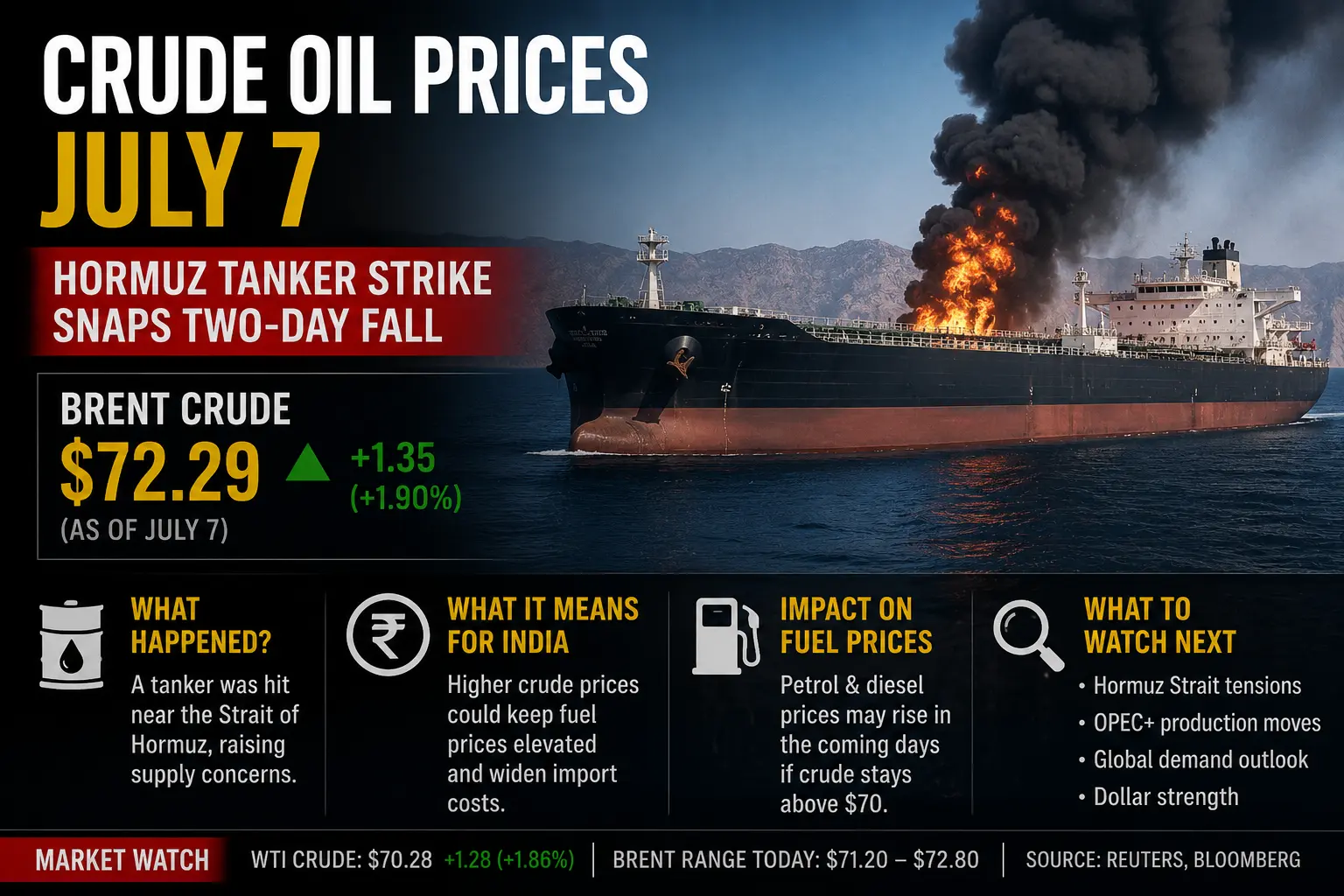
Something hit a tanker near the Strait of Hormuz on Monday. Nobody has claimed responsibility yet. But the oil market — which had spent the last two days quietly convincing itself the worst was over — woke up fast. Brent crude futures climbed 28 cents, or 0.39%, to $72.29 a barrel by early Tuesday. U.S. West Texas Intermediate (WTI) gained 29 cents, or 0.26%, to $68.84 a barrel. Small numbers on paper. But after two straight sessions of decline that had dragged both benchmarks back close to their pre-Iran-war levels, even a fraction of a move matters. The question energy traders, Indian oil importers, and anyone paying attention to petrol pump prices should be asking right now: is this a blip, or the beginning of something worse?
- Brent crude rose to $72.29 per barrel on July 7, 2026 — up 0.39% after a two-day decline.
- A projectile struck a tanker near the Strait of Hormuz, reversing the recent calm in oil markets.
- WTI crude settled at $68.84 per barrel, up 0.26% — both benchmarks had been close to pre-Iran-conflict lows.
- The Strait of Hormuz handles roughly 20% of global oil trade — any disruption there moves prices worldwide within hours.
- India imports about 85% of its crude oil needs, making Hormuz a chokepoint that directly touches every Indian fuel bill.
- Watch for any claim of responsibility for the projectile strike — that single announcement could move Brent by $3-5 per barrel in either direction.
The Strait Nobody Talks About Until Something Goes Wrong
Picture a narrow strip of water, roughly 33 kilometres wide at its tightest point, sitting between Oman and Iran. About 21 million barrels of oil pass through it every single day, according to the U.S. Energy Information Administration. That is one in every five barrels of oil traded anywhere on earth. The Strait of Hormuz is not just important. It is irreplaceable — there is no pipeline, no alternate route that can absorb that kind of volume if the strait closes or even slows down.
For the last few weeks, the markets had been watching Hormuz closely. Iran's nuclear negotiations with the West had created a fog of uncertainty. At their worst, reports of Iranian naval activity near shipping lanes had pushed Brent above $80 in mid-June 2026. Then things appeared to stabilise. Tanker traffic normalised. By late June, crude had fallen to four-month lows — Brent touching $75.07, then sliding further, as ships moved freely and analysts started trimming their risk premiums.
But the oil market has a memory. Every time Hormuz calms down, the next incident hits harder — because traders had let their guard down. So when news broke on July 7 that a projectile had struck a tanker near Oman, the reaction was immediate. Not a panic. But a definite, sharp reversal. And that is what makes this moment worth watching closely.
What Actually Happened on July 7
Early on Monday, a tanker was hit by what initial reports described as a projectile near Oman — which sits at the southern entrance of the Strait of Hormuz. No casualty figures have been officially confirmed. No group has claimed the strike. Evacuation procedures were reportedly activated on board, according to Reuters.
- Brent crude, July 7: Rose to $72.29 per barrel — a gain of 28 cents or 0.39% from Monday's close.
- WTI crude, July 7: Rose to $68.84 per barrel — a gain of 29 cents or 0.26%.
- Previous two sessions: Both benchmarks had fallen steadily, closing near their pre-Iran-war-threat levels — the lowest since early March 2026.
- Context of the strike: This is not the first such incident in 2026. A similar attack on a cargo vessel near Oman on June 25, 2026 had already caused a 2% single-day spike in oil prices, as reported by Reuters at the time.
- Hormuz traffic status: Until July 6, tanker flow through the strait had been improving — a fact that had been actively pulling prices down through late June.
- Who it affects first: Asian buyers, including India, Japan, and South Korea, who receive the bulk of Gulf crude shipments routed through Hormuz, are most directly exposed to any sustained disruption.
The details of the July 7 strike remain thin. That, ironically, is part of why the market moved. Uncertainty about who fired, what they hit, and whether it was a one-off or the start of a pattern — that uncertainty has a price tag. And right now, the market is paying it.
What happened immediately after was telling. Reuters reported that oil prices had risen more than 2% on June 25 after a similar projectile hit a cargo ship near Oman. The market recovered quickly then, as traffic resumed within days. The question this time is whether the pattern holds — or whether this July strike signals something more deliberate.
What Analysts Are Actually Watching Right Now
Here is the real picture behind the numbers. Two separate forces are pulling oil prices in opposite directions simultaneously. And the direction crude takes over the next two weeks depends entirely on which force wins.
On one side, there's the supply story. Iran's production outlook has been weighing on the market. If Iran reaches a nuclear deal with Western powers — or even a partial agreement that lifts some sanctions — Iranian crude could add anywhere from 500,000 to 1 million barrels per day back to global supply. That is enormous. OPEC+'s combined output decisions already pushed the market into a mild surplus in Q2 2026, according to the International Energy Agency's June 2026 Oil Market Report. More Iranian oil on top of that would drag Brent well below $70. Some analysts at the time were already calling for $65 Brent by September 2026 if that scenario played out.
On the other side, you have the security story. Every projectile that hits a tanker near Hormuz adds what traders call a “geopolitical risk premium” to the price — essentially, the market charging extra for the uncertainty that supply might be disrupted. That premium had shrunk to nearly zero by early July as Hormuz traffic normalised. Monday's strike brought it back. How big it gets depends on what happens next.
The third angle — the one most people miss — is the demand picture. China's economic recovery in 2026 has been slower than expected. Indian refinery demand remains strong, but global oil consumption growth forecasts for 2026 were revised down by the IEA from 1.2 million barrels per day in January to around 0.9 million barrels per day by June. Slower demand growth, combined with oversupply fears, was already doing most of the work in pulling prices down before this week's incident.
Put it together and you get a market that is genuinely uncertain — not just about today's prices, but about where crude will be sitting in October 2026. That's not a comfortable place for anyone who needs to plan ahead. And in India, that means everybody from the government's petroleum ministry to the truck driver sitting at a Rajasthan highway dhaba waiting for his next fuel bill.
What This Means for You — and Your Petrol Bill
Let's make this personal, because it is.
India imports about 85% of its crude oil requirements, according to the Ministry of Petroleum and Natural Gas. Most of that — roughly 60% of imports — comes from the Gulf region, routed through the Strait of Hormuz. So when something happens in that narrow strip of water off Oman, it doesn't stay there. It travels. It shows up in the Indian Oil Corporation's procurement costs. It moves through the supply chain. And eventually, with some lag, it can show up at the pump.
For a middle-class family in Pune running one car and one two-wheeler, petrol prices are not abstract. At current prices — petrol sitting at roughly ₹103-106 per litre in most major cities as of early July 2026 — a sustained $5 per barrel rise in Brent could, depending on government pricing decisions, translate to a ₹2-3 per litre increase at the pump. That doesn't sound like much. But multiply it across a month's driving, and for a household spending ₹3,000-4,000 per month on fuel, it's real money.
The government, for now, has some buffer. The central excise duty on petrol and diesel — which was cut in 2022 to absorb global price spikes — has headroom to be adjusted again if needed. But that is a political call, not just an economic one, and with state elections in the calendar, no government moves on fuel prices lightly.
For businesses, the calculation is sharper. Trucking, aviation, shipping, fertiliser production — all of these sectors run on fuel costs. IndiGo (NSE: INDIGO), India's largest airline by market share, spent roughly ₹19,000 crore on aviation turbine fuel in FY2025-26, according to its Q4 FY26 results filing. A sustained crude price rise of even 5% translates to hundreds of crores in added costs for the carrier — costs that eventually find their way into ticket prices.
What should you do right now? If you're planning a long road trip or a flight booking in the next 30-45 days, the window before prices potentially adjust is open — but it's closing. For investors watching the oil-linked sectors: OMCs (Oil Marketing Companies) like Hindustan Petroleum Corporation Ltd (NSE: HINDPETRO) and Bharat Petroleum Corporation Ltd (NSE: BPCL) tend to see margin pressure when crude rises without matching retail price hikes. Keep an eye on how the government responds in the next two weeks.
What to Watch For Next
Three things will determine where crude prices go from here. Each one has a specific trigger point.
First — the identity of the attacker. If any group claims responsibility for the July 7 tanker strike and that claim connects it to the broader Iran-linked regional conflict, markets will add another $3-5 per barrel to the risk premium almost immediately. If it remains unclaimed and appears to be an isolated incident, the current $72 Brent level may hold or drift back toward $70 within a week.
Second — the OPEC+ production decision. The group's next output review is due in August 2026. If producers decide to hold or increase the production cuts they implemented in early 2026, the supply side tightens and provides a floor under prices. If they signal more output — especially given that some members need higher production to fund domestic budgets — prices could soften further regardless of Hormuz tensions.
Third — Iran's nuclear talks. Any breakthrough in negotiations between Tehran and Washington, or any collapse that leads to new sanctions or military posturing, will move crude faster than any tanker strike. Diplomatic signals from Vienna, where talks have reportedly continued through June and into July 2026, are the most important variable nobody on the consumer side is tracking closely enough.
The best-case scenario: Hormuz remains open and traffic flows normally, Iran talks inch toward a partial deal, and Brent drifts toward $68-70 by end of July. The worst case: another strike, a claim of responsibility with regional implications, and Brent back above $78 within ten days. The most likely outcome, based on the current pattern: volatile sideways movement between $70 and $74, with sharp intraday spikes on any new security incident — exactly the kind of market that makes planning difficult for Indian refiners and the government alike.
The one date to mark: OPEC+'s August 2026 ministerial meeting. That is where the supply story either gets resolved or complicated further. Everything between now and then is noise — important noise, but noise.
Frequently Asked Questions About Crude Oil Prices and the Hormuz Strait
Why does the Strait of Hormuz matter so much to crude oil prices?
Simply put, there is no alternative. About 21 million barrels of oil pass through this narrow waterway every single day — roughly one-fifth of all oil traded globally. If ships can't move freely through Hormuz, the world's oil supply tightens fast. For India, which sources most of its Gulf crude through this route, even a partial disruption raises import costs within days.
How does a tanker attack near Oman push oil prices up?
Here's the thing: oil markets don't just price in what's happening right now. They price in what might happen next. When a tanker gets hit, traders immediately ask — is this a one-off, or a pattern? That uncertainty costs money. It gets priced into futures as a “risk premium,” pushing Brent and WTI higher until the situation clarifies. The June 25, 2026 attack near Oman triggered a 2% single-day jump in crude prices, according to Reuters.
How does rising crude oil affect Indians directly?
India imports about 85% of its crude needs, according to the Ministry of Petroleum and Natural Gas. Higher crude means higher costs for fuel, fertilisers, plastics, aviation, and trucking. A sustained $5-per-barrel rise in Brent can push petrol prices up by ₹2-3 per litre in India, depending on government pricing decisions — a real hit for families spending ₹3,000-4,000 monthly on fuel.
Should I worry about petrol prices going up immediately after this news?
Not immediately — India's fuel prices don't change overnight with every crude movement. The government and state-owned oil companies absorb short-term fluctuations. But if crude stays elevated for 3-4 weeks or climbs past $78-80, expect pressure on retail fuel prices. Book flights and plan long drives before any official price revision is announced. Watch for OMC statements in the next fortnight.
What is the latest update on crude oil prices as of July 7, 2026?
The short answer: Brent crude stood at $72.29 per barrel and WTI at $68.84 per barrel as of July 7, 2026, after both benchmarks snapped a two-day falling streak. A projectile struck a tanker near Oman, reviving security concerns in the Hormuz region. Both benchmarks had been trading near their lowest levels since early March before Monday's incident reversed the trend.