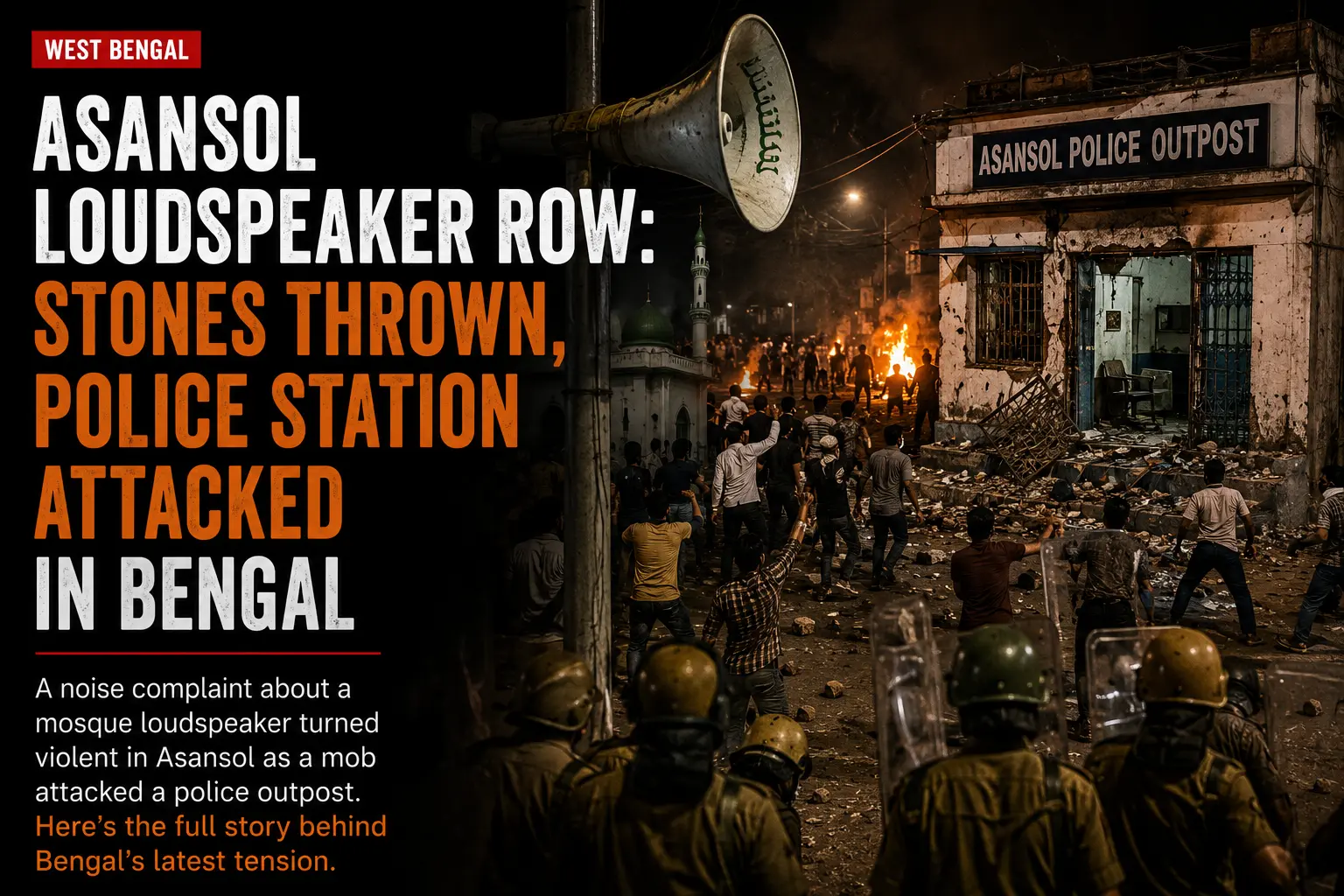
Asansol Loudspeaker Row: Stones Thrown, Police Station Attacked in Bengal
Friday prayers had just ended in Asansol's Naya Mohallah area when the situation turned ugly—a lot faster than anyone could have predicted. Wow. That one police visit to a local mosque, sparked by a simple noise complaint, lit a fuse nobody in the neighbourhood was prepared for. No joke. A mob gathered, stones started flying, and by the time things calmed down, a police outpost had been attacked in broad daylight in West Bengal. If you think this is just a local fight about noise—read on, because there's a lot more happening here.
- So a mob straight-up attacked a police outpost at Naya Mohallah in Asansol, West Bengal, all stemming from a Friday dispute over loudspeaker volume near a mosque.
- And look, police only visited the mosque after a formal noise complaint was filed by a local resident—they simply asked authorities to lower the volume, not shut it down.
- The mob, however, accused officers of trying to stop Friday prayers entirely. Police have completely denied this claim.
- Things got ugly: stones were pelted at police personnel, and the situation needed a heavy police deployment to get the area back under control.
- West Bengal's Asansol district isn't new to communal tension—and this incident has reignited serious concerns about law and order in the region.
- No official arrest count has been confirmed yet, but senior police officials are on the ground monitoring the area closely.
Think.
What Actually Happened That Friday Morning in Asansol
Let's go back to the beginning—a resident near the Jahangiri Mohalla area of Asansol, one of West Bengal's biggest industrial cities, filed a complaint about the high volume of a mosque's loudspeaker. Big deal. This kind of complaint isn't unusual anywhere in India. Right? Neighbours file noise complaints all the time, about temples, mosques, marriage halls, DJ parties—you name it.
So police from the Jahangiri Mohalla police station responded to the complaint the way they're supposed to. And? They went to the mosque and asked the authorities there to lower the loudspeaker volume. That's it. A routine request. But what happened next was anything but routine. Unreal.
But not for the reasons you'd expect.
Word spread through the neighbourhood—and the word that spread wasn't accurate. Let that sit. People started saying that police had come to stop Friday prayers altogether. That stings. That the police wanted to silence the azaan. That's not what happened. But the damage was done.
A large crowd then gathered near the Naya Mohallah police outpost, which is a smaller police point in the same area. The result? And then the stones started flying.
- Location: Naya Mohallah area, Asansol, Paschim Bardhaman district, West Bengal
- Day and timing: The incident happened on a Friday, which is the day of Jumu'ah—the most important prayer of the week for Muslims, making the crowd's anger even more intense
- The trigger: Police had asked mosque authorities to reduce loudspeaker volume after a noise complaint—not stop prayers
- What the mob did: Pelted stones at police personnel and attacked the Naya Mohallah police outpost directly
- Police response: Heavy force was deployed to the area to control the crowd and restore order
- Current status: The area remains tense, with police patrolling regularly
Senior police officials made it clear—their team had only gone to the mosque to ask for the volume to be reduced. Not small. There was no attempt to stop prayers. Key point. One local officer told reporters that this kind of misunderstanding is exactly what bad actors use to turn a small issue into a big fire. Is this really a surprise?
And here's why that matters.
Why Asansol? The History Behind the Tension
Asansol isn't just some random city; it's the second-largest urban area in West Bengal after Kolkata, with a population of over 12 lakh people. And more. It has a long history of coal mining, industrial work, and—this is important—communal sensitivity. Think about it.
Period.
And back in 2018, Asansol saw one of the worst communal riots in Bengal in recent memory—a brutal conflict that happened during Ram Navami, a Hindu festival. Wild. Violence broke out between two communities, shops were burned, and a local cleric, Maulana Imdadullah Rashidi, made national headlines when he publicly asked his community not to retaliate, even after his own son was killed. Yep. That was a rare and powerful moment of peace in a city that has often been at the edge of conflict.
So when you hear about stone-pelting at a police station in Asansol over a loudspeaker complaint, you have to understand this city carries weight. Huge. Every small incident here has the potential to become something much bigger. And that's big. People on both sides know it.
And here's the thing—loudspeaker disputes have been a flashpoint across India for the past few years. True. From Uttar Pradesh to Maharashtra to Karnataka, the question of religious loudspeakers—their volume, their timing, and who has the right to complain about them—has become one of the most sensitive political issues in the country. Facts. So what looks like a noise complaint on the surface is actually sitting on top of years of tension, political blame games, and deep community distrust.
The kind of thing most people miss.
What the Attack on Police Actually Means
Think about what happened here for a second: a police outpost, a government building where officers work, was attacked by a mob throwing stones. That's the truth. That's not a protest. That's not a demonstration. Read that again. That's a direct attack on law enforcement.
Look—police across India have limited powers to regulate loudspeakers, but they do have them. That's real. Under the Noise Pollution (Regulation and Control) Rules, 2000, loudspeakers used in residential areas must stay within certain decibel limits—45 dB during the day and 55 dB in commercial zones. And now? When a complaint is filed, police are required to act. That's exactly what the Asansol officers did.
The problem is the gap between what police actually did and what people believed they did. Big shift. That gap—just a few hours of rumour spreading through a neighbourhood—led to a police station being pelted with stones. Nobody talks about this.
Political reactions have come in quickly. And opposition BJP leaders in West Bengal are using this to attack Chief Minister Mamata Banerjee's government, saying it's too soft on those who attack police. Worth it. The Trinamool Congress—Mamata's party—hasn't made a major public statement on the incident yet. That silence, some political observers say, speaks volumes in itself. But who really benefits here?
For ordinary residents of Asansol, whether Hindu or Muslim, this incident makes daily life feel more fragile. A shopkeeper near Naya Mohallah, a schoolteacher commuting through the area, a mother worried about her children's school route—none of them caused this. Not anymore. But all of them are now living with the consequences. And where does that leave the rest of us?
Big shift.
How This Affects People Living in the Area Right Now
So for the people of Asansol's Naya Mohallah and surrounding areas, the immediate impact is simple: fear. When stones fly and police stations get attacked, ordinary people lock their doors. They just do. Shops shut early. Parents don't send children to school. Auto drivers avoid certain routes.
And think about a daily wage worker in Asansol who earns maybe ₹400-500 a day. Every hour his shop or workplace stays shut because of curfew-like conditions is money he doesn't earn and can't get back. That's real. There aren't any compensations for that. No government scheme to cover a day of lost income because your neighbourhood became a news story.
For Muslim residents of the area, there's a different kind of fear—that the actions of a mob will paint the entire community with the same brush. Most Muslims who prayed at that mosque on Friday had nothing to do with the stone-pelting. But they'll face the sideways looks, the suspicion, the WhatsApp forwards with misleading videos. That's a burden no one should have to carry for something they didn't do.
Worth paying attention to.
For police officers in Asansol, this incident is a direct threat to their safety. Officers who respond to routine complaints—noise issues, traffic disputes, domestic fights—now have to worry that any interaction with a community could turn into a mob attack. That kind of fear makes police either over-cautious or over-aggressive. Neither outcome is good for the people they're supposed to protect.
If you live in Asansol or know someone who does—the practical advice right now is this: avoid the Naya Mohallah and Jahangiri Mohalla areas for a few days, follow official police advisories, and don't share unverified videos or messages about the incident on WhatsApp. Those messages are often what turn a local dispute into a city-wide crisis.
And that's just the beginning.
What Happens Next — And What to Watch For
So here's what's coming in the next few days. Police will most likely make arrests—that's standard procedure after an attack on a police outpost. True. The question is how many, and from which community. That decision will either calm things down or add more fuel. So what does this actually mean?
And West Bengal Police and the state government will come under pressure to take a clear stand. If they're seen as going soft, BJP will use it in political campaigns. If they're seen as targeting one community, TMC will face backlash from its own voter base. There isn't an easy answer here politically, which is exactly why these situations drag on.
Wow.
There are three ways this could go. Best case: police make swift, fair arrests, local leaders from both communities publicly call for calm, and Asansol returns to normal within a week. Most likely: a slow, tense standoff where life returns to half-normal while investigations drag and political blame games continue for weeks. Worst case: another triggering incident happens before things fully cool down, and the situation escalates again like it did in 2018.
The one thing to keep your eye on is whether Bengal Police file a proper FIR naming those who attacked the police outpost, and whether those arrests happen quickly. That will tell you everything about how seriously the state government is taking this. Watch for that in the next 48-72 hours.
Frequently Asked Questions About the Asansol Loudspeaker Violence
What started the violence in Asansol's Naya Mohallah area?
Simply put, it all kicked off with a noise complaint about a mosque's loudspeaker. Police visited and asked them to lower the volume, but rumours spread that police were trying to stop Friday prayers entirely. An angry mob attacked in response.
Did police actually try to stop Friday prayers in Asansol?
Here's what you need to know: police have flat-out denied this. Local officials stated that officers from Jahangiri Mohalla police station only asked mosque authorities to reduce the loudspeaker volume following a formal complaint, which they're legally required to investigate. There's zero evidence they tried to stop prayers. The entire attack was fueled by dangerous misinformation that spiraled out of control in the neighbourhood.
How does this violence affect ordinary people living in Asansol?
Good question. For everyday folks, the impact is huge and immediate. Shops close down, daily wage workers lose their income, and a general sense of fear takes over. Both Hindu and Muslim residents, who had no part in this, get trapped in the crossfire.
What should residents of Asansol do right now to stay safe?
The thing is, you should probably avoid the Naya Mohallah and Jahangiri Mohalla areas for now. Don't share unverified videos or messages on social media or WhatsApp, because that's what makes these situations ten times worse. For real information, stick to official West Bengal Police social media accounts or trusted local news sources to get your updates. Stay safe out there.
Has Asansol seen this kind of communal trouble before?
Honestly—yes, and it's serious history. Asansol experienced some of West Bengal's worst communal violence back in March 2018 during Ram Navami. People were killed, property was torched, and the city was on edge for days. That history makes every new flare-up here far more worrying.