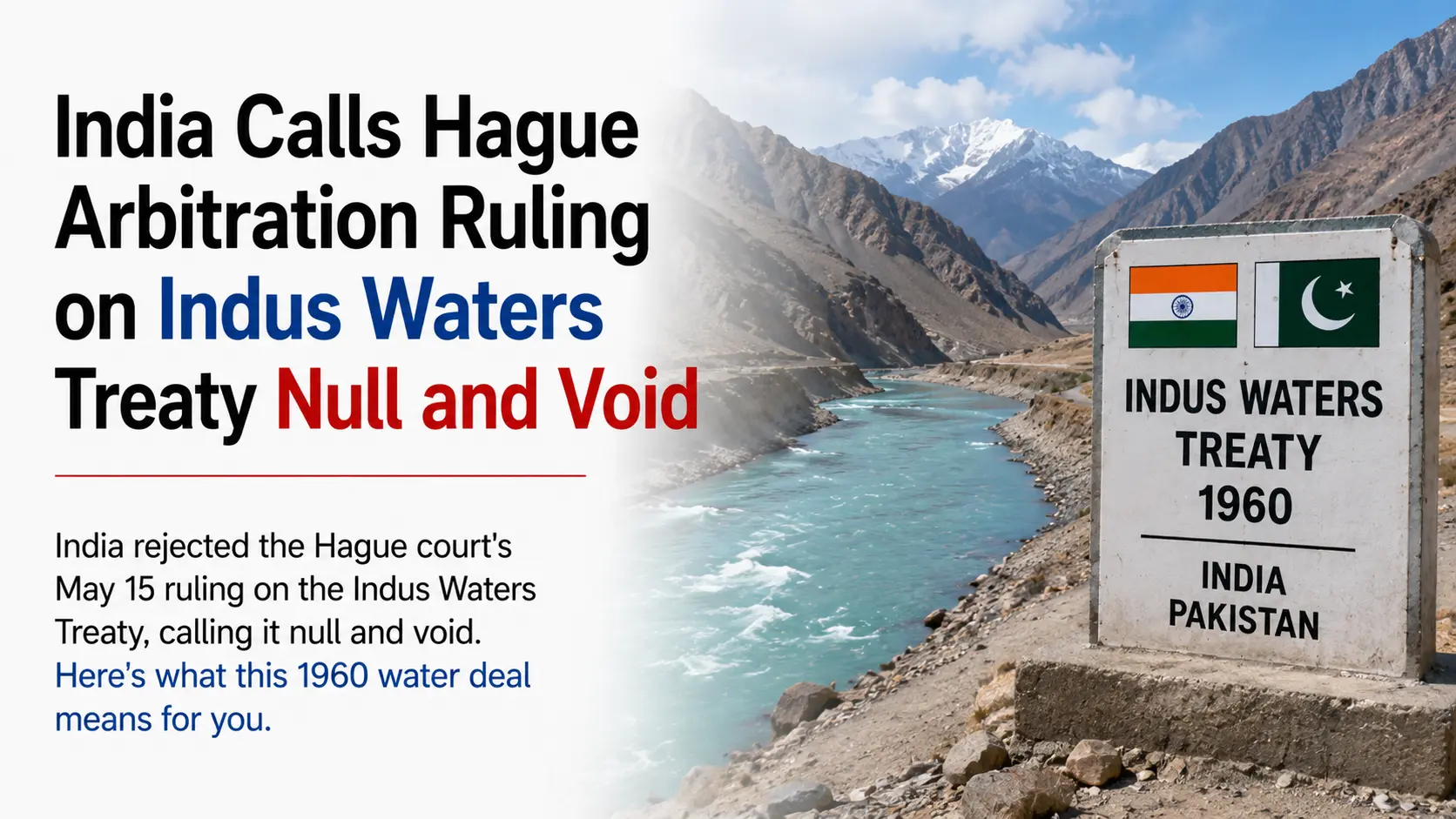
India Calls Hague Arbitration Ruling on Indus Waters Treaty Null and Void
On May 15, 2025, a ruling came out of The Hague — and India flatly, utterly refused to accept it. Wow. The so-called Court of Arbitration (CoA) passed a fresh decision about the Indus Waters Treaty, the old water-sharing deal between India and Pakistan. And now? India's response was immediate and blunt: the ruling is “null and void.” In other words, India's saying this ruling doesn't exist as far as it's concerned. But why is India so angry about a court ruling? Keep reading — because this story goes much deeper than a legal argument between two governments.
- The Hague's Court of Arbitration dropped a ruling on May 15, 2025, concerning the Indus Waters Treaty, and India didn't waste a second rejecting it.
- India has officially put the Indus Waters Treaty (IWT) — signed way back on September 19, 1960 — in abeyance, which means it isn't following the treaty for now.
- Look, India says the Court of Arbitration was set up illegally and without India's agreement, so its rulings carry zero weight for New Delhi.
- And the latest ruling? It was about “maximum water flows” — a technical point on how much water can flow through the rivers covered by the treaty.
- Pakistan's been pushing this arbitration since at least 2022 — but India has refused to show up to any of those proceedings.
- It's the farmers and communities in Punjab, Jammu & Kashmir, Himachal Pradesh, and Rajasthan who will feel any real change in how Indus waters are managed going forward.
And here's why that matters.
The Old Deal That Still Causes New Fights
Picture this. It's 1960. India and Pakistan have been independent nations for just 13 years — and both countries desperately need water for their farms and their people. Right? The Indus River and its five tributaries — the Jhelum, Chenab, Ravi, Beas, and Sutlej — flow through both countries. Facts. Someone has to decide who gets what. So on September 19, 1960, Prime Minister Jawaharlal Nehru and Pakistan's President Ayub Khan signed the Indus Waters Treaty (IWT) in Karachi, a deal the World Bank helped broker.
The basic idea was pretty simple — India got full rights over the three eastern rivers (Ravi, Beas, and Sutlej) while Pakistan got the three western rivers (Indus, Jhelum, and Chenab). True. It was one of the few agreements between the two neighbours that actually survived wars, nuclear tests, and decades of bad blood. Think about it. Even after the 1971 war, the Kargil conflict in 1999, and the 2001 Parliament attack, both sides kept following the treaty. So for 65 years, it held. Now? It's cracking.
The real question is — what broke the agreement that survived everything else?
But not for the reasons you'd expect.
What Actually Happened and What India Said
The trouble didn't start overnight. Let's go through it step by step, because there are a few moving parts here. And that's big.
- The Kishanganga and Ratle projects: India started building two hydropower projects — the Kishanganga dam in Jammu & Kashmir and the Ratle dam in Himachal Pradesh — on the western rivers. Pakistan objected, saying these projects break the rules of the IWT.
- Pakistan goes to The Hague (2022): Pakistan took the dispute to the Permanent Court of Arbitration (PCA) at The Hague, Netherlands, without India agreeing to join. India said from day one that this court has no right to hear the case.
- India's boycott: So India refused to take part in any of the proceedings. Not one hearing. Not one written reply. India's position was crystal clear — this court doesn't have the authority to decide anything about the IWT.
- The May 15, 2025 ruling: The Court of Arbitration passed a fresh decision on “maximum flows” — basically a technical ruling about how much water India can or cannot hold back. India rejected it instantly.
- India's official response: India's government said — and this is word for word from the official statement — that the court was “constituted illegally” and that “any proceeding, award, or decision issued by it is null and void.”
- Treaty put in abeyance: India had already formally told Pakistan in January 2023 that it was putting the IWT “in abeyance.” That word means India has paused its obligations under the treaty. It's not a full cancellation — but it's not business as usual either.
Look — the Indian government's spokesperson made it very clear that New Delhi never recognised the setting up of this court in the first place. Yep. So in India's eyes, anything this court decides simply doesn't count. Not small. Think of it like a cricket match where one team refuses to accept that the umpire was appointed correctly. They play — but they don't accept his decisions.
And the Pahalgam attack in April 2025 made things even sharper — and after that terror attack, India took a very hard line on Pakistan on multiple fronts. Big shift. The Indus Waters Treaty became one of those fronts. The result? Total deadlock.
Think.
Why India's Anger Goes Beyond Just a Court Ruling
Here's what most people miss. This isn't just about water or a legal fight. Wild. This is about who has the power to tell India what to do with its own rivers — and India's answer is a firm no to anyone outside its borders. Key point. And why does this matter right now?
From India's point of view, the IWT itself has problems, and the treaty was written in 1960. That's real. Back then, nobody was thinking about climate change, shrinking glaciers, or the energy needs of a modern country. Unceal. Jammu & Kashmir and Himachal Pradesh — the states where these rivers flow — need hydropower. And the treaty's rules make it very hard for India to build the kind of dams it needs without Pakistan objecting.
And from Pakistan's point of view, the western rivers are a lifeline. About 80% of Pakistan's farmland depends on the Indus water system. No joke. If India holds back water or changes the flow through its dams, Pakistan's farmers face a crisis. That stings. This isn't a small worry for them — it's an existential one.
From an international law angle, experts are split. Some say India is right that the court was set up in a way that goes against the IWT's rules. Big deal. The IWT has its own process for settling fights — first through a “Permanent Indus Commission,” then a “Neutral Expert,” and only after all that, an arbitration court. Not anymore. Pakistan skipped steps, India says. Others argue that India simply doesn't want any outside body telling it what to do.
And politically inside India? Taking a tough stand on Pakistan is never unpopular. Think about it. So there's that angle too — let's be honest about it.
The kind of thing most people miss.
Who Actually Feels This — And How
Okay, so two governments are fighting over legal language in The Hague. But what does this mean for real people? And where does that leave the rest of us?
So for a farmer in Punjab, the Ravi and Beas rivers are everything. Huge. Wheat, rice, cotton — the whole crop cycle depends on how much water flows into the canals. And? The IWT already gave India full control over these eastern rivers, so a change in the treaty's status doesn't immediately hit Punjab farmers. But if the broader water-sharing system breaks down, canal water supplies could get complicated. Punjab already deals with a groundwater crisis. Any added pressure on surface water is a serious worry.
For people living in Jammu & Kashmir, the stakes are different. The Kishanganga project, once fully running, can give the region much-needed electricity. Big. Right now, J&K faces regular power cuts, especially in winter. And more. A strong hydropower project means fewer cuts, lower bills, and more stability. But every time Pakistan raises a legal objection and the project gets delayed, those benefits get pushed further away.
For communities in Rajasthan, the Indira Gandhi Canal — which carries water from the Beas and Sutlej rivers — is a lifeline for one of the driest states in India. Yep. Any change in how the Indus system is managed can ripple all the way to the Thar Desert. That's the truth. That's how connected this all is.
And for Pakistan's farmers — especially those in Sindh and Punjab province across the border — the fear is real. If India starts using more water from the western rivers through its dams, less will flow downstream into Pakistan. Let that sit. In a country already dealing with floods, droughts, and food insecurity, that's a nightmare scenario. That's the truth.
So here's the bottom line: this isn't a diplomatic game. Real crops, real electricity, real drinking water — all of it is tied to how this plays out. Period.
Worth paying attention to.
What Comes Next — And What You Should Watch
This story is far from over. Here are the things that actually matter going forward. Nobody talks about this.
First, India's water projects will move ahead. With the treaty in abeyance and India refusing to recognise the court, New Delhi has effectively given itself more freedom to build dams on the western rivers. That's real. The Kishanganga and Ratle projects will keep moving. Key point. Watch for updates on their completion timelines — those are the real on-ground markers of how India is using this new position.
Second, Pakistan may escalate. Islamabad could take this back to the World Bank — the original guarantor of the IWT — or raise it at the United Nations. Wild. Neither of those routes is fast or simple, but Pakistan has few other options if it wants international pressure on India. And? Watch whether the World Bank says anything officially in the coming weeks.
Third, will the treaty die fully or survive in some form? Here's the real question — what happens next? Three realistic ways this goes: Best case — both countries sit down and renegotiate the treaty. A new, updated IWT that reflects today's climate reality and energy needs could work for both sides. Big deal. But given the current state of India-Pakistan relations, this needs a dramatic improvement in ties first. Let that sit. That's not happening anytime soon. Most likely — the current standoff continues for years. Yep. India keeps building its projects. Pakistan keeps filing international complaints. The treaty stays technically in abeyance — not dead, not alive. Wild. A kind of slow freeze. Worst case — the water dispute becomes a trigger for a bigger conflict. That stings. Water wars aren't science fiction. They've happened. If Pakistan's water crisis deepens and it blames India's dams, the pressure on both governments could escalate dangerously. This is the scenario experts worry about most.
One thing to keep an eye on specifically: the Permanent Indus Commission — the body set up under the IWT where officials from both countries meet every year to share water data — hasn't met properly in years. Right? If and when those meetings restart, that will be the first real sign of things cooling down. Read that again.
And that's just the beginning.
Big shift.
Frequently Asked Questions About the Indus Waters Treaty
What is the Indus Waters Treaty and why does it matter to India?
Simply put, the Indus Waters Treaty is a water-sharing deal signed between India and Pakistan on September 19, 1960. It decided which country uses which Indus system rivers. It's critical because millions depend on this water daily.
Why has India put the Indus Waters Treaty in abeyance?
The thing is, India formally told Pakistan back in January 2023 that it was pausing its duties under the treaty. The main reason? Pakistan kept raising disputes without following the proper steps laid out in the agreement itself. It’s like they were skipping the rules. Then, the Pahalgam terror attack in April 2025 added huge tension, pushing India to take an even harder stance on all fronts with Pakistan.
How does this affect ordinary Indians living in border states?
Honestly — farmers in Punjab depend on the Ravi and Beas rivers, which India already controls, so no immediate hit there. But people in Jammu & Kashmir stand to gain big from faster hydropower projects, meaning more reliable electricity.
Can Pakistan force India to follow the Court of Arbitration's ruling?
Here's what you need to know: the short answer is no, not easily. India says the court was set up illegally, so it doesn't recognize its authority at all. Period. Pakistan can try the World Bank or the UN, but neither has direct power to force India's hand. International pressure is one thing, but actual enforcement is nearly impossible when a large country just refuses to play ball.
What is the latest update on the Indus Waters Treaty dispute in 2025?
Good question. The most current development is that May 15, 2025 ruling from the Court of Arbitration, which India rejected the same day. Right now, the treaty remains in abeyance. India's hydropower projects are moving forward, and there are no formal talks between the two countries scheduled.