Title: SIR Enumeration Form Errors: What Voters Are Getting Wrong and How to Fix It
Suresh Kumar, a retired schoolteacher in Patna, filled out his Special Intensive Revision enumeration form three times. Unreal. The first two attempts — both rejected. His name, spelled one way in the 2002 electoral rolls and a slightly different way in his Aadhaar card, kept creating a mismatch the form simply would not accommodate. That stings. He's not alone. Across cities and towns, ordinary voters are discovering that a form meant to confirm their existence on the electoral rolls has become a source of genuine panic. The confusion is real, it's widespread, and — here is the part that matters most — most of it's completely avoidable.
- The Election Commission of India's Special Intensive Revision (SIR) process requires all voters to fill out enumeration forms to verify and update their presence on electoral rolls.
- Many voters are making errors while filling these forms, with some mistakes traced directly to incorrect spellings in the 2002 voter rolls that were never corrected.
- Errors in the SIR form can risk a voter's name being deleted from the rolls — affecting their right to vote in future elections.
- Multiple political leaders, including Tamil Nadu Chief Minister M.K. Stalin, have publicly flagged confusion in the form's design and called for clearer instructions.
- Civic groups and voters are demanding instructional videos in Hindi, Urdu, and English to help people fill the form correctly before the deadline passes.
- If you've already made an error, options exist to correct the form — but you need to act before the enumeration window closes.
And here's why that matters.
Why a Voter Form Is Causing This Much Trouble
India's electoral rolls aren't perfect. Not small. They never have been. Anyone who has tried to vote and found their name missing — or found a stranger's name in place of their own — knows exactly how broken the system can feel on polling day. The SIR process was designed to fix that. Think. To go door to door, verify every name, update every address, and produce a clean, accurate voters' list before the next election cycle.
But clean intentions don't guarantee clean execution. Key point. The problem right now is layered. First, there's the form itself — designed for officials who understand its logic, not for the first-time voter in a small town who has never seen government paperwork like this before. That's real. Second, and more insidious, is the hangover from old data. The 2002 electoral rolls — which form the base record for millions of voters — contain spelling errors that were baked in two decades ago and never corrected. And more. So when a voter tries to fill in their details today, they face a choice: match the wrong spelling in the old rolls, or write their name correctly and risk a mismatch flag.
That isn't a small problem. That's the truth. That is a structural flaw. And it's landing hardest on exactly the kind of voter who can least afford to lose their place on the rolls.
The kind of thing most people miss.
What Is Actually Happening on the Ground
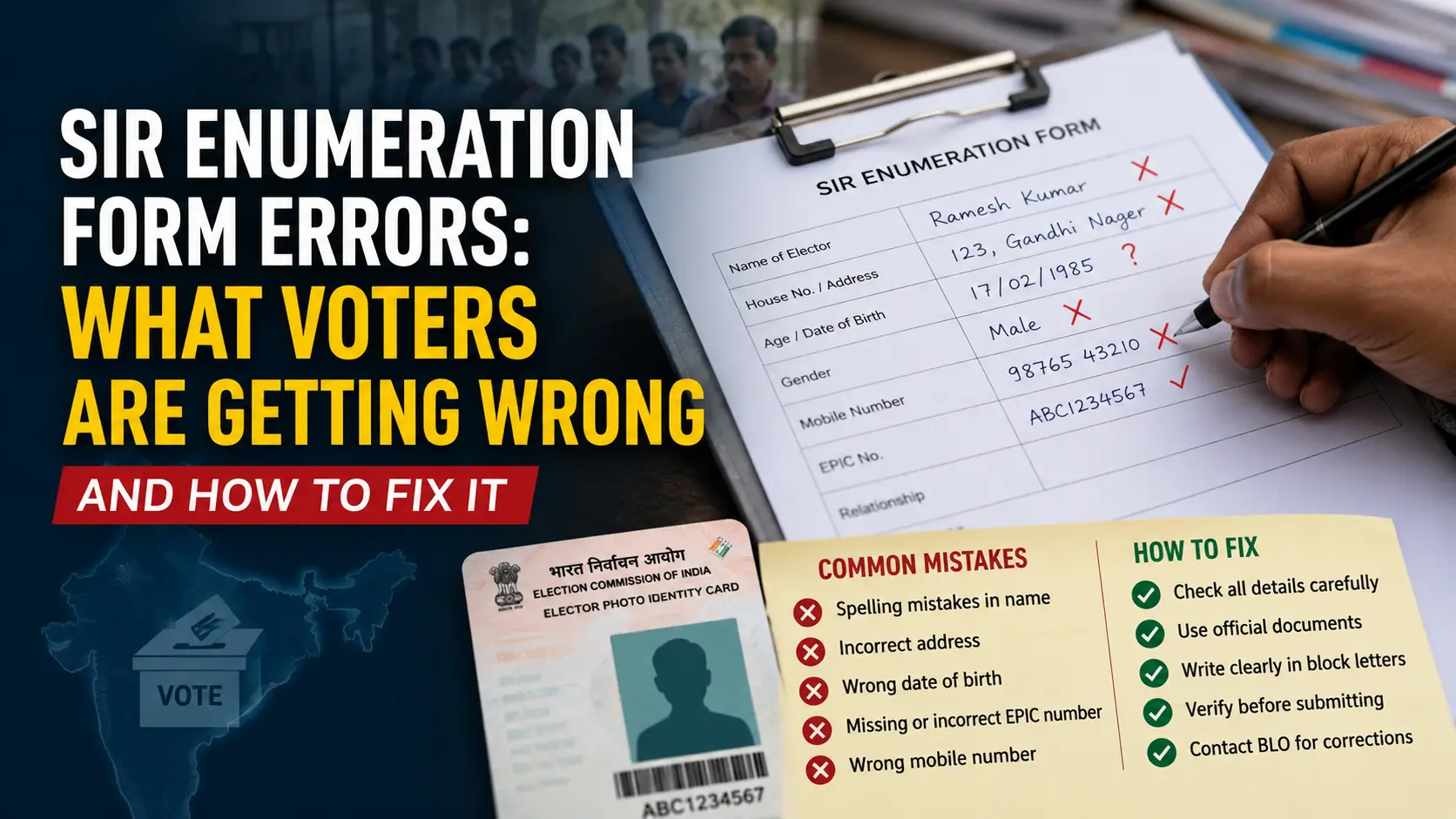
Reports from multiple cities show the same pattern repeating. Big. Voters sit down with the enumeration form, read the instructions — where instructions exist at all — and then make errors. Some errors are simple: wrong column, wrong format for dates, missing information in a mandatory field. Yep. Others are more complicated, stemming from the mismatch between how a name appears on old rolls versus how a person spells it today.
- Spelling mismatches from 2002 rolls: Voters whose names were entered incorrectly in old electoral data are now uncertain whether to replicate the error or correct it — both choices carry risk of flagging.
- Lack of awareness about form requirements: Many people are filling the form without understanding which fields are mandatory, what documents they need to cite, and what happens if they leave something blank.
- No standard instructional video: Civic groups have pointed out that a simple explainer video in Hindi, Urdu, and English — showing how to fill the form step by step — doesn't yet exist in any accessible, widely distributed format.
- Risk of voter deletion: This is the one that should make every Indian pay attention. An incorrectly filled or unverified enumeration form can result in a voter's name being removed from the electoral rolls entirely.
- Political alarm bells ringing: Tamil Nadu Chief Minister M.K. Stalin publicly said the SIR enumeration form is full of confusion and warned that the current process risks large-scale deletion of voter names — a statement that signals this isn't a fringe concern.
- Urban voters equally hit: Reports from Kolkata show city residents — not just rural or semi-urban populations — are experiencing the same confusion, suggesting the problem is with the form's design, not just voter literacy.
The Election Commission of India, as the constitutional authority overseeing this process, hasn't yet issued a detailed public correction or a simplified guidance document in response to these reports, according to information available at the time of writing. And?
What has happened, instead, is that individual voters are turning to YouTube — searching for videos explaining what to do when you've already made a mistake on the SIR form. Read that again. The fact that this is a top search query right now tells you everything about the gap between official communication and ground reality.
Worth paying attention to.
Wow.
The Real Picture Behind the Confusion
Here is what this story is actually about — and it's bigger than a badly designed form.
Every five years, India goes through the motions of updating its electoral rolls. Wild. And every five years, the same structural weaknesses resurface: data from older rolls that was never corrected, forms designed by bureaucrats for bureaucrats, and a communication gap that falls hardest on first-generation voters, elderly citizens, and people who don't read English. The SIR process is meant to be the fix. But when the fix itself becomes the problem, you have to ask a harder question: who designed this form, and did anyone test it with an actual voter before rolling it out?
Three distinct perspectives are emerging right now. The government's position — at least implicitly — is that the process is working and voters need to follow the instructions. True. Political opposition, led most visibly by CM Stalin's warning, says the form's design is the problem, not the voter. And ordinary citizens — the Suresh Kumars filling the form for the third time — just want someone to show them, clearly and simply, what to write in which box. That's big.
There's also a historical comparison worth making. India has run voter verification drives before. What separates successful ones from chaotic ones isn't the quality of the data — it's the quality of the communication. Not anymore. States that ran parallel awareness campaigns, used local language videos, and deployed volunteers at gram panchayat level saw far lower error rates. The infrastructure for that approach exists. It's just not being used consistently this time.
Think about it.
How This Affects You Directly
If your name is on India's electoral rolls — and it should be, if you're a citizen above 18 — the SIR enumeration process directly affects your right to vote. This isn't abstract. This isn't political. This is your vote. Huge.
For a young voter in their twenties who registered recently, the risk is lower — your data is newer and less likely to have the 2002 spelling problem. But for a voter above 40 whose name went into the rolls before digital entry was standardised, the mismatch risk is real. No joke. For senior citizens who rely on a family member to help them with paperwork, one wrong entry by a well-meaning son or daughter could create a discrepancy that takes months to fix — if it gets fixed at all before the next election.
For voters in states with large Urdu or Hindi-speaking populations, the absence of an instructional video in those languages isn't a minor inconvenience. Facts. It is a barrier to participation that shouldn't exist in 2025. The right to vote means nothing if the paperwork to confirm that right is inaccessible.
So what should you do right now? First, check your enumeration form — whether you've filled it or are about to. Match your name exactly as it appears in your existing voter ID card, not your Aadhaar, not your PAN. If there's a spelling error in your voter ID, flag it to your local Booth Level Officer (BLO) and ask for the correction process, rather than writing a different spelling on the new form. Second, if you've already submitted a form with an error, don't panic — the correction window typically exists, and your BLO is the right person to approach. Third, if you haven't filled the form yet, search for the official Election Commission of India portal or contact your local electoral registration officer directly. Don't rely on third-party videos alone.
And that's just the beginning.
What to Watch For Next
The pressure on the Election Commission is building from multiple directions — political opposition, civic society, and voters themselves. Big shift. The call for a multilingual instructional video is gaining ground, and it's the kind of ask that is hard to refuse publicly without looking indifferent to voter welfare.
Watch for two specific things in the coming days. First, whether the Election Commission releases any clarification or simplified guidance on the form — particularly addressing the 2002 spelling mismatch issue, which appears to be the most technically complex problem voters are facing. And now? Second, whether states with large affected voter populations — Bihar, Uttar Pradesh, West Bengal, Tamil Nadu — push back formally through their chief electoral officers or through the political channel that CM Stalin has already opened.
The worst-case scenario is that the enumeration window closes with thousands of forms incorrectly filled, names flagged for deletion, and no efficient correction mechanism in place. That would mean voters losing their place on the rolls not because they failed to participate — but because the system failed to explain itself clearly enough. Worth it.
The best-case scenario is simpler: the Election Commission moves quickly, releases a plain-language guide in Hindi, Urdu, and English, directs BLOs to run correction camps at the ward and panchayat level, and extends the window if needed for areas with documented high error rates.
The most likely scenario? Somewhere in between — partial fixes, some states managing better than others, and a final roll that is cleaner than what it replaced but messier than what it could have been. The result?
Nobody talks about this.
Frequently Asked Questions About the SIR Enumeration Form
What is the SIR enumeration form and why do I need to fill it?
Simply put, the SIR — Special Intensive Revision — is the Election Commission of India's drive to verify and update every voter's details on the electoral rolls. The enumeration form is the document you fill to confirm your name, address, and basic details. If you don't fill it correctly, your name could be removed from the voter list before the next election.
What should I do if I made a mistake while filling the SIR form?
Here's the thing: don't ignore it. Contact your local Booth Level Officer, or BLO, as soon as possible. BLOs are the ground-level officials managing the enumeration process in your ward or village. Explain the error, ask for a correction form, and carry your voter ID card when you go. Acting early gives you the best chance of fixing it before the window closes, ensuring your right to vote isn't jeopardized by a simple oversight.
Why does my name appear differently in old voter rolls — and what do I write on the new form?
Here's the short version: match what your current voter ID card says, not your Aadhaar or PAN. Old electoral rolls — especially those from around 2002 — contain spelling errors that were never corrected. Writing a different spelling on your new form creates a mismatch. Flag the error to your BLO and ask for an official name-correction simultaneously, rather than guessing which version to use.
Is there an instructional video available to help fill the SIR form in Hindi or Urdu?
Good question. As of this report, there isn't a single, widely distributed official video in Hindi, Urdu, and English covering form-filling step by step. Unofficial videos exist on YouTube, but for accurate guidance, the Election Commission's official website or your state's Chief Electoral Officer portal is the safest reference point, as they're the authorities on this process. This lack of official, accessible guidance is a significant point of concern for voters and civic groups.
Can my name be deleted from voter rolls if my SIR form has an error?
In plain words, yes — that risk exists, and it's the reason this issue is being taken seriously at the political level. Tamil Nadu Chief Minister M.K. Stalin has specifically warned that the current process could lead to large-scale voter deletions. If your form has errors or goes unverified, your name may be flagged, putting your voting rights at risk. Contact your BLO immediately and confirm your status rather than waiting and hoping for the best.