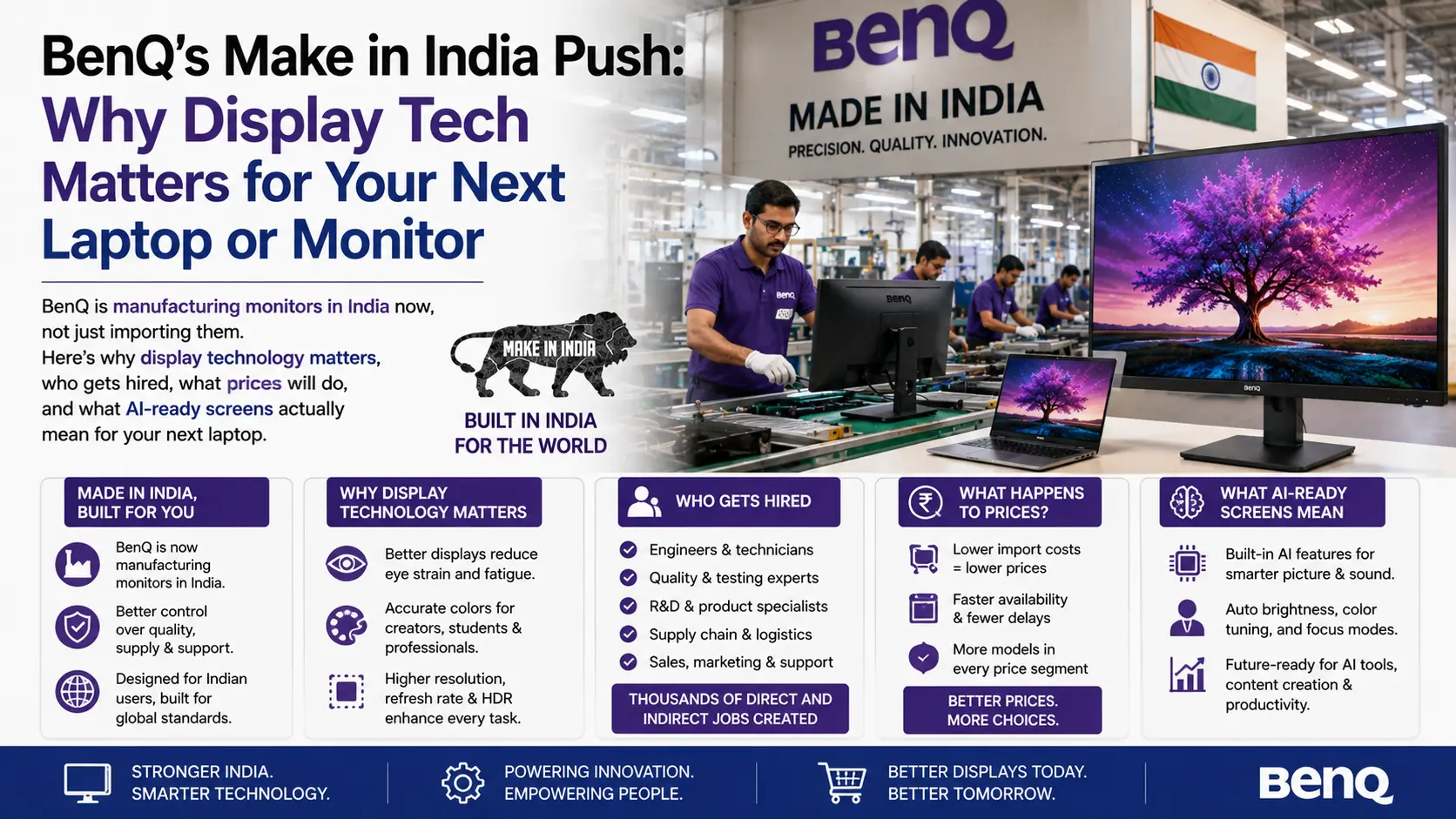
BenQ's Make in India Push: Why Display Tech Matters for Your Next Laptop or Monitor
The display company BenQ just made a big move—one that signals a massive shift for tech manufacturing in the region—by getting serious about building screens right here in India instead of just importing them. Big shift. This isn't just business talk. Not small. It's a signal that display technology, which most people ignore, is becoming something India actually cares about making at home.
Think about the last time you bought a monitor or looked at a laptop screen—you probably didn't give a second thought to where that piece of tech actually came from, did you? Right? Not anymore. And BenQ's new 'Make in India' strategy is changing that. And that's big. The company's investing in local manufacturing, training Indian workers, and building supply chains across the country, meaning some of your screens will now be made in Indian factories instead of China or Taiwan.
Here's the thing—this matters to you whether you're a student buying your first laptop, a parent shopping for a home office setup, or just someone who wants better quality products made closer to home. Think about it. The impact is real. And more. And why does this matter right now?
- BenQ's now making displays right in India — moving away from importing everything by working with local partners.
- The new game is all about perfect color and AI-ready screens — which means smarter, more precise displays for everyone from designers to students.
- Since hybrid work took over, people's needs have changed — those long hours at home mean screen quality is no longer a luxury.
- We're talking hundreds of potential new jobs — in manufacturing, QC, supply chain, and tech support across several Indian states.
- With AI PCs on the horizon, displays have to evolve — BenQ is already on it, designing screens for these next-gen machines.
- Bottom line? Prices for Indian buyers could finally get more affordable — since making things locally cuts down on import costs.
Why BenQ Decided to Make Displays in India
Five years ago, BenQ wouldn't have even considered making monitors here—frankly, India just wasn't seen as a serious manufacturing hub for high-tech displays. Period. But something shifted. Wild. Millions of people stopped going to offices and started working from home, and suddenly, a good monitor wasn't a luxury—it was a necessity.
At the same time, India started pushing the 'Make in India' initiative hard—the government basically told companies to build stuff locally instead of just dumping imported products on the market. Big deal. And? So BenQ noticed two things happening at once: Indian demand was skyrocketing, and the government was rolling out the red carpet with incentives and favorable policies. The result? A perfect storm.
And the company realized something else, something nobody talks about—color accuracy suddenly matters way more than it ever did before. Why? Is this really a surprise? Key point. Because India has millions of designers, video editors, photographers, and content creators who need screens that show true colors. That's real. These pros were buying expensive imported monitors, so BenQ saw a massive opportunity: manufacture locally, serve this booming market, and become the go-to choice for Indian creators.
Really.
But not for the reasons you'd expect.
The Real Story: What BenQ Is Actually Building
So let's get real about what BenQ's 'Make in India' actually means on the ground.
- Local manufacturing plants: Look, BenQ has teamed up with Indian manufacturers to set up assembly and testing units. And these aren't just basic assembly lines—they've got quality control labs where every single screen is tested for color accuracy, brightness, and performance.
- Developing a supply chain: The company is actively working with Indian component suppliers. This means key parts like glass panels and backlights now come from Indian companies, not shipped from overseas. Local supply chains mean faster delivery and way lower shipping costs.
- Creating jobs: From factory workers to engineers and customer service teams, BenQ's expansion is hiring across the board. This is a big deal because tech manufacturing jobs usually pay a lot better than retail or service gigs.
- AI-ready screens: Now here's the forward-thinking part. BenQ is designing displays specifically for AI PCs—laptops with built-in artificial intelligence chips. These screens have special features like hyper-accurate color for AI image generation, faster response times, and better energy efficiency.
- Pro-level monitors for creators: Professional monitors with true-to-life colors are notoriously expensive. But making them locally could slash prices by 15-20 percent. This is huge for India's massive community of video editors, graphic designers, and photographers.
- Hybrid work gear: We're also talking about monitors designed for people splitting time between home and the office. These screens have built-in webcams, better speakers, and smart cable management to make switching spaces a breeze.
But here's what's interesting—BenQ isn't just trying to win a race to the bottom on price. Not at all. Think. The company is betting big that Indian buyers actually care about quality now. True. They're willing to pay a bit more for a screen that lasts longer, shows accurate colors, and is made right here at home.
The kind of thing most people miss.
Why Display Technology Actually Matters (Even If You've Never Thought About It)
Most people think a screen is just a screen, right? They all show videos and web pages. But that's like saying a car is a car—it's technically true, but it misses the entire point. Let that sit. It's a massive oversimplification. Facts.
So here's what's really changing, and it starts with color accuracy—if you've ever edited a photo on a cheap laptop screen and had it look completely different on someone else's phone, you know exactly what this means. That stings. Right? Professional monitors show true colors, so what you see is what everyone else will see. Huge. And for India's booming creator economy, this isn't just nice to have; it's absolutely essential.
Second, you've got AI integration, and your next laptop will almost certainly have an AI chip built right in. These chips help with everything from image generation and video editing to translation and coding. Unreal. But they create a lot of heat and need special displays that can handle blazing-fast processing speeds. Yep. So BenQ's new monitors are designed specifically for this, with faster refresh rates and special color modes for AI apps.
Third, let's talk about eye comfort because if you work from home, you're staring at a screen for 8-10 hours straight. And your eyes get tired. So what does this actually mean? No joke. Modern displays now have features like reduced blue light, flicker-free tech, and dynamic brightness adjustment. Worth it. Local manufacturers can build these features in without the insane markup that comes from importing.
Look, this is precisely why the shift from being import-only to local manufacturing is such a massive deal—it's not just about some vague notion of nationalism or supporting Indian industry. Read that again. It's about building products that Indian workers, students, and creators actually need. That's the truth. And at prices they can finally afford.
And that's just the beginning.
What This Means for You — Different Scenarios
Let's talk real impact—how does this actually change your life? But who really benefits here?
If you're a student, you're probably chained to a laptop for assignments, online classes, and research, and a better monitor costs money you don't have. Not anymore. But if BenQ can manufacture locally and knock costs down by 15-20 percent, a good 24-inch display could fall from ₹15,000 to around ₹12,000-13,000. Big. That's suddenly way more affordable for college students.
If you're a work-from-home professional, you spend 8+ hours a day staring at a screen, which means eye strain, back pain, and headaches are very real issues. That stings. Local manufacturing means better monitors become accessible, and companies might even start buying quality displays for their remote workers instead of the cheapest junk they can find. The result? Your health and productivity both improve.
If you're a content creator, you know graphic designers, video editors, and photographers in India have been at a serious disadvantage for years. Why? Professional color-accurate monitors cost a fortune—₹30,000-50,000—because they're all imported. Think. Local manufacturing could potentially drag this down to the ₹20,000-35,000 range. That's a total game-changer for freelancers and small creative agencies.
If you're looking for a job, BenQ's expansion means hiring across a ton of different roles, from quality control specialists and assembly line workers to engineers and customer service reps. That's real. And all these jobs pay better than typical retail work. Facts. In cities like Bangalore, Hyderabad, and Chennai where tech manufacturing is blowing up, this creates real opportunities.
So what's the bigger picture? India stops being just a buyer of high-end tech and starts becoming a maker. Wild. Your next monitor might actually have a 'Made in India' stamp on it, and your laptop's screen might have been tested in an Indian factory. And that's not just a label—it's a fundamental shift in how India participates in the global tech economy.
Period.
What Happens Next — Dates and Milestones to Watch
BenQ's 'Make in India' strategy isn't something that's happening overnight. Not at all. Think of it as a multi-year rollout. But here's the real question — what happens next?
Phase 1 (Now — 2026): Assembly and testing facilities are already up and running. BenQ is ramping up local production of its standard monitors and basic professional displays right now. Big shift. Expect to see 'Made in India' BenQ monitors hitting retail stores by mid-2025 onwards. And now?
Phase 2 (2026-2027): This is when full component manufacturing kicks in, moving way beyond simple assembly. And it means Indian factories will actually make more of the parts themselves instead of just putting together imported components. Key point. This requires more investment, for sure, but it also creates a lot more jobs.
Phase 3 (2027+): This phase is all about integration with the AI PC ecosystem. As chipmakers like Intel and AMD launch their AI PCs in India, BenQ will have displays specifically optimized for these powerful new computers. That's the truth. This is when you'll see the real innovation—screens with AI features baked right in.
The one critical date to watch for is when BenQ announces its first major order from a big Indian corporation for these local displays. Huge. Right now, most corporate purchases are still for imported goods. Let that sit. Once Indian IT companies, banks, and government offices start ordering locally-made displays in bulk, you'll know the strategy is a massive success.
So here's what you can expect immediately: prices will start to fall. Not dramatically, but within 6-12 months, good quality monitors should cost 10-15 percent less than they do today. Worth it. Second, product availability will improve—no more waiting weeks for imports to clear customs. Third, warranty and service will get better because the company has local teams on the ground to handle support.
Frequently Asked Questions About BenQ's Make in India Strategy
What does 'Make in India' mean for BenQ specifically?
Simply put, it means BenQ is now manufacturing monitors inside India, not just importing them. The company's partnering with local firms, setting up assembly units, and building Indian supply chains. This translates to better prices and local job creation.
How is local manufacturing different from just importing and selling?
Good question. When you import, you're just buying a finished product, shipping it, and adding costs. Local manufacturing is a much deeper commitment. It means the product is assembled, tested, and packaged here, using a local workforce and, increasingly, local parts. It's cheaper, faster, supports the Indian economy directly, and shows the company is investing in the country's long-term growth, not just its market.
Will monitors made in India be lower quality than imported ones?
The thing is, no. BenQ is using the exact same quality control standards in India as it does in Taiwan. A monitor that costs ₹17,000 locally versus ₹20,000 imported has identical quality—you're just cutting out middlemen and shipping costs.
Why do displays need to be 'AI-ready' anyway?
Look—the next wave of laptops will have powerful AI chips inside them, handling tasks like image generation, coding help, and instant translation. These AI processes are demanding; they need displays with faster response times and specialized color modes to keep up without lag or distortion. BenQ's AI-ready monitors ensure your setup won't be obsolete in a year.
When can I actually buy a locally-made BenQ monitor in India?
Here's the short version: Some models are already in production, with retail availability ramping up through 2025. You should start seeing 'Made in India' BenQ displays in major electronics stores and online by mid-2025. My advice? Start checking product listings around April or May of 2025 for that label.
The Bigger Picture: Why This Matters for India's Tech Future
BenQ's move isn't just one company making a simple business decision—it's a massive signal. It says: India is finally ready to manufacture complex technology, not just assemble it. And it shows Indian workers can build quality displays. Indian supply chains can support this.
Wow.
For decades, India bought most of its tech from overseas. Not anymore. Now, more and more companies are looking at local manufacturing, which creates a virtuous cycle. Think about it. More manufacturing means more jobs, more local expertise, and more innovation happening right inside India. Universities start training more engineers in display tech. Component suppliers get better. Over time, India becomes a real player in tech manufacturing, not just a passive market.
This also matters politically and economically, and this is the part nobody talks about. Countries that manufacture their own technology have more control over their future. They create jobs. They develop expertise. And they reduce their dependence on imports. BenQ's decision to go 'Make in India' is part of a larger shift where India is demanding—and companies are delivering—a real manufacturing presence, not just sales offices.
So for you, as a consumer or a job-seeker, it means more choice, better prices, and better local support. That's real. For India, as a country, it means moving up the value chain. Big deal. From being just a buyer to becoming a maker. Period.