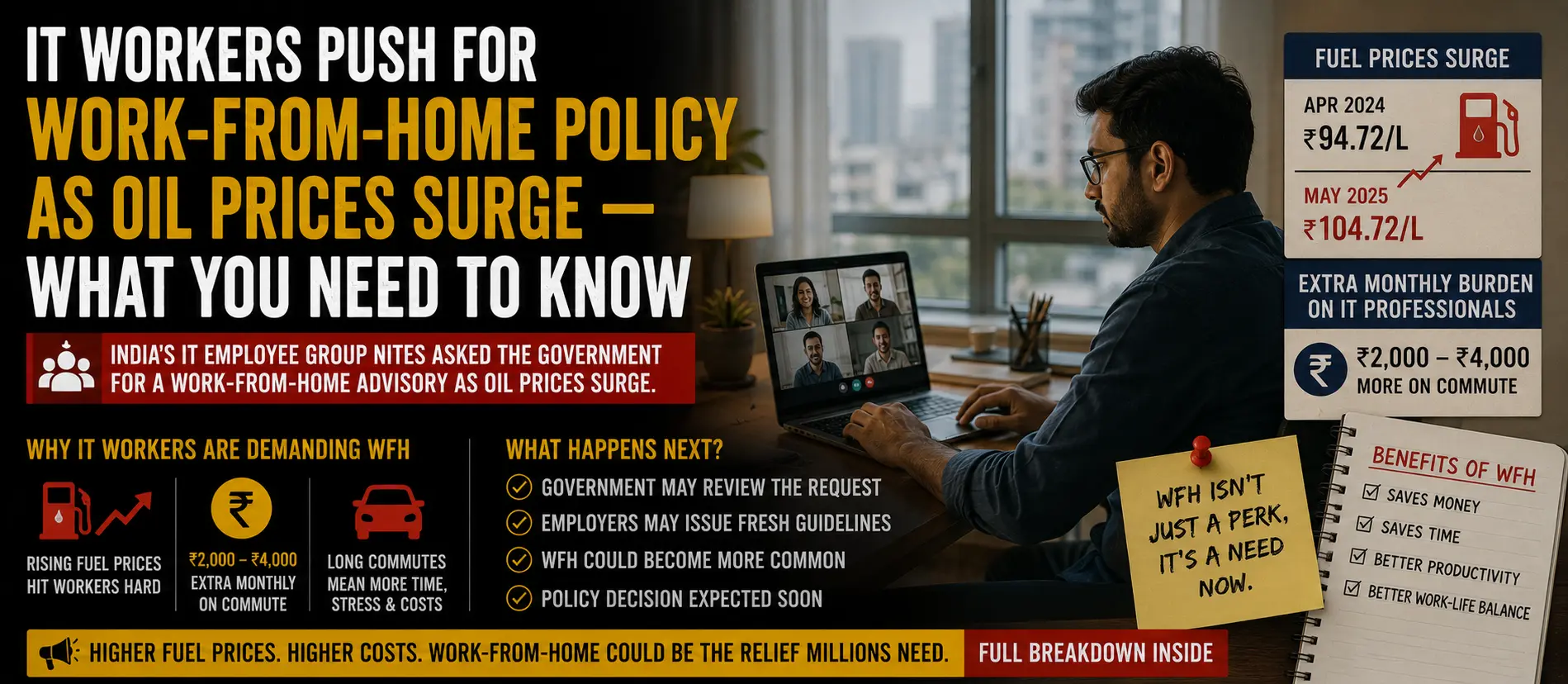
Something unusual just happened in India's IT offices. An industry group called NITES — that stands for Nascent Information Technology Employees Senate — walked into a government ministry and made a bold request. They want work-from-home to become the default way IT workers do their jobs. Not optional. Mandatory. And they have a reason that affects your daily life more than you might think.
Why now? Oil prices are climbing. When oil gets expensive, petrol and diesel cost more. That means the bus ride to the office costs more. The auto-rickshaw fare goes up. The fuel bill for your car burns a bigger hole in your pocket. For someone earning ₹50,000 a month, that extra ₹2,000 to ₹3,000 spent on commuting each month is real money. Money that could have gone toward groceries, school fees, or savings. So NITES asked India's Ministry of Labour and Employment to step in and push companies toward letting workers stay home.
But here is what makes this interesting — this is not just about saving money on travel. This is about the future of how India works.
- NITES official request: India's IT employee group asked the Ministry of Labour and Employment to make work-from-home mandatory for IT workers where possible
- Reason behind the push: Rising oil and fuel prices are making office commutes expensive for salaried workers across Indian cities
- Who gets affected: Roughly 50 lakh IT professionals working in Bangalore, Hyderabad, Delhi, Mumbai, and Pune face higher travel costs monthly
- Real money impact: Average IT worker spends ₹2,000 to ₹4,000 extra per month on fuel, food, and transport as prices rise
- What NITES wants: An official government advisory making remote work the standard, not the exception for tech jobs
- Government response pending: Ministry officials have not yet made a formal announcement or issued the requested advisory
Why Fuel Prices Pushed IT Workers to Speak Up Now
India's oil prices hit a three-year high this month. Petrol costs nearly ₹100 per liter in many cities. Diesel is right behind it. When you drive to work five days a week, those numbers add up fast.
Think about Rahul, a software developer in Bangalore. He takes an auto-rickshaw from his home in Whitefield to his office in Koramangala. That is roughly 20 kilometers each way. Five days a week. Four weeks a month. When auto fares jumped by ₹1.50 per kilometer, his monthly commute cost jumped from ₹3,200 to ₹4,100. That is one extra meal a day that he has to skip or cut back on.
Now multiply Rahul by 50 lakh IT workers across India's tech hubs. You are looking at thousands of crores of rupees flowing out of workers' pockets every single month. NITES connected these dots and realized the government needed to hear this. So they sent a formal request to the Ministry of Labour and Employment asking for an official advisory.
An advisory sounds like a boring government document, right? It is not. When the central government issues an advisory, companies take it seriously. Banks follow it. IT firms follow it. State governments follow it. It carries weight.
What Exactly Is NITES Asking For?
NITES did not ask for a ban on offices. They asked for something simpler but smarter — a government advisory that makes work-from-home the standard option for IT jobs, with office time only when absolutely necessary.
Here is what that would look like in practice:
- Default position: IT workers work from home unless their job specifically requires them to be in the office (like IT support staff who manage servers physically)
- Office days: When company meetings or collaborative work happens, maybe one or two days a week in the office, not five
- Worker choice: Employees get to decide if they want to come in on those days or stay home if their work allows it
- Company responsibility: Firms provide the tools for remote work — laptops, internet allowance, software access — instead of office space costs
- Travel reimbursement: For days workers do come in, companies reimburse commute costs or provide office transport
- Legal protection: An official advisory protects workers from being punished or passed over for promotions just because they choose to work from home
This is not new. During COVID-19, India's entire IT industry worked from home for nearly two years. Companies discovered that productivity did not drop. In fact, many projects moved faster. Employees were happier. Retention improved. But after offices reopened, most companies quietly pushed workers back to five-day office weeks. Why? Because office culture is what bosses know, and many companies still measure productivity by who is sitting at the desk.
Why This Matters for Your Paycheck and Your Future
If NITES wins this fight, you might see something shift in how India's economy works.
Right now, an IT worker in Bangalore spends roughly 10 to 12 percent of their salary on commuting, food, and office-related expenses. For someone earning ₹60,000 per month, that is ₹6,000 to ₹7,200 gone every month just to show up at work. Add fuel price hikes on top, and that number jumps to ₹8,000 or more.
But there is something bigger here. Offices need space. Space costs rent. Rent in tech hubs like Bangalore, Hyderabad, and Mumbai is insanely expensive. A company with 5,000 employees needs a massive building. That building costs ₹50 crore to ₹100 crore to build or rent. If even half those workers can work from home two or three days a week, the company saves ₹10 crore to ₹20 crore per year on real estate alone.
Where does that money go? Right now, it stays in the company's pocket as profit. But if the government puts pressure on companies through an advisory, it could flow to workers instead — higher salaries, better benefits, or lower work pressure.
For workers outside tech hubs, this is even bigger news. Right now, a talented programmer in a tier-2 city like Nagpur or Lucknow cannot get a Bangalore IT job because she cannot afford to move there. With remote work becoming normal, she could earn a Bangalore salary while living in her hometown, where living costs are one-third lower. That money could go to her family's education, health, or starting a business.
What Other Countries Are Already Doing
India is not leading on this one. Other countries already figured it out.
In the United States, after COVID-19, tech companies like Google, Meta, and Microsoft let employees choose where they work. Most offer three days in the office, two days remote. Some offer fully remote positions. These companies found that they could hire talent from anywhere in the world, not just from expensive cities like San Francisco.
The European Union passed a directive saying workers have the “right to disconnect.” If you work from home, your boss cannot call you at 9 p.m. It is a legal protection. No Indian law has anything like this yet.
Even Singapore and Japan — countries with strong office cultures — started pushing remote work during the pandemic and kept it. Japan's government now encourages companies to let workers work from anywhere in the country to reduce pressure on Tokyo's overcrowded trains.
India's IT sector is world-class. But on worker-friendly policies like remote work? We are actually behind, even compared to countries we think of as more traditional.
What Could Go Wrong With This Plan?
Nothing is simple in government.
Some companies will resist. Managers who built their careers on supervising people at desks will worry that remote workers are not “really working.” Some old-school business leaders still believe you can only manage people you can see. Training junior staff is harder when everyone is remote — that is real. Some IT projects do need people in the same room brainstorming together.
There is also a cost issue. If a company already has expensive office space leased for five years, telling them to shift to hybrid work overnight creates a financial mess. They might push back hard against any government advisory that costs them money.
And here is a quiet concern nobody talks about — not every IT worker wants to work from home. Some people live in tiny shared apartments where there is no quiet space to work. Some have poor internet at home. Some feel isolated working alone. An advisory that sounds good on paper could actually make things worse for them if companies use it as an excuse to cut office perks or reduce staff benefits.
What Happens Next?
Right now, the Ministry of Labour and Employment has not officially responded to NITES. The group submitted their request, and it is sitting on someone's desk in New Delhi.
Here are the real dates you should watch:
- Within the next 30 days: The ministry will likely conduct internal meetings to decide if an advisory is even on the table. If ministers think it is a good idea, they will ask for input from major IT companies
- 30 to 90 days: If the ministry moves forward, they will consult with industry giants like TCS, Infosys, Wipro, and HCL to understand the impact. This is when lobbying happens — both for and against
- 3 to 6 months: A draft advisory could be released for public comment. This is when workers, companies, and unions will have a chance to argue for their positions
- 6 to 12 months: The final advisory gets issued. It will probably not be as strong as NITES hoped, but it will be something official that companies have to acknowledge
The most likely outcome? A middle-ground advisory that suggests companies “consider” remote work as an option, with flexibility for different job roles. It probably will not be mandatory, but it will give workers legal backing to push their companies toward hybrid arrangements.
Frequently Asked Questions About Work-From-Home in India's IT Sector
What exactly does NITES want the government to do?
NITES asked the Ministry of Labour and Employment to issue an official advisory making work-from-home the standard arrangement for IT professionals where the job allows it. This advisory would not be a law, but it would carry enough weight that companies would have to take it seriously and justify why they demand office-only work. It protects workers legally if they choose remote work.
How would a government advisory change things if companies do not have to follow it?
Good question. An advisory is not binding like a law, but it functions as official government guidance. When the government says something officially, companies worry about public reputation and regulatory scrutiny. If a company ignores a government advisory on worker welfare, they risk bad press, difficulty hiring talent, and potential future government action. Many companies will comply even without legal force.
Which IT workers would benefit most from a work-from-home policy?
Software developers, data analysts, quality assurance testers, and backend engineers benefit most because their work does not require physical presence. Workers in Tier 2 cities like Nagpur, Indore, and Chandigarh gain the most because they can now access Bangalore-level salaries without moving. Entry-level employees and women workers also benefit — commute safety and cost become non-issues.
Could this policy actually hurt some IT workers?
Yes. Workers who live in shared apartments with poor internet might struggle. Junior staff who need hands-on mentoring could miss learning opportunities. Some people work better with office structure and community. Additionally, if companies cut office perks or snack budgets because fewer people are in the office, benefits could shrink. The policy needs strong worker protections built in.
When will the government actually make a decision on this advisory?
No official timeline exists yet. Based on how government moves, expect a response in 3 to 6 months. If the ministry decides to proceed, a draft advisory could arrive in 6 to 9 months, and a final version in 9 to 12 months. This assumes the idea does not get stuck in bureaucratic delays, which is a real possibility given how slowly government processes work.
The Real Question Nobody Is Asking
Here is what bothers me about this whole situation.
NITES asked the government to step in and fix something that companies should have figured out themselves. During COVID-19, IT companies proved that remote work works. Productivity stayed high. Projects shipped on time. Employees were happier and less stressed. The technology works. The process works. So why did companies push everyone back to offices the moment lockdowns ended?
Because office presence is easier to measure and manage than actual productivity. Because executives built their careers on managing visible teams. Because real estate investments needed to be justified. But none of these reasons actually serve workers or customers better.
If NITES wins and the government issues an advisory, it will not be because remote work is new or revolutionary. It will be because workers had to go to the government to ask for something that should have been obvious in 2021.
That says something about who has power in India's labor market, and it is not the workers.