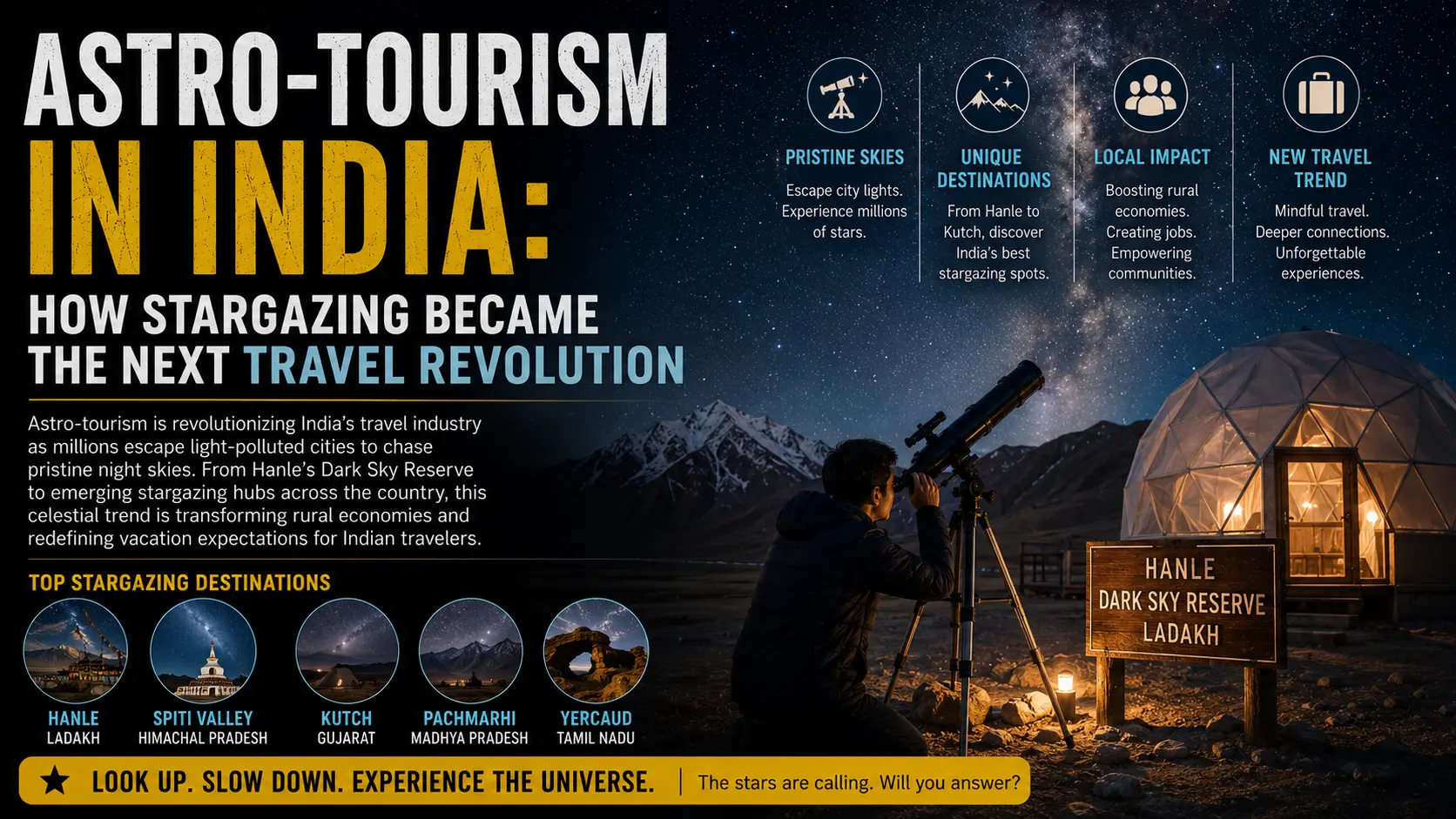
Astro-tourism is transforming India's travel landscape as millions of city-dwellers escape light pollution to chase the Milky Way. What was once a niche interest among amateur astronomers has exploded into a mainstream phenomenon, with dark-sky destinations across the country now rivaling traditional hill stations and beach resorts in booking demand. From the crisp mountain skies of Ladakh to the newly designated dark-sky reserves of rural villages, Indians are rediscovering an ancient relationship with the cosmos—and the tourism industry is racing to keep pace with this celestial boom.
Why Astro-Tourism Matters: India's Escape from the Darkness Within Light
Urban India faces a silent crisis that few talk about openly. Rapid industrialization, unplanned city expansion, and the proliferation of artificial lighting have robbed most Indian metros of their night skies. Residents of Delhi, Mumbai, Bangalore, and Kolkata now live under perpetually orange-tinted heavens where fewer than a dozen stars remain visible on clear nights. This phenomenon, known as light pollution, has stripped younger generations of an experience their grandparents took for granted: witnessing the Milky Way in all its glory.
But this loss has sparked something unexpected. Travel companies report a sharp surge in inquiries for astro-tourism packages, with bookings increasing by 60–70% year-over-year in premium tier cities. The appeal runs deeper than Instagram aesthetics. Travelers describe the experience as transformative—a reconnection with nature's grandeur and a reprieve from the relentless connectivity of modern life. For many, a night under a truly dark sky becomes a pilgrimage, albeit one without temples or rituals.
India's Dark-Sky Revolution: From Remote Villages to Global Recognition
The astro-tourism boom didn't emerge by accident. Several catalysts have aligned to turn India into a stargazing destination of international stature. The designation of Hanle in Ladakh as India's first Dark Sky Reserve represents a watershed moment—recognition from the International Dark-Sky Association that authenticates India's potential on the global stage. Meanwhile, private enterprises and state tourism boards have invested heavily in infrastructure at strategic locations, transforming basic viewing sites into destination-grade experiences.
What started with enthusiasts traveling to high-altitude Himalayan plateaus has now expanded across diverse geographies. Travelers no longer need to endure weeks of trekking or extreme altitude to experience pristine night skies. Dedicated astro-tourism clusters have emerged in Maharashtra, Gujarat, Rajasthan, and Tamil Nadu, each offering unique combinations of dark skies, accommodations, and cultural experiences.
- Hanle, Ladakh: India's first designated Dark Sky Reserve, attracting international astronomers and serious stargazers. Altitude of 14,764 feet provides exceptional atmospheric clarity.
- Coorg, Karnataka: Emerging as a budget-friendly astro-tourism hub with multiple homestays offering telescope facilities and guided night-sky walks for families.
- Khimsar, Rajasthan: Desert landscape offering minimal light pollution combined with luxury camp accommodations and professional astronomer guides.
- Ponmudi, Kerala: Hill station leveraging monsoon-cleared skies and exotic biodiversity for immersive astro-nature experiences.
- Lonavala & Khandala, Maharashtra: Close proximity to Mumbai and Pune making these accessible weekend destinations for astro-tourism enthusiasts.
- Nandi Hills, Karnataka: Recently promoted as a dark-sky destination with improved infrastructure for group stargazing events and astrophotography workshops.
The business model behind these destinations reveals sophisticated understanding of modern Indian travelers. Rather than offering bare-bones stargazing, operators bundle telescope experiences with heritage walks, farm-to-table dining, yoga sessions, and cultural performances. This hybrid approach appeals to families, couples, and corporate groups—not just hard-core astronomy buffs.
The Economic and Social Ripple Effects: How Astro-Tourism Transforms Communities
Rural villages hosting astro-tourism infrastructure have experienced tangible economic transformation. A study by travel analytics firms indicates that villages designated as dark-sky destinations see average annual tourism revenue increases of 45–50% within three years of development. Small-scale farmers earn supplementary income through farm-stays, local guides transition from seasonal agricultural work to year-round employment, and entire communities gain renewed economic vitality without the ecological destruction associated with mining or industrial development.
The social impact extends beyond economics. Astro-tourism has inadvertently sparked broader conversations about light pollution, environmental stewardship, and sustainable development in Indian cities. School groups visiting dark-sky destinations return to their communities as informal ambassadors for conservation. Meanwhile, the establishment of dark-sky reserves has created enforceable frameworks protecting nocturnal ecosystems, benefiting not just humans but also nocturnal wildlife that depends on natural darkness for survival. Some industry experts estimate that astro-tourism could directly support 150,000–200,000 jobs across India by 2028 if current growth trajectories continue.
What's Next: Astro-Tourism Goes Mainstream in 2026 and Beyond
Industry forecasts position astro-tourism as one of India's defining travel trends for 2026. Major hotel chains including IHCL and Oberoi are planning astro-resort launches in strategically selected locations. Technology companies are developing astro-tourism apps featuring real-time sky maps, celestial event alerts, and virtual astronomer consultations. State governments—particularly Rajasthan, Ladakh, and Karnataka—have added astro-tourism to their five-year tourism development strategies with dedicated funding allocations.
For Indian travelers, this means unprecedented access to quality stargazing experiences at various price points. Budget options starting at ₹3,500 per night cater to college students and young professionals, while luxury astro-resorts command ₹25,000–50,000 for premium telescope experiences and personalized astronomer sessions. The democratization of astro-tourism suggests that within the next 2–3 years, visiting a dark-sky destination will transition from exotic curiosity to normalized weekend getaway for middle-class Indian families.
Frequently Asked Questions
What is astro-tourism and why is it becoming popular in India?
Astro-tourism combines stargazing and travel to destinations with minimal light pollution. It's surging in India because rapid urbanization has eliminated night-sky visibility in major cities, creating intense demand among travelers seeking authentic celestial experiences and escape from metropolitan fatigue.
Which are the best dark-sky destinations to visit in India for beginners?
Coorg in Karnataka, Khimsar in Rajasthan, and Lonavala in Maharashtra offer excellent beginner-friendly astro-tourism experiences with reasonable accessibility, good infrastructure, and professional guides. These don't require extreme altitude acclimatization like Ladakh.
How much does an astro-tourism trip cost in India?
Budget astro-tourism experiences range from ₹3,500–8,000 per night, mid-range options cost ₹10,000–18,000, and luxury astro-resorts charge ₹25,000–60,000 nightly. Prices vary based on location, season, and included amenities like telescope access and expert guides.
What is India's first Dark Sky Reserve and where is it located?
Hanle in Ladakh was designated as India's first Dark Sky Reserve by the International Dark-Sky Association. Located at 14,764 feet, it offers exceptional atmospheric clarity and attracts international astronomers and serious stargazing enthusiasts.
Do I need special equipment or knowledge to enjoy astro-tourism?
No prior knowledge is necessary. Most astro-tourism destinations provide telescopes, guides, and educational sessions. Operators cater to all experience levels, from families curious about constellations to seasoned astrophotographers seeking rare celestial phenomena.