How India's Big Health Push Is Saving Native Communities from Disease
There's a health crisis happening right now in Native American and Alaska Native communities across the United States — and here is what India should be paying attention to regarding how it's being fixed. Big shift. It's a massive problem that won't solve itself. Period.
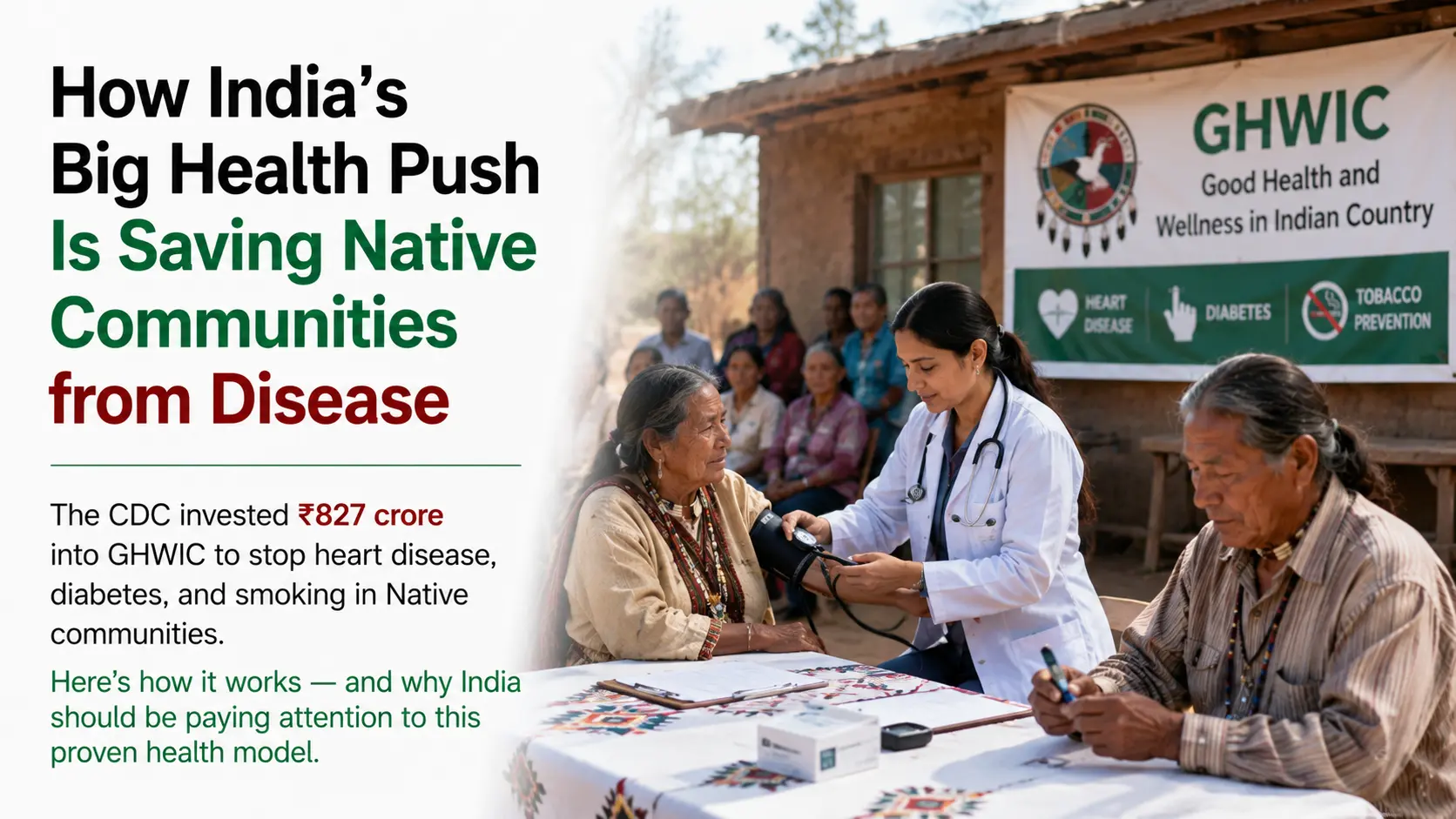
The Centers for Disease Control and Prevention (CDC) just did something highly unusual—they put a staggering ₹827 crore into a five-year plan to crush heart disease, diabetes, and smoking in Native communities. Wow. This isn't small money, and it's definitely not some pilot project. No joke. This is America's biggest single health push for these communities in decades, and the program's name is Good Health and Wellness in Indian Country, or GHWIC (pronounced "quick").
So here's why you should care, even if you're in Mumbai or Bangalore: Native Americans face health problems that look shockingly familiar to India's own struggles. Think about it. We're talking high diabetes rates, heart disease killing young people, and smoking taking far too many lives. That's real. The solutions the CDC is trying? They could work here too. And they're absolutely worth understanding.
- ₹827 crore from the CDC — this is America's biggest health investment for Native American and Alaska Native communities in a long time.
- A five-year mission (GHWIC) — it's laser-focused on crushing diabetes, heart disease, stroke, and tobacco use.
- Reaching over 1,200 communities — we're talking federally recognized tribes, Alaska Native villages, and even urban Native groups.
- A dual strategy — first, stop disease before it ever starts, and second, help those already sick manage their health better.
- Early wins are in — pilot programs already saw tobacco use plummet and healthier eating go up.
- The India link — India's rural and tribal areas face the same battles, which means these tactics could be a game-changer here.
And that's just the beginning.
Why Native Communities Need This Help Right Now
Native Americans and Alaska Natives face a health emergency that most Americans simply don't talk about. Let that sit. The death rates from heart disease? They're nearly 50% higher than for white Americans. And more. Diabetes is three times more common, and smoking rates are way above the national average. That stings.
Think about what this means in real terms—a 45-year-old Navajo man has less chance of seeing his grandkids than a 45-year-old from New York City. Unreal. A woman in Alaska has a higher chance of a heart attack in her 50s than making it to her 70s. Right? These aren't just statistics; these are families losing breadwinners and kids growing up without parents.
Think.
And these diseases killing communities don't happen by accident. They come from poverty, from limited access to fresh food, from stress, and from a long history of neglect. Big deal. Many Native communities don't have grocery stores nearby—only gas station snacks and fast food chains. And now? Gyms, yoga centers, and health clinics? They're not in most reservations. So the CDC decided to stop treating symptoms and start fixing the root causes.
The kind of thing most people miss.
What GHWIC Actually Does — The Breakdown
Look, GHWIC isn't just handing out medicines or telling people to exercise more. It's a complete rethink of how to stop disease in communities that have been left behind for far too long.
The program works in five main ways:
- Stop tobacco and smoking first — because this kills more Native Americans than any single other thing. GHWIC funds tobacco quit-programs, helps stores remove displays that push cigarettes to kids, and works with tribal leaders to ban smoking in public spaces.
- Make healthy eating actually possible — GHWIC brings farmers markets to reservations, funds community gardens, teaches people how to cook traditional foods that are actually nutritious, and works with restaurants to serve healthier options instead of just fried food.
- Get people moving without a gym — walking clubs, dancing classes, traditional sports, community parks. No expensive gym membership needed. The idea is simple: if it's free and happens near your home, people will do it.
- Treat heart disease and diabetes before they kill — GHWIC funds mobile clinics that visit remote communities, trains community health workers (people from the community itself), and sets up programs where people can manage their own health with support.
- Make sure the whole community is involved — not just doctors and bureaucrats. GHWIC works with tribal governments, elders, schools, churches, and local leaders to build health into the culture of each community.
Started back in 2014, GHWIC ran a test phase through 2019. The result? Communities that got full support saw tobacco use drop. Yep. Fewer kids started smoking, more families were cooking healthy meals at home, and people were actually exercising. Facts.
Wow.
So in April 2019, the CDC doubled down. They funded GHWIC for another five years—from 2019 to 2024—with even more money and more communities. Not anymore. Now it covers tribal nations, Alaska Native villages, and Native organizations in big cities like Los Angeles and Denver. Huge.
Worth paying attention to.
What's Actually Working — The Numbers That Matter
You might be skeptical. "Health programs never work," you're probably thinking. "People don't change habits. Money gets wasted." Is this really a surprise?
It's a fair point. But GHWIC's first phase showed something completely different. Key point.
In communities where the program ran at full-strength, here's what actually happened:
- Smoking rates dropped measurably — in some communities by up to 15% in just three years. That's huge. Most anti-smoking programs struggle to move the needle by even 3%.
- Kids started eating better — schools that got involved saw more kids choosing vegetables at lunch. It sounds small, but dietary habits formed at age 8 can stick for life.
- More people were physically active — walking clubs that GHWIC started had thousands of members. These weren't gym members—just regular people walking their neighborhood with neighbors.
- Diabetes prevention programs worked — people at high risk learned to catch prediabetes before it became full diabetes. This alone saves lives and lakhs of rupees in medical bills per person.
- Mental health improved alongside physical health — because communities that exercise together, eat together, and make healthy choices together also feel less lonely and depressed.
So why did this work when so many other programs have failed? Because GHWIC didn't send outside experts to tell communities what to do. That's the truth. It hired people from those very communities. It listened to what people actually wanted and used money to remove barriers—not lecture people about willpower.
The numbers don't lie.
What This Means for India and for You
Now, you might be thinking: "This is all about America. Why should I care?"
Well, here's the thing: India has incredibly similar problems in different places. Wild. Tribal areas in Chhattisgarh, Jharkhand, and Odisha face the exact same health crisis. Rural communities everywhere are struggling with diabetes and heart disease. And? Urban slums are packed with people living on fast food because fresh vegetables cost way too much.
GHWIC's approach—fixing the system instead of blaming individuals—could absolutely work here too. Think about it:
- For a farmer in Bihar — GHWIC-style programs could help him grow vegetables for his own family and sell the extras at local farmers markets. More income, better health, better food security.
- For a school in rural Telangana — instead of just telling kids to "eat healthy," a GHWIC-style program would actually get fresh food to the school, teach cooks how to prepare it, and get parents involved.
- For a construction worker in Mumbai — a community health worker (someone from his own neighborhood) could help him understand his diabetes risk without needing a private doctor he can't afford.
- For you personally — the habits GHWIC teaches are free. Walking clubs cost nothing. Home cooking costs less than delivery. The barrier isn't knowledge—it's whether your community makes these things normal and easy.
GHWIC proves something that governments usually forget: people will make healthy choices if you remove the barriers and involve them in the solution. Read that again. It's not about willpower. It's about possibility. Period.
And here's why that matters.
What's Happening Now and What to Expect
As of 2024, GHWIC is in its second funded phase (which started in 2019 and runs through 2024). More communities are being added. More funding is flowing. And—this is key—the communities that succeeded in phase one are now becoming models for phase two.
Here's what to watch for:
First, whether the U.S. government continues funding beyond 2024. This program works, but that doesn't guarantee the money keeps flowing. True. Politics matters, and if there's a government transition or budget cuts, GHWIC could shrink. And that's big.
Big shift.
Second, whether other countries—including India—adopt GHWIC's model. Health experts are already watching closely. Nobody talks about this. The World Health Organization (WHO) has noted that community-based health programs like GHWIC are far more effective than top-down approaches. Not small.
Third, whether the successes in Native communities are measurable over a full decade. Five years isn't that long. Let that sit. Real health transformation takes 10-15 years, and GHWIC is in the middle of that journey right now. So what does this actually mean?
If you live in a tribal area, a rural area, or even an urban slum in India—pay attention to whether your local government is trying anything similar. Because GHWIC's success shows that it doesn't take huge amounts of money. It takes focus, respect for the community, and consistency over five years. Those are things any government can provide if it chooses to.
But not for the reasons you'd expect.
Frequently Asked Questions About GHWIC and Community Health
What exactly is GHWIC and who started it?
Honestly — GHWIC is the CDC's big push to stop chronic diseases in Native American and Alaska Native communities. Launched in 2014, it uses ₹827 crore to fight diabetes, heart disease, and smoking.
How does GHWIC actually help communities on the ground?
Here's the short version: GHWIC makes health accessible. Instead of just lecturing, it brings farmers markets to reservations, starts walking clubs, and trains local health workers. It won't just tell people to exercise; it builds parks and community centers to make it easy. The core idea is simple but powerful: change the environment to make the healthy choice the easy choice, which is a massive shift from old public health models.
Has GHWIC actually reduced disease rates or is it just talk?
Simply put, yes. It's not just talk. The first phase saw tobacco use drop by up to 15% in some areas. More kids are eating vegetables and adults are exercising. These are measured, real-world results, not just hopeful theories.
Could a program like GHWIC work in India?
The thing is, absolutely. India faces almost identical health crises in its tribal areas, rural villages, and even urban slums. The GHWIC model of hiring local people and removing barriers instead of just scolding folks works universally where poverty and access are issues. So the real question isn't if it *could* work in India—it's whether the government will finally commit the funds and political will to see it through.
When will GHWIC expand to more communities or continue beyond 2024?
Look — the program's current funding runs through 2024. Its future really hinges on U.S. government budget decisions. For the latest info, the CDC's website is your best bet. Sustained political support is always the big question mark for effective programs like this one.
The Real Lesson Here
GHWIC isn't a miracle cure, and it won't instantly fix centuries of health inequality. But it shows something critical: communities that are listened to, respected, and given resources can dramatically improve their own health. Worth it.
The program treats people as partners, not patients. That's real. It removes barriers instead of just scolding. It hires from within communities instead of sending in outside experts. And most importantly—it stays committed for years, not just months.
And that's the polar opposite of how most health programs work. Read that again. Most programs are quick announcements followed by minimal funding, staffed by people from outside the community, and designed by people who don't live with the problem. Not anymore.
GHWIC works because it's different. And that difference matters—not just in America, but everywhere health disparities exist. That includes India.
So if you're in a community struggling with health issues, look at GHWIC and ask your local leaders a simple question: why aren't we trying this? It costs less than you think. It works faster than you'd expect. And it treats people like they actually know what they need—because they do.