LEAP India’s D-Street Debut: A Measured Start for the KKR-Backed Logistics Major
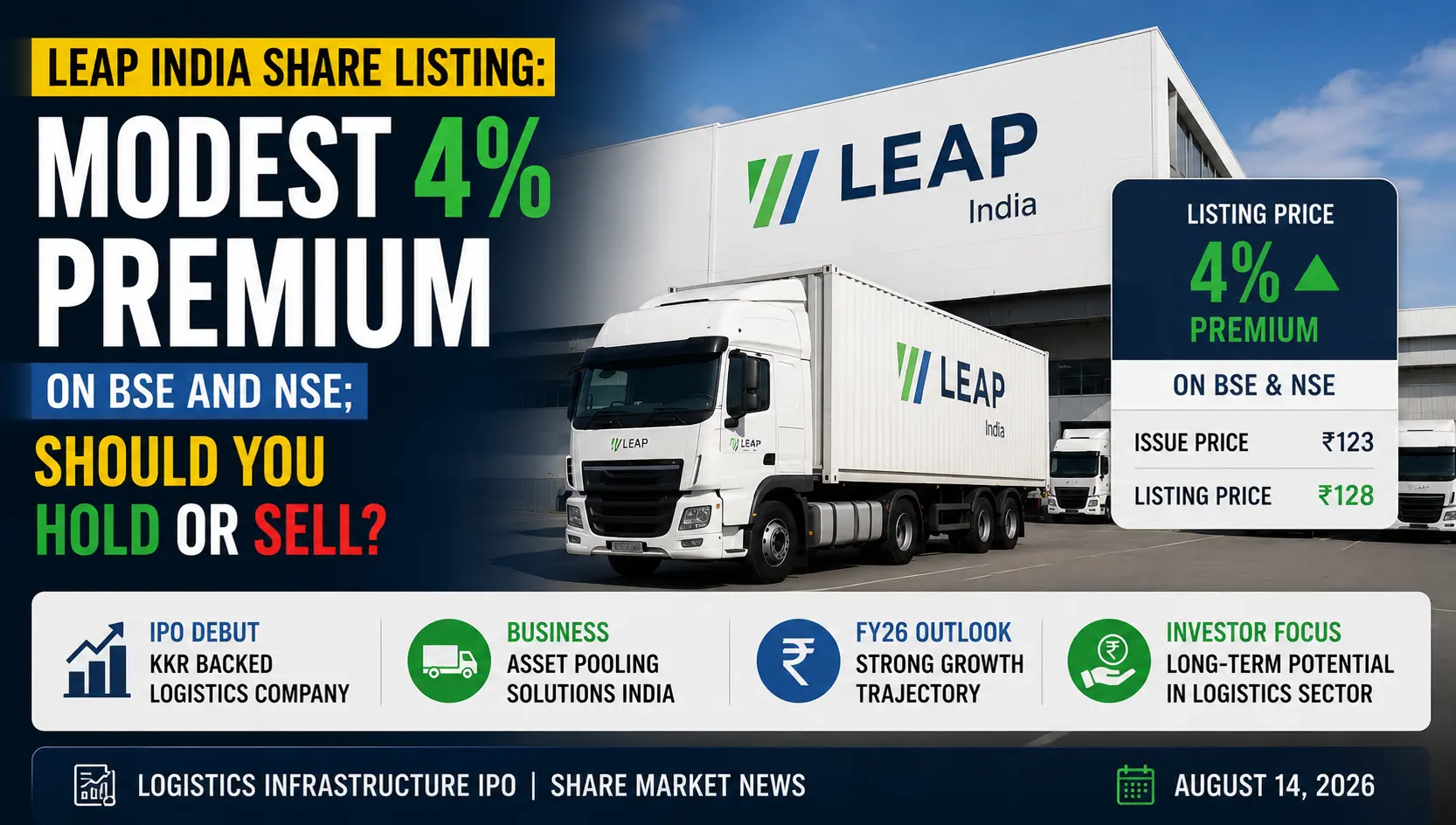
The Indian stock market witnessed another significant debut on Friday, August 14, as LEAP India Limited officially listed on the BSE and NSE. Backed by the global investment powerhouse KKR, LEAP India is a leader in the logistics infrastructure and asset-pooling space. While the company's fundamentals are considered robust, its entry into the public market was relatively quiet, with the stock listing at a modest premium that fell short of pre-listing expectations.
The Listing Day Numbers
LEAP India set its IPO price at the upper end of the band at ₹159 per equity share. On the listing morning, the shares opened on the BSE at ₹166, reflecting a premium of 4.4%. On the National Stock Exchange (NSE), the stock made its entrance at ₹165.90, a 4.34% gain.
Leading up to the listing, the unlisted or "grey market" (GMP) had hinted at a potential 8% gain for investors. The actual opening at 4% suggests a cautious approach from market participants, potentially due to the demanding valuation at which the IPO was priced.
A Look at the Subscription Journey
The ₹2,480-crore public issue was open for bidding from August 7 to August 11, 2026. By the end of the subscription period, the issue was booked 8.38 times. The demand was skewed heavily toward institutional players:
Qualified Institutional Buyers (QIBs): This category showed the most confidence, subscribing 16.84 times their reserved portion.
Non-Institutional Investors (NIIs): This segment, often comprising high-net-worth individuals, was subscribed 12.64 times.
Retail Investors: Small-scale investors were more conservative, with a subscription rate of 1.71 times.
The IPO structure included a fresh issue of shares worth ₹480 crore and an offer for sale (OFS) totaling ₹2,000 crore from existing shareholders.
Strategic Use of Capital
One of the primary reasons for LEAP India going public was to clean up its balance sheet. The company has earmarked approximately ₹360 crore from the fresh issue proceeds to repay or prepay existing borrowings. By reducing its debt burden, LEAP India aims to improve its net margins and create more room for capital-intensive expansion in the future. The remaining funds will be used for general corporate purposes to streamline operations.
Who is LEAP India?
Founded in 2013, LEAP India has carved a niche for itself in the sustainable supply chain sector. Its core business revolves around "asset pooling"—providing reusable pallets and returnable packaging solutions to a variety of industries. Instead of companies buying thousands of wooden pallets, they rent them from LEAP India, which handles the logistics, maintenance, and repair.
As of early 2026, the company boasts a prestigious client list of over 1,000 entities, including giants like Marico, Hindustan Coca-Cola Beverages, Toll Logistics, and Daikin. KKR’s acquisition of a majority stake in 2023 provided the company with the global expertise and financial muscle needed to dominate the Asian infrastructure market.
Financial Trajectory: Profitability on the Rise
LEAP India’s financial health provides a strong case for long-term investors. In the financial year ended March 31, 2026, the company reported a massive 54% year-on-year increase in total income, reaching ₹747.36 crore. Even more impressive was the growth in Profit After Tax (PAT), which surged by 66% to ₹62.34 crore. These numbers indicate that the company has been able to scale its operations efficiently while maintaining control over costs.
Market Outlook: Hold or Sell?
For many retail investors, the question after a modest 4% listing is whether to hold for the long term or exit. Analysts suggest that LEAP India is a "steady growth" play rather than a "fast money" stock. The logistics sector in India is undergoing a transformation driven by e-commerce and quick-commerce, both of which rely heavily on efficient warehousing and packaging.
While the listing might have been tepid, LEAP India’s strong client relationships and the backing of KKR make it a formidable player in its sector. Investors with a long-term horizon might find the current levels attractive if the stock stabilizes. However, those looking for immediate multi-bagger returns may need to reassess their expectations in light of the stock's current valuation.