What is the status of the August 27 holiday according to the Supreme Court order?
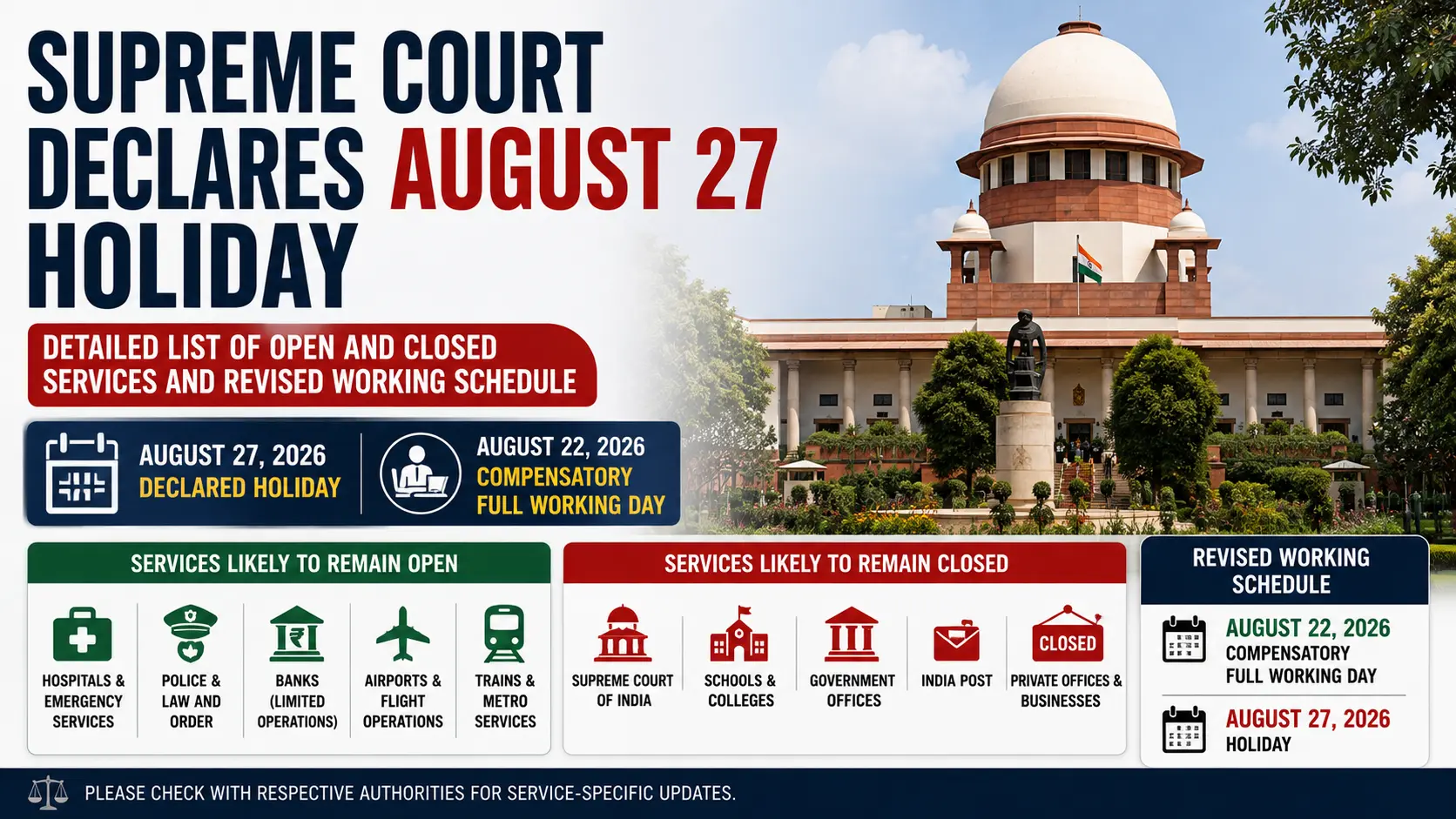
The Supreme Court of India has officially declared August 27, 2026 (Thursday), as a holiday for the Court and its Registry. This decision creates a three-day closure from August 26 to August 28. To compensate, August 22, 2026 (Saturday), has been designated as a full working day.
Quick Facts: Supreme Court Revised August Schedule
New Holiday: August 27, 2026 (Thursday)
Compensatory Working Day: August 22, 2026 (Saturday)
Registry Working Hours (Aug 22): Until 5:00 PM
Total Closure Period: August 26 (Milad-un-Nabi), August 27 (Special Holiday), and August 28 (Raksha Bandhan).
Detailed Overview and Administrative Context
The administrative landscape of the Supreme Court of India underwent a significant shift following a formal petition by the Supreme Court Advocates-on-Record Association (SCAORA). The association requested the Full Court to designate August 27, 2026, as an additional holiday to bridge a gap in the existing judicial calendar. On August 14, 2026, the Administrative General Branch issued a circular confirming that the request was accepted.
This specific change is not merely a pause in judicial activity but a strategic realignment of the court’s operational hours. By declaring this holiday, the Supreme Court effectively creates a bridge between two existing holidays—Milad-un-Nabi (August 26) and Raksha Bandhan (August 28). This three-day cluster allows the legal fraternity a continuous break but necessitates a compensatory mechanism to ensure that the judicial clock does not lose vital momentum. The "Saturday for a Thursday" trade is a standard but significant procedural move that affects thousands of active litigations and administrative filings.
Technical Breakdown and Working Day Specifications
The circular issued by the Administrative General Branch provides granular details on how the compensation will occur. While August 27 remains completely closed for physical filings and judicial hearings, the preceding Saturday, August 22, 2026, will see the Supreme Court and its Registry functioning at full capacity.
Operational Parameters for August 22:
Working Status: Full working day (replaces the standard Saturday off or half-day).
Registry Timing: The offices will remain operational until 5:00 PM, allowing for the filing of petitions, affidavits, and other legal documents.
Judicial Benches: Regular benches will sit to hear listed matters, ensuring that the total number of working days for the year 2026 remains consistent with the pre-approved judicial calendar.
Limitation Periods: Lawyers and litigants must note that since the Registry is open on August 22, any limitation period expiring on that day must be honored through physical or electronic filing as per the Supreme Court Rules, 2013.
Comparative Analysis of Public vs. Judicial Holidays
A critical point of confusion for the general public remains the scope of this order. It is essential to distinguish between a Supreme Court Holiday and a National Public Holiday. The order issued on August 14 applies exclusively to the Supreme Court of India and its internal Registry.
| Entity | August 27 Status | August 22 Status |
| Supreme Court of India | Closed (Holiday) | Open (Full Working Day) |
| Nationalized/Private Banks | Open (Regular Day) | Closed (If 4th Saturday) |
| Stock Markets (NSE/BSE) | Open (Regular Trading) | Closed (Weekend) |
| High Courts/District Courts | Open (Unless Notified) | Per Local Calendar |
| Private Corporations | Open (Regular Day) | Per Company Policy |
Unlike holidays declared under the Negotiable Instruments Act, which affect banking and financial sectors, this judicial circular does not impact the daily operations of schools, colleges, or private businesses. Consequently, while the highest court of the land rests, the rest of the nation’s infrastructure will remain operational on August 27.
Expert Analysis and Strategic Impact on Backlog
Legal analysts suggest that the creation of a three-day holiday cluster (August 26–28) is a response to the logistical needs of the legal community, many of whom travel during festive periods. However, the decision to make August 22 a full working day reflects the Chief Justice of India’s commitment to reducing the case pendency, which currently hovers at significant levels.
By ensuring the Registry works until 5:00 PM on a Saturday, the court is mitigating the risk of a "filing bottleneck" that often occurs before a long break. Experts believe this move will force a surge in filings on August 22, potentially putting temporary pressure on the Supreme Court's digital servers and physical staff. For the industry, this sets a precedent for "bridge holidays" being balanced with weekend shifts, a trend that might be adopted by various High Courts across India to manage their respective annual calendars.
Jurisdictional Scope and Legal Implications
The jurisdictional boundaries of this holiday are strictly confined to the Tilak Marg premises and its associated administrative wings. It is a common misconception that a Supreme Court holiday dictates the schedule for lower judiciaries. Each High Court in India—from Bombay to Madras—operates under its own set of rules and administrative autonomy.
Unless the respective Registrar Generals of various High Courts issue similar notifications, they will remain functional on August 27. This creates a unique situation where lawyers practicing in both the Supreme Court and Delhi High Court, for instance, may have a holiday in the former while appearing for matters in the latter. Litigants are advised to consult their specific counsel to confirm if their particular court of interest is following the Supreme Court’s lead or maintaining its original schedule.
Practical Guidance for Litigants and Legal Tech Services
For those utilizing Legal Tech platforms for e-filings, the August 27 holiday means that while the portal might be accessible, the "date of filing" for matters requiring urgent mention may be pushed to the next working day. The August 22 working day is the most critical window for any litigant facing an impending deadline.
Actionable Advice:
Urgent Mentions: If a matter requires an urgent stay order before the August 26–28 break, it must be mentioned before the bench no later than August 25.
Physical Filings: Ensure all paper-books are submitted to the Registry by 5:00 PM on August 22.
E-Filing Servers: Expect higher traffic on the e-filing portal on August 22 and 25; it is advisable to complete submissions during non-peak morning hours.
Certified Copies: Applications for certified copies of orders passed earlier in the week should be submitted by August 22 to avoid the three-day delay.