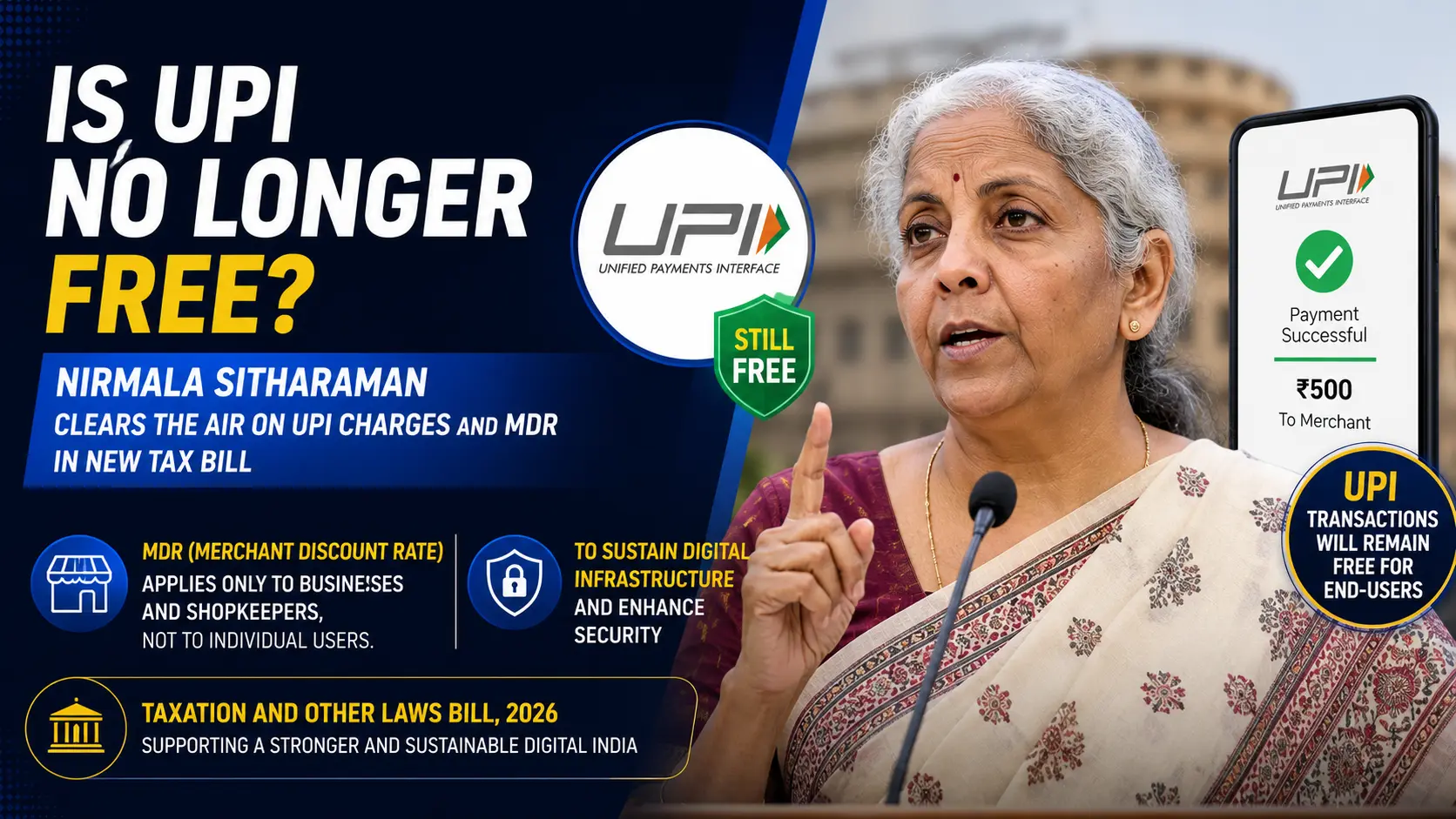
The Truth About UPI Charges: Customers Can Breathe Easy as FM Clarifies Merchant Discount Rate (MDR) Rules
The Unified Payments Interface (UPI) has become the heartbeat of India's economy. From street vendors to luxury showrooms, digital payments have replaced cash. However, a wave of panic recently gripped the nation following news of the 'Taxation and Other Laws (Amendment) Bill, 2026.' Rumors suggested that every digital transaction would soon attract a fee. Finance Minister Nirmala Sitharaman has now stepped in to provide a definitive answer: UPI remains free for you and me.
The Political Row Over Digital Fees
The controversy began when Congress leader Jairam Ramesh alleged that the new bill was a "hidden tax" on the common man. He claimed that ordinary people would be forced to pay extra for using UPI. Responding sharply on X (formerly Twitter), the Finance Minister dismissed these claims as a "canard" (false rumor). She clarified that the government's priority is to protect the end-user while ensuring the financial sustainability of the banks and fintech companies that run the system.
Understanding MDR: Who Pays What?
The technical term at the center of this debate is the Merchant Discount Rate (MDR). When you buy a product and scan a QR code, the transaction seems instant, but behind the scenes, banks, payment service providers (PSPs), and the National Payments Corporation of India (NPCI) work together to move that money securely.
FM Sitharaman clarified that the MDR applies only to the merchants (the shopkeepers or businesses) and not to the customers. In simpler terms, if you pay ₹500 for a meal, you only pay ₹500. The bank might deduct a tiny percentage from the ₹500 that the restaurant receives. This revenue helps banks invest in servers, better apps, and robust cybersecurity to prevent fraud.
Why the Law is Changing
Currently, Section 10A of the Payment and Settlement Systems Act, 2007, prohibits banks from charging for UPI or RuPay debit card transactions. This "Zero MDR" framework was essential to encourage people to switch to digital payments.
However, with billions of transactions happening every month, the cost of running this infrastructure has skyrocketed. The RBI Governor recently noted that "someone has to pay" for the public infrastructure of digital payments. The new Bill gives the government the legal authority to decide which transactions remain free and which can have a small fee levied on the merchants. This transition ensures that the UPI ecosystem can grow without relying solely on government subsidies.
Beyond UPI: A Boost for 'Make in India'
While the media focus has been on UPI, the Taxation and Other Laws (Amendment) Bill, 2026, is a broader economic reform package. Here are the key highlights:
Electronics Manufacturing: To turn India into a global alternative to China, the bill extends income tax exemptions for foreign electronics companies (manufacturing phones, laptops, and servers) until the year 2040-41.
Ease of Doing Business: The bill simplifies rules for global fund managers to relocate to India, making the country a more attractive destination for global capital.
Data Infrastructure: It removes hurdles for foreign cloud companies using Indian data centers, promoting the growth of the local tech industry.
Parliamentary Stalemate
The Bill was passed in the Lok Sabha via a voice vote without a formal debate. The Opposition, led by the Congress party, has been protesting since the start of the Monsoon Session on unrelated issues. Minister Sitharaman lamented that the lack of constructive engagement from the Opposition prevented a detailed discussion on the floor of the House, which would have helped clear public confusion much sooner.
The Verdict for the Common Man
For the average Indian citizen, the message is clear: keep using UPI without worry. Your peer-to-peer transfers (sending money to friends or family) and your small grocery payments will not cost you anything extra. The government is creating a legal framework to allow banks to earn from large businesses to keep the system safe and efficient for everyone.
As digital payments continue to grow at a record pace, this balance between user-convenience and corporate sustainability is seen as a necessary step in India's journey toward becoming a fully digital economy.