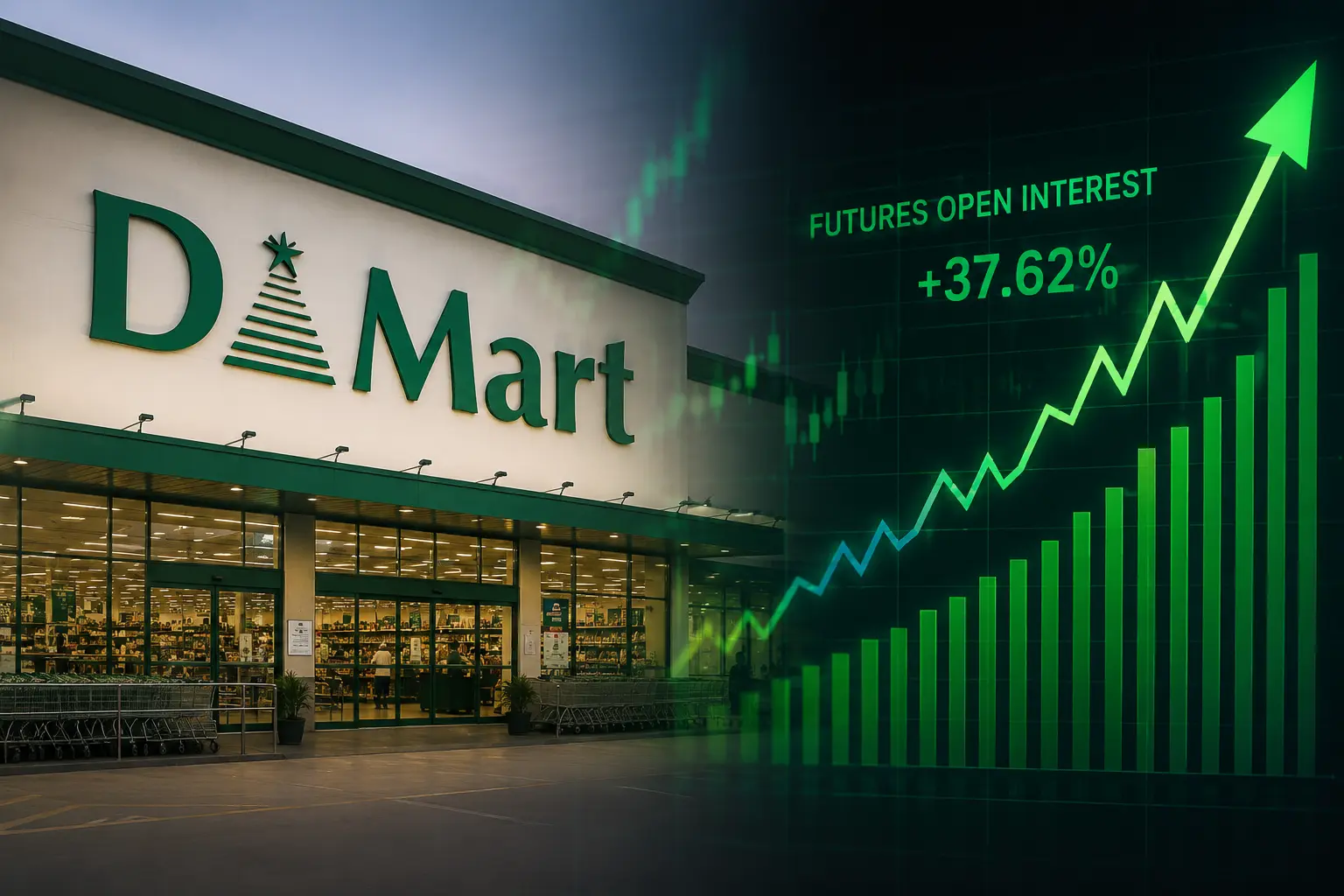
Avenue Supermarts Limited — the company behind India's D-Mart retail chain, listed on BSE and NSE under the ticker DMART — has seen a sharp surge in futures open interest, placing it among a group of F&O stocks analysts are currently watching closely. For a retail investor who tracks derivatives data as a directional signal, this is a move worth understanding before the next trading session.
- DMART (Avenue Supermarts Limited) has seen a sharp surge in futures open interest on BSE and NSE.
- The stock is among four F&O counters analysts are currently monitoring for directional signals.
- Rising open interest in futures can indicate either fresh bullish bets or hedging activity. The price move alongside it is what tells you which.
- Retail investors should track OI alongside price direction and volume before drawing any conclusion.
What Is Open Interest and Why Does It Matter?
Open interest (OI) is the total number of outstanding futures or options contracts that haven't been settled. When OI rises, it means new money's entering the market for that stock. Traders are opening fresh positions, not just squaring off old ones. When OI falls, money's walking out.
A surge in open interest by itself tells you there's activity. It doesn't tell you whether that activity is bullish or bearish. You need to read it alongside price to understand the intent.
If DMART's futures OI is rising while the stock price is also rising, it typically points to fresh long positions — buyers betting on more upside. If OI is rising while the price is falling, it usually means fresh short positions are being built, with traders expecting further decline. And if price is rising but OI is falling, it could signal a short squeeze or unwinding of earlier bearish bets.
Why DMART Is Being Watched Right Now
Per analysts tracking F&O data, DMART is one of four stocks that have seen a notable rise in futures open interest recently. This kind of clustering — where multiple large-cap counters see OI surge together — often precedes a directional move in the broader market, or in the retail sector specifically.
Avenue Supermarts, which runs over 360 D-Mart stores across India, is one of the most closely followed consumer discretionary stocks on Dalal Street. Its quarterly earnings, same-store sales growth, and footfall numbers are treated as a proxy for urban consumption demand. When derivatives traders start building large positions in DMART futures, it usually reflects a view on one of two things: the company's near-term earnings outlook, or a broader macro call on consumer spending.
For a household investor in Mumbai or Bengaluru who holds DMART in a long-term equity portfolio, a surge in futures OI means the stock's entering a period of heightened speculative attention. That doesn't mean you should sell. It means you should watch — and understand what the professionals are positioning for.
How to Read the Signal Without Getting Burned
Derivatives data can mislead as often as it guides. Here's how experienced market watchers interpret an OI surge without overreacting.
First, check whether price is confirming the move. A rising OI with a flat or declining price is a mixed signal; it means positions are being built, but conviction isn't yet showing up in buying pressure. Second, look at the put-call ratio (PCR) for DMART options. A falling PCR alongside rising futures OI can mean the smart money's leaning short. Third, track rollover data as the expiry approaches. High rollover with maintained OI means traders believe the move has legs into the next series.
None of these indicators work in isolation. Treating a single data point — like an OI surge — as a buy or sell signal is one of the most common mistakes retail F&O participants make. The National Stock Exchange of India (NSE) publishes open interest and futures data daily through its Bhavcopy reports, which are freely available on the exchange's official website.
What This Means for Long-Term DMART Shareholders
If you own DMART shares and aren't a derivatives trader, the honest answer is: this OI surge probably doesn't require you to act. Futures open interest reflects short-term speculative positioning, not the fundamental story of the business.
Avenue Supermarts has built one of the most capital-efficient retail models in India — low discounting, high inventory turnover, and a cautious expansion strategy that prioritizes store profitability over footprint growth. Those fundamentals don't change because futures traders are active in the stock for a few sessions.
That said, an OI surge can occasionally precede a large price move in either direction — especially if it coincides with an upcoming earnings announcement, a sector-wide development, or a broader market catalyst. Watching the next few trading sessions closely, particularly around key price levels and volume patterns, is a reasonable response for any investor who owns the stock.
Frequently Asked Questions About DMART Futures Open Interest
What does a surge in DMART futures open interest mean?
A surge in DMART futures open interest means new trading positions are being opened in the stock's futures contracts on NSE or BSE. It signals heightened speculative activity. Whether it's bullish or bearish depends on whether the stock price is rising or falling alongside the OI increase.
Should I buy DMART stock because of the OI surge?
An OI surge alone isn't a buy signal; it only confirms that traders are active. To assess direction, you need to check whether price is rising or falling with the OI, look at the put-call ratio for DMART options, and consider whether any earnings or sector news is due. Consult a SEBI-registered advisor before acting.
Where can I check DMART futures open interest data?
The National Stock Exchange of India (NSE) publishes daily futures and options data, including open interest figures, through its official Bhavcopy reports on the NSE website. BSE also publishes equivalent F&O data. Both are free and updated after each trading session.
Is high open interest in DMART a sign of institutional activity?
High open interest often reflects institutional or large trader participation because retail investors rarely move OI materially on a large-cap stock like DMART. However, it doesn't confirm institutional buying; institutions also use futures to hedge existing equity positions, which can look identical in OI data.
What should I watch next after the DMART OI surge?
Track DMART's price movement relative to OI over the next few sessions. Watch rollover data as the current expiry approaches. Monitor whether any earnings or sector-level news coincides with the positioning. If you hold the stock, reviewing key support and resistance levels with a registered advisor is a sound next step.
Investment Disclaimer: This article is for informational purposes only and does not constitute investment advice. Stock market investments are subject to market risks. Past performance is not indicative of future results. Please consult a SEBI-registered financial advisor before making investment decisions.