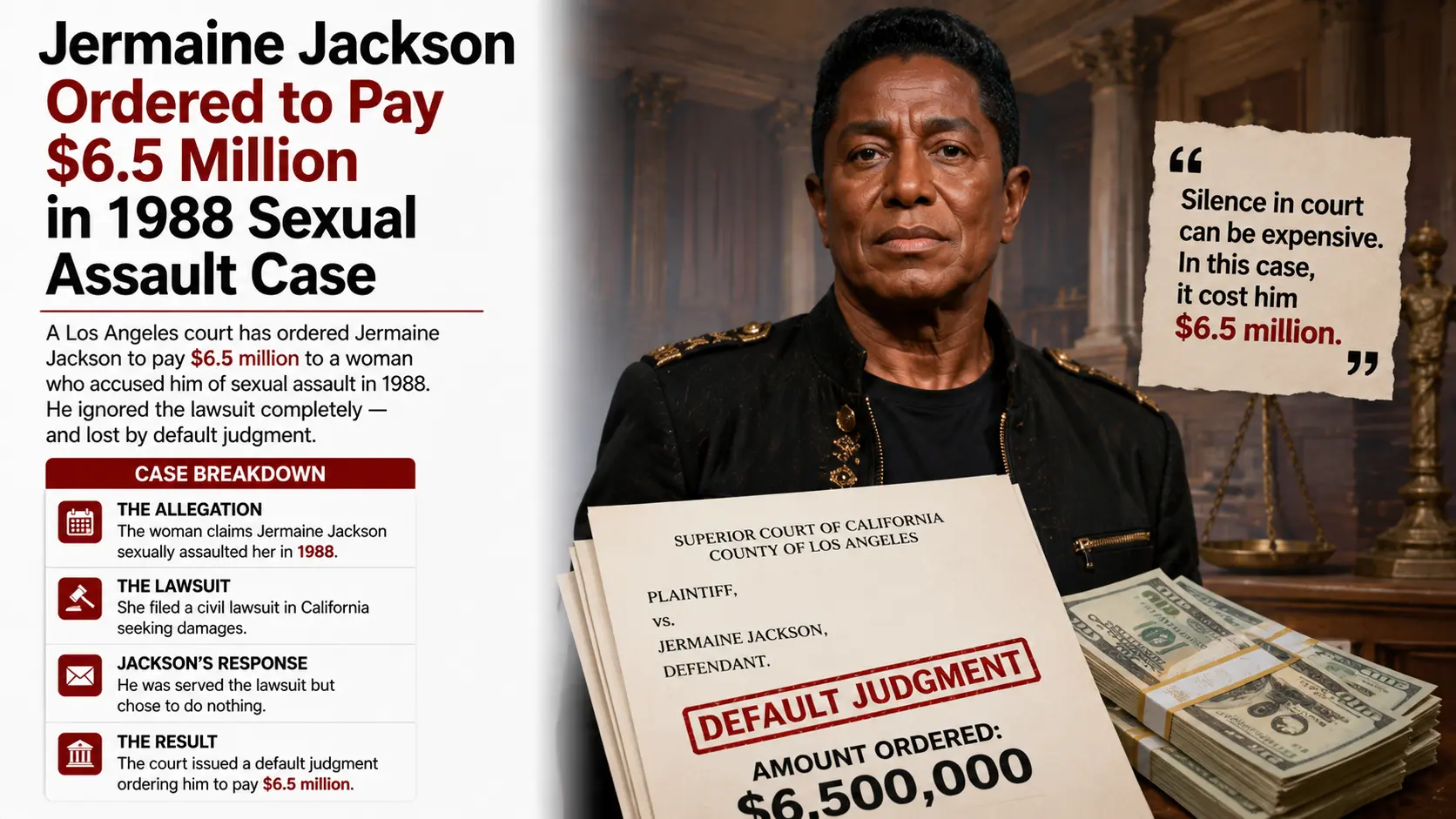
Jermaine Jackson Ordered to Pay $6.5 Million in 1988 Sexual Assault Case
Look, a major legal loss just hit Jermaine Jackson—the kind that reshapes a legacy overnight. Wow. The former Jackson 5 singer has been ordered to pay $6.5 million to a woman who accused him of sexual assault way back in 1988. That's real. Here is what happened, and why Jackson's silence may have cost him literally everything.
So Jackson never showed up to defend himself in court—not once. Think about it. He didn't file any papers and didn't even respond to the lawsuit. Period. So the judge made a default judgment, which basically means the court ruled against him because he refused to participate in the case at all.
Here's the thing—this is a real problem for celebrities who think they're above the law. And? When you ignore a lawsuit, courts assume you have no defense. And that’s exactly what happened here. Is this really a surprise?
And here's why that matters.
- $6.5 million judgment: Jermaine Jackson's on the hook for $6.5 million owed to Rita Butler Barrett because he just plain ignored her lawsuit.
- 1988 assault allegation: Barrett's lawsuit says Jackson violently forced his way into her home and sexually assaulted her back in 1988.
- Lawsuit filed December 2023: The suit wasn't filed until December 2023, a full 35 years after the alleged attack.
- Default judgment issued: Since Jackson never bothered to respond, the court handed down a default judgment, which is an automatic loss.
- Berry Gordy allegation: Barrett also claims music legend Berry Gordy helped cover up the whole incident to protect Jackson's career and Motown's bottom line.
- Emotional and physical damages: She says the assault left her with severe and lasting psychological trauma that she's still battling today.
Wow.
How We Got Here — The Full Story
So Rita Butler Barrett knew Jermaine Jackson for years before the incident, which makes what happened next even more shocking. Let that sit. She claims he forced his way into her home in 1988, and what followed left her terrified for her life.
And for decades, she stayed silent—a common story for survivors of trauma. And now? Then in December 2023, she decided to file a lawsuit, and she wasn't looking for a small settlement either. Big deal. She wanted $6.5 million in damages to cover the emotional pain, the therapy bills, and everything else that came from what she says was a violent crime.
But think about what that means. Thirty-five years went by before she felt strong enough to go to court. That's the truth. That tells you something about how traumatic this wasn't just a fleeting moment, but a lifelong burden.
But not for the reasons you'd expect.
What Actually Happened in Court
Here's where this gets really important—Jackson's legal team had a simple job: show up and defend him. Right? They needed to file papers, make arguments, and do the basic things any lawyer does in a case like this. Facts. And they didn't do *any* of that.
Really.
- No response filed: When Barrett's lawyers served Jackson, his team didn't file a single legal document to challenge her story.
- No court appearance: Jackson was a no-show for every single hearing and court date, not even sending his lawyers.
- Silent defense: There wasn't a statement, a denial, or any kind of counter-argument from Jackson's camp. Just silence.
- Judge's decision: With a defendant who refused to participate, the judge had little choice but to issue a default judgment—an automatic loss.
- How default judgments work: Look, when you ghost a lawsuit, the court just assumes the other person's claims are true. There's no one there to say otherwise.
- The amount set: And the court set the damages at $6.5 million to cover Barrett's physical and emotional suffering.
But this isn't a situation where the judge said “maybe he did it, maybe he didn't.” No joke. The judge essentially said Jackson had his chance to defend himself, and he just walked away from it.
The kind of thing most people miss.
The Berry Gordy Connection — Why It Matters
Now here's where this story gets even bigger, because Barrett's lawsuit doesn't just point at Jackson. And that's big. It also names Berry Gordy, the legendary founder of Motown Records.
Here's what we know: Gordy knew about the assault, according to Barrett. Think. And according to her, he covered it up—not to protect victims, but to protect money. The result? Jackson was a huge star, and Jackson 5 albums made millions. Why would Gordy let a scandal destroy all that profit? But who really benefits here?
So Barrett claims Gordy kept quiet about the incident to protect Jackson's image and keep the music business rolling. Wild. Think about that for a second—a powerful executive supposedly silencing a victim because it was just bad for business.
And this is a serious allegation that goes way beyond just Jackson. Read that again. It suggests a pattern of powerful people in the music industry protecting wealthy performers instead of listening to victims.
Period.
What This Really Means for Victims and the Industry
Look, this case sends a message. Unreal. A loud one, at that. Even when decades pass, victims can still come forward. Yep. And courts will listen.
And Barrett waited 35 years, a time when most people likely thought her case was too old, too forgotten, and too far in the past. Worth it. But she took Jackson to court anyway and she won—not because of some dramatic trial, but because Jackson refused to show up.
That refusal cost him $6.5 million.
For victims everywhere, this is really important. Key point. It shows that you don't need a perfect case or tons of evidence sitting in a folder. You need courage to speak, and a good lawyer helps. And more. But sometimes, the other person's silence does the rest of the work for you.
And for the music industry, this is a wake-up call. Big shift. The days of powerful record executives silencing victims and protecting stars might not be completely over, but courts are making it much, much more expensive to try.
And that's just the beginning.
What Comes Next for Jermaine Jackson
So Jackson now has a $6.5 million debt, but that isn't the end of this story—it's the beginning of a whole new chapter. But here's the real question—what happens next?
And he can try to appeal the judgment, which means asking a higher court to overturn the decision. That stings. But here’s the problem: he didn't participate in the original case, so an appeals court might ask why he didn't bother to defend himself the first time. Not small.
He can also try to negotiate a payment plan with Barrett. $6.5 million isn't something most people can pay in one lump sum.
But one thing is certain. Not anymore. Jackson's silence in court has now become very, very expensive.
Think.
Why This Matters Beyond the Courtroom
But this case teaches a hard lesson about how the legal system works in America. Nobody talks about this. Ignoring a lawsuit isn't a smart strategy; it's a losing strategy.
When you refuse to show up and defend yourself, the court doesn't assume you're innocent. Big. It assumes you have nothing to say, and that assumption costs you dearly. Huge.
For Jackson, that assumption just cost him $6.5 million.
For other celebrities watching this case, the message is crystal clear. You may think silence protects you. It doesn't. Usually, it just destroys you.
Frequently Asked Questions About Jermaine Jackson and This Case
What is a default judgment and how does it work in court?
Here's the short version: It’s what happens when someone sued completely ignores the case. If you don't show up or file a response, the judge basically rules for the other side automatically. It's a total loss.
Why didn't Jermaine Jackson's lawyers respond to the lawsuit?
Honestly—nobody knows for sure except his inner circle. It's a total mystery. It's possible his team thought the case was too old to be a real threat, or perhaps Jackson himself decided against funding a defense. And why does this matter right now? Because whatever the internal reason was, the outcome was a catastrophic, multi-million-dollar mistake. Courts just don't look kindly on being ignored.
Can Jermaine Jackson appeal this $6.5 million judgment?
Simply put, yes, he can try to appeal. But it's a massive uphill battle. He'd have to prove the lower court made a serious error, but his own failure to participate makes that argument incredibly weak.
What does Berry Gordy have to do with this case?
Good question. Rita Barrett claims Gordy, the Motown Records founder, knew about the assault and actively covered it up—all to protect Jackson's star image and the label's profits. This elevates the case beyond a single incident, suggesting a systemic problem where powerful executives allegedly prioritized money and public relations over a victim's safety and justice. It's a huge allegation.
How much time do victims have to file a sexual assault case in America?
The thing is, it really depends on the state. Some states are getting rid of time limits for these cases entirely, while others have extended them. Barrett filing 35 years later shows the law in her state gave her that window, a big shift from the old days.
The Bigger Picture — What This Tells Us
Look, this isn't just about one singer and one lawsuit—this case shows that the power balance is slowly shifting. That's the truth. Victims are speaking up, courts are listening, and silence is becoming more and more expensive. And now?
For Rita Barrett, this judgment is validation. Let that sit. For Jermaine Jackson, it’s a $6.5 million reminder that ignoring the law doesn't make your problems go away—it makes them much, much worse. Facts.
The question now is whether Jackson will pay, fight it in appeals court, or try to negotiate. True. Whatever he does, this case will sit in the legal record forever. And where does that leave the rest of us? And that alone sends a message that victims are listening to.