The Last House Ending Explained: Ancient Secrets, "Broccoli Water," and the Mystery of the Final "Hello"
Netflix’s latest sci-fi sensation, The Last House , has left audiences gripped and deeply confused. Starring Greta Lee and Wagner Moura, the film follows the Delgado family, who find themselves trapped in their suburban home by an invisible force while mysterious silhouettes move through a never-ending rain.
If you’ve finished the film and are left wondering what exactly those creatures were, how the family survived for half a decade, and whose voice delivered that final spine-chilling "Hello," you aren't alone. Director Louis Leterrier and his creative team have finally stepped forward to explain the mysteries lurking beneath the surface.
They Aren't Aliens: The Truth About the Creatures
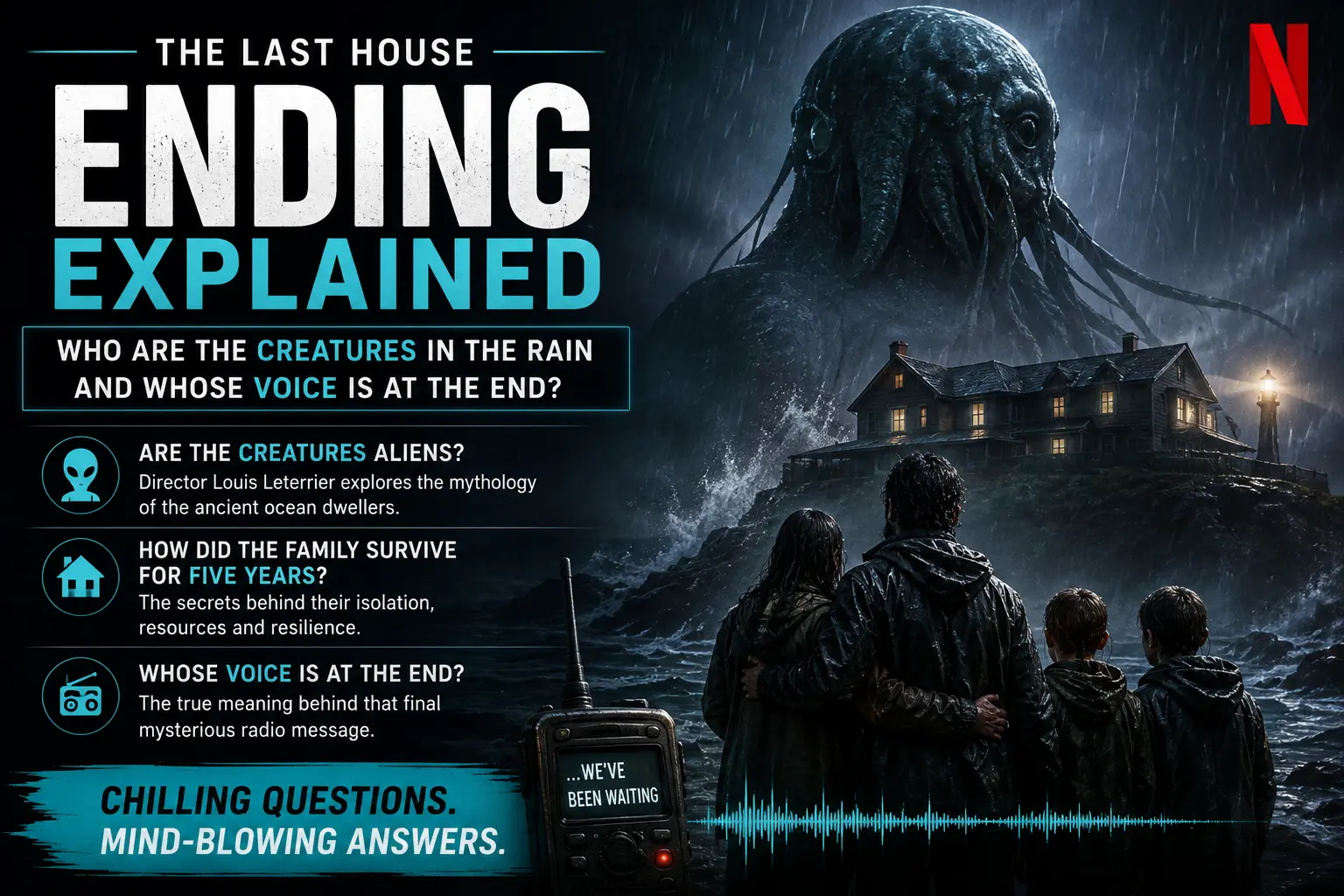
The biggest misconception viewers have is that the forces outside are extraterrestrial. According to director Louis Leterrier, these beings are actually "Ancient Ocean Dwellers." They didn't come from another planet; they’ve been on Earth far longer than humans.
"We are living on their planet," Leterrier explains. These creatures remained in the depths of the ocean for eons, but humanity’s impact on the environment—pollution and "boiling the oceans" through global warming—finally forced them out. The invasion isn't a conquest; it’s a reclamation. The creatures are returning to take back what was theirs, forcing humans to learn how to share the planet.
The design of the creatures was intentionally kept vague to maintain a sense of dread. Using a mix of practical silicone suits and digital effects, the team created a fluid, dancer-like entity that stands on tentacles. The goal was to make the audience fill in the blanks with their own fears.
Five Years in Captivity: The Art of "Chimney Fishing"
One of the most shocking moments in the film is the sudden time-lapse, revealing that the Delgados have been trapped for over five years. To make this feel real, the production filmed largely in chronological order, allowing the actors to physically inhabit the exhaustion and hunger of their characters.
But how do you survive in a sealed house for five years? The answer lies in the chimney. After the chimney cap falls off, it creates a "chink in the armor." While not big enough to escape through, it becomes the family’s lifeline.
The production team coined the term "chimney fishing" to describe how Jason (Wagner Moura) used the opening to catch small animals and collect rainwater. Inside, the house became a "lifeboat," with the family harvesting every piece of furniture, clothing, and vacuum part to build irrigation systems for indoor crops. Every scratch on the wall and every repurposed tool tells a story of a thousand desperate decisions.
Why Were They Spared? The Power of Trust
The emotional core of the ending centers on Jason’s character arc. Throughout the film, Jason tries to control the situation with violence and tools. However, it is his daughter, Ruth, who realizes the creatures are trying to communicate, not just kill.
In the finale, the creatures spare the family only when Jason finally puts down his weapons and trusts Ruth’s intuition. By choosing coexistence over combat, the Delgados prove to the creatures that humanity is capable of change. According to Leterrier, the message the creatures wanted to deliver was for humans to "learn how to live together" with each other and the natural world.
The Great "Hello" Mystery
The film ends on a haunting note. Ruth asks into a radio, "Are there any other survivors out there?" and a staticky voice responds with a simple "Hello?"
While fans have been theorizing about the identity of the survivor, Leterrier is keeping the secret closely guarded. He teased that the voice belongs to a "very, very, very iconic" person. However, he insists that viewers will never know for sure, leaving the scale of humanity's survival an open question.
Submerged Sets and "Broccoli Water"
Filming the flooded finale was a massive technical undertaking. Rather than relying on green screens, the production built real tanks and actually submerged the house set. The actors had to undergo intense diving training to perform while holding their breath for long periods.
To get the water to look appropriately murky and post-apocalyptic, the crew discovered that a mixture of broccoli worked better than any chemical dye. The cast jokingly referred to the set as "broccoli water," which added a unique (and likely smelly) realism to the final scenes.
The Last House serves as more than just a lockdown thriller; it is a grim reflection of our current environmental path. It asks a simple but terrifying question: if nature decided to reclaim the Earth, would we be worthy of staying?