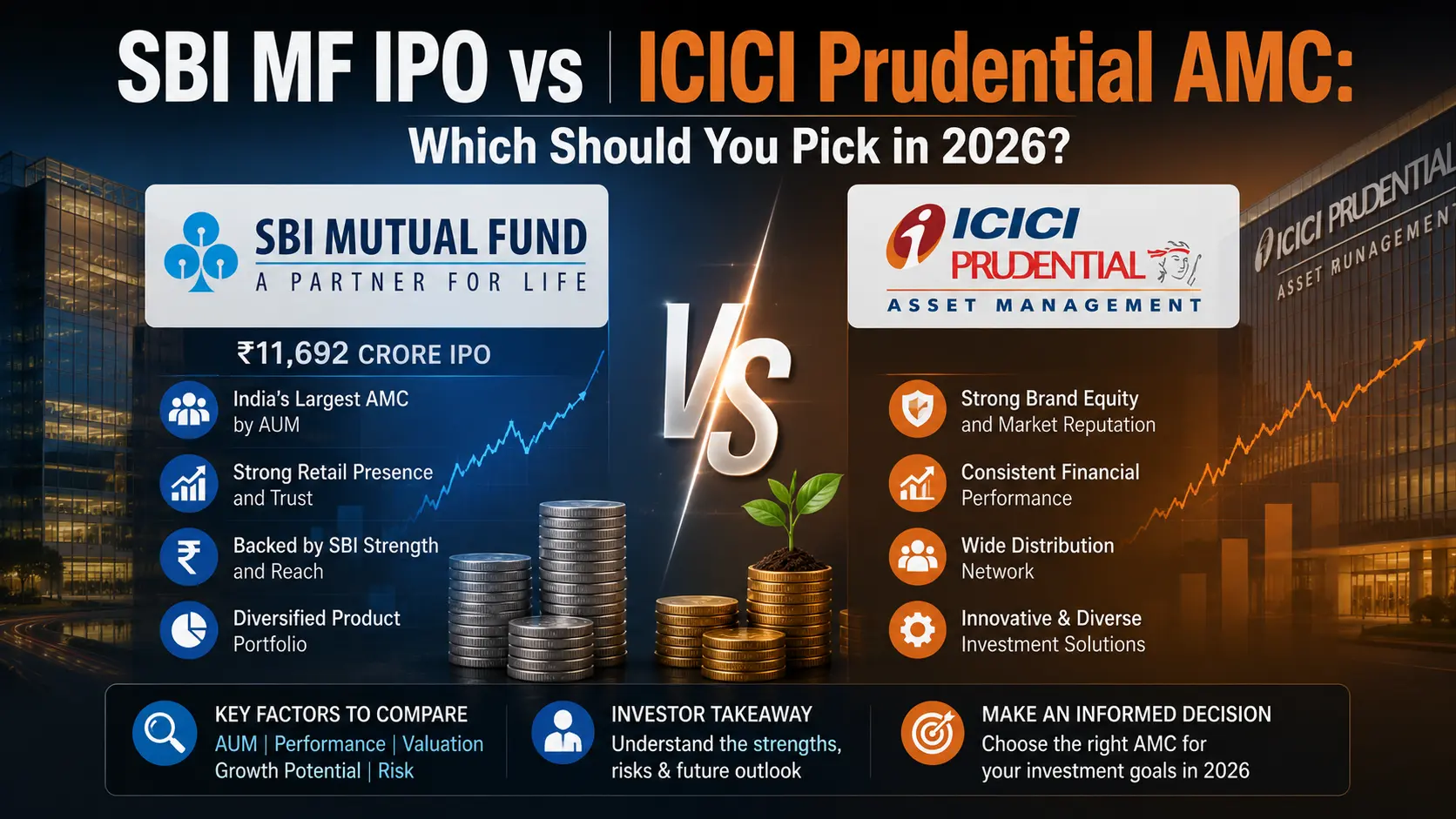
India's largest mutual fund house is finally going public. SBI Funds Management has filed for an IPO worth ₹11,692 crore. The moment that number landed, one question started circulating in every broker's office and personal finance group: should you apply for the SBI MF IPO, or is ICICI Prudential Asset Management Company — already listed, already tested — the smarter bet for your money?
This isn't a simple answer. Both companies sit at the top of India's asset management industry. But they're different businesses at different stages, and the choice between them depends on what kind of investor you are.
- SBI Funds Management has filed for an IPO worth ₹11,692 crore, making it one of the largest AMC listings in India's history.
- SBI MF is India's largest asset management company by assets under management (AUM), with a dominant presence in SIP accounts and retirement portfolios across the country.
- ICICI Prudential AMC is already listed on Indian exchanges and has an established track record as a publicly traded company.
- The two AMCs compete directly for the same pool of Indian retail and institutional investors, making this a genuine head-to-head comparison for investors deciding where to put their money.
- Applying for an IPO and buying an existing listed stock involve different risk profiles — understanding that difference is the starting point for this decision.
What Is the SBI MF IPO, and Why Does It Matter?
SBI Funds Management is the asset management arm of State Bank of India, the country's largest public sector bank. For decades, it's run mutual funds, pension products, and institutional portfolios. Millions of Indians with SIP accounts — many of them first-time investors who started investing through their SBI bank branch — are effectively already customers of this company without realizing it.
The IPO, at ₹11,692 crore, isn't a small offering. For context, that's roughly the size of several mid-cap companies listed on the NSE combined. An IPO of this scale in the asset management space is rare in India, and it'll draw attention from retail investors, high-net-worth individuals, and institutional funds alike.
What makes this different from most IPOs is what the company actually does. SBI MF doesn't manufacture anything. It doesn't run a factory or lay fiber-optic cables. It manages money — and it earns a fee for doing so. That fee, called the expense ratio, comes out of the funds it manages. The bigger the AUM, the more it earns. This is a business that scales without proportionally adding costs, which is why AMC stocks tend to trade at premium valuations.
ICICI Prudential AMC: The Benchmark You Are Comparing Against
ICICI Prudential Asset Management Company (NSE: IPRUMF) has been listed for several years. It's one of the most closely tracked AMC stocks on Indian exchanges. The company is a joint venture between ICICI Bank and Prudential plc, the British financial services group. Its performance as a listed company gives investors something SBI MF can't yet offer: a public history of quarterly earnings, dividend announcements, and market-price discovery.
For a salaried professional in Bengaluru or Pune who already holds mutual fund units in ICICI Prudential schemes, buying the AMC's stock means betting on the company that manages those funds — not just the funds themselves. It's a different kind of ownership, and an important distinction to understand.
ICICI Prudential AMC competes directly with SBI MF for AUM market share. Both are among the top three AMCs in India by total assets managed. The rivalry is real. Growth of one doesn't automatically come at the expense of the other — India's mutual fund industry has been expanding fast enough to accommodate multiple large players.
IPO vs Listed Stock: The Risk Profile Isn't the Same
Before comparing the two companies, you need to understand what you're actually comparing. Buying shares in the SBI MF IPO means purchasing at a price set by the company and its bankers. That price reflects their view of what the business is worth, not the market's verdict. Listed stocks, including ICICI Prudential AMC, are priced every second by the market based on supply, demand, earnings data, and sentiment.
IPOs in India have a mixed track record. Some have listed at significant premiums and delivered strong returns for investors who got allotment. Others have listed flat or below issue price and taken months or years to recover. This IPO's size — ₹11,692 crore — means it'll require substantial institutional participation to sustain post-listing demand. That isn't a red flag, but it's a factor worth weighing.
ICICI Prudential AMC, being already listed, carries what investors call “price discovery risk” in a different direction — you pay today's market price, which may already reflect years of optimism. The upside from a listing pop doesn't exist. But neither does the downside of an IPO that prices itself aggressively and disappoints on day one.
What Drives AMC Valuations in India
Both companies are valued primarily on one metric: assets under management. The higher the AUM, the more fee income the AMC earns. AUM grows when markets rise (existing fund values go up) and when new investors add money (net inflows). It shrinks when markets fall or when investors pull money out (net outflows).
That means AMC stocks are highly sensitive to equity market conditions. In a bull market, AUM rises, fee income rises, and AMC stocks tend to do well. In a sharp correction, AUM falls, and AMC margins come under pressure. For a retail investor in Mumbai or Hyderabad thinking about either stock, this is the core risk — these aren't defensive businesses. They move with the market.
SBI MF's advantage here is scale and distribution. With State Bank of India's branch network behind it, SBI MF has access to a pool of investors that no private AMC can easily replicate — particularly in smaller cities and rural areas where SBI branches operate and private banks don't. That distribution moat is real and durable.
ICICI Prudential AMC's advantage is its track record of fund performance, brand recall among urban investors, and the operational transparency that comes with being a listed company for longer. Investors who want to analyze quarterly numbers before committing have more data to work with.
The Question Every Investor Needs to Answer Before Deciding
An investor in Lucknow who put ₹5,000 into an SBI MF SIP five years ago and is now considering whether to also buy SBI MF shares in the IPO is facing a layered decision. She already has exposure to the company's fund performance through her SIP. Buying IPO shares would give her equity exposure to the company's earnings — a different and additional bet.
For someone with no existing mutual fund exposure to either company, the comparison becomes cleaner. ICICI Prudential AMC offers the certainty of a market-determined price and a history of listed performance. SBI MF offers the possibility of listing gains and long-term upside from India's still-underpenetrated mutual fund market — but with IPO-specific uncertainty built in.
Neither choice is obviously correct. The right one depends on your investment horizon, your risk appetite, and whether you're comfortable with IPO-stage uncertainty versus the premium you might pay for an already-discovered stock.
What the SBI MF IPO Filing Tells Us
Per the information available from the IPO filing, the offering is worth ₹11,692 crore. Beyond the headline number, the specifics of valuation — the price band, the price-to-earnings multiple, the price-to-AUM ratio — will only become clear once SEBI processes the draft red herring prospectus (DRHP) and the company announces its issue price. Until that price is public, any direct valuation comparison with ICICI Prudential AMC is premature.
What investors can do now is study ICICI Prudential AMC's listed performance as a proxy for what a large Indian AMC's public market journey looks like — its revenue growth, margin profile, dividend history, and how its stock price has moved relative to the broader Nifty. That exercise will give anyone considering the SBI MF IPO a useful frame of reference.
Frequently Asked Questions About SBI MF IPO vs ICICI Prudential AMC
Is SBI MF IPO better than buying ICICI Prudential AMC shares?
There's no universal answer. SBI MF IPO offers potential listing gains and long-term exposure to India's largest AMC by AUM. ICICI Prudential AMC is already listed, with a known market price and public earnings history. Your choice should depend on your risk appetite, investment horizon, and comfort with IPO uncertainty versus a premium-priced listed stock.
What is the SBI MF IPO size?
SBI Funds Management has filed for an IPO worth ₹11,692 crore, making it one of the largest AMC listings in India. The price band and final issue price won't be announced until SEBI reviews the draft red herring prospectus. Until then, the exact per-share valuation isn't public.
How does SBI Funds Management make money?
SBI Funds Management earns fees — called expense ratios — from the mutual fund assets it manages. The larger its assets under management (AUM), the more fee income it generates. AUM grows through new investor inflows and when equity markets rise, making the company's earnings closely tied to stock market performance and investor sentiment.
Is ICICI Prudential AMC stock a good buy in 2026?
ICICI Prudential AMC (NSE: IPRUMF) is an established listed AMC with a long track record. Whether it's a good buy depends on its current valuation relative to AUM growth, earnings trajectory, and broader market conditions. Analysts' views vary. Check the latest quarterly results and consult a SEBI-registered financial advisor before deciding.
What is the difference between buying an AMC's IPO and investing in its mutual funds?
Investing in a mutual fund means your money goes into a portfolio of stocks or bonds managed by that AMC. Buying the AMC's shares, however, means you own a piece of the company that earns fees from managing those funds. These are completely different bets — one is on the market, the other is on the business that manages money in the market.
Investment Disclaimer: This article is for informational purposes only and does not constitute investment advice. Stock market investments are subject to market risks. Past performance is not indicative of future results. Please consult a SEBI-registered financial advisor before making investment decisions.