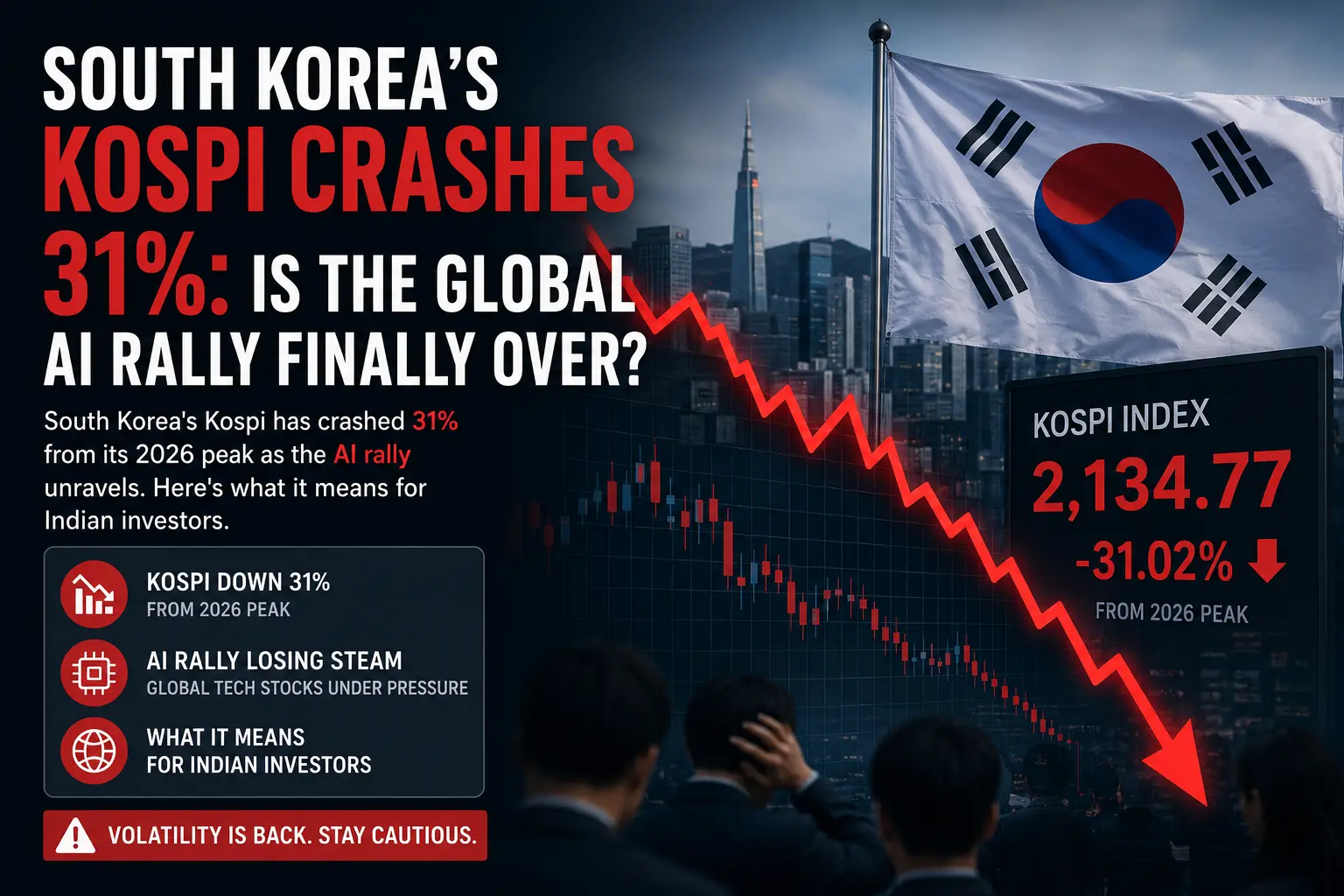
South Korea's benchmark Kospi index has crashed 31% from its 2026 peak, making it one of the sharpest corrections among major Asian markets this year. The trigger is the very same AI-driven rally that kept global equity investors confident for the better part of two years. Now, its unravelling is sending ripple effects across markets that are far closer to your portfolio than Seoul.
- South Korea's Kospi has fallen 31% from its 2026 peak, one of the steepest drops among major Asian indices this year.
- The correction is driven by the unwinding of the AI rally — the same theme that inflated tech valuations globally, including in India.
- Indian investors in tech-heavy mutual funds and Nifty IT stocks face indirect exposure to this correction through global sentiment and fund flows.
- Retail investors should review their tech fund allocations and avoid panic-selling — the story is about risk repricing, not a fundamental collapse.
Why Kospi's Fall Is Not Just Korea's Problem
South Korea's stock market isn't a distant abstraction for Indian investors. Kospi is home to Samsung Electronics, SK Hynix, and LG Energy Solution — companies that sit at the heart of global semiconductor and display supply chains. When AI hardware demand drove memory chip prices higher, SK Hynix's stock soared. Kospi rode that wave. Now, as markets question whether AI infrastructure spending will deliver the returns promised, that same wave is pulling back — and it's pulling hard.
The 31% drop from peak isn't a routine correction. A 10% fall is a correction. A 20% fall is a bear market entry. A 31% drop is a repricing of an entire theme. And that theme — that AI would deliver near-infinite demand for semiconductors, data centre hardware, and enterprise software — is the same theme running through your Nifty IT index and every tech-focused mutual fund sold in India over the last two years.
For a retail investor in Hyderabad or Pune who put money into a technology fund or a global ETF with Korea exposure expecting the AI wave to continue, this correction is the story nobody told them was coming.
What the AI Rally Unravelling Actually Means
The AI rally of the past two years was built on a simple bet: that companies building AI infrastructure — chips, servers, cloud platforms, software — would see demand grow faster than anyone had modelled. That bet drove semiconductor stocks from Seoul to Santa Clara to Bengaluru to extraordinary heights.
The unravelling doesn't mean AI is dead. It means valuations had run ahead of the actual revenue and profit delivery. When earnings disappoint, or when the pace of AI adoption in enterprise turns out to be slower than projected, the market corrects sharply and fast. Kospi's 31% drop reflects exactly that repricing — a market that had priced in perfection, confronting something less than perfect.
India's Nifty IT index tracks companies like Infosys (NSE: INFY), Tata Consultancy Services (NSE: TCS), Wipro (NSE: WIPRO), and HCL Technologies (NSE: HCLTECH). These are services businesses, not chip makers. But they aren't insulated. Their largest clients are American and European enterprises that are now questioning how much to spend on AI-linked IT transformation projects. When global tech spending sentiment turns cautious, Indian IT services revenue guidance feels the drag — sometimes with a lag of one to two quarters.
The Indian Mutual Fund Exposure You May Not Have Mapped
Several popular mutual fund categories in India carry meaningful indirect exposure to this correction. Technology sector funds and international funds with Asia or global tech mandates are the most direct. Funds that track the Nasdaq-100 or global information technology indices will have seen drawdown already, though the quantum varies by fund and hedging policy.
Nifty IT, which tracks the top IT companies listed on NSE, is a domestic index — but domestic doesn't mean decoupled. Infosys and TCS together derive most of their revenue from the United States and Europe. When global tech budgets tighten, their deal pipelines and revenue growth forecasts get revised downward. That shows up in the stock price. It also shows up in your fund's NAV.
A 35-year-old investor in Chennai who has been putting ₹10,000 a month into a Nifty IT ETF for the last 18 months, betting on the AI upcycle, is now watching global developments that are directly connected to the return on that SIP. The Kospi crash is a signal — not a death sentence, but a signal worth reading carefully.
What You Should Actually Do Now
Panic-selling is the worst response to a theme-driven correction, and it's also the most common one. Indian retail investors have a documented tendency to exit equity funds at the bottom of correction cycles, locking in losses right before recoveries. Data from AMFI (Association of Mutual Funds in India) consistently shows net outflows from equity funds during sharp market stress periods.
The more useful question is whether your allocation to technology-linked instruments was sized for the risk you're actually carrying. A portfolio with 40% in tech funds was making a concentrated bet on a single theme. If the AI rally was the thesis, the Kospi correction is the market's first serious challenge to that thesis. That isn't a reason to exit — it's a reason to know what you own and why.
Review your fund factsheets. Check what percentage of your tech funds are in domestic IT versus global tech. Check whether your international fund has Korea or semiconductor exposure. If you don't know the answer, ask your distributor or log into your AMC's portfolio tool — most of them now show geographic and sectoral breakdowns at fund level.
If you're holding Nifty IT stocks directly, watch the quarterly earnings guidance from TCS and Infosys closely. Both companies give revenue growth guidance in dollar terms for each quarter. Any downward revision in that guidance will tell you more about the actual ground reality than any global index movement.
The Broader Pattern Worth Understanding
Markets have a rhythm with technology cycles. In 2000, the dot-com crash wiped out stocks that had priced in decades of internet growth in less than three years of actual existence. The companies that survived — Amazon, Google, a handful of others — went on to deliver exactly the growth that was promised, just on a longer timeline. Investors who panicked in 2001 missed the actual payoff that came after 2003.
The AI cycle isn't the dot-com bubble in terms of financial leverage or sheer speculation volume. But the valuation excess has been real, and the Kospi correction is one of the clearest market signals that the excess is being worked off. Korean tech stocks — especially memory chip companies — were priced for a world of permanent AI-driven demand growth. The correction says the market no longer believes that story at those prices.
What comes next is slower, more selective, and probably more grounded. Companies with actual AI revenue, actual margin improvement, and actual client contracts will survive this repricing and grow into their valuations. Companies that were riding the theme on hope won't.
Frequently Asked Questions About Kospi Crash and Indian Investors
Does the Kospi crash directly affect Indian stock markets like Nifty or Sensex?
Not directly, but there's indirect pressure. When major Asian markets fall sharply, foreign institutional investors often reduce risk across emerging markets, including India. Nifty IT stocks are particularly sensitive because their clients — US and European tech companies — drive the same global sentiment that's correcting in Korea right now.
Which Indian mutual funds are most exposed to this correction?
Technology sector funds, Nasdaq-linked funds, and international funds with Asia or global tech mandates carry the most direct exposure. Nifty IT ETFs and index funds have indirect exposure through the earnings impact on Indian IT companies that serve global tech clients. Always check your fund's factsheet for geographic and sectoral breakdown.
Is now a good time to buy Nifty IT stocks at lower prices?
Any buying decision should be based on your investment horizon, risk capacity, and the earnings outlook for individual companies — not just on the fact that prices have fallen. Watch upcoming quarterly results from TCS and Infosys for their revenue guidance. A falling stock isn't automatically a bargain; it may be pricing in a genuine slowdown in IT spending.
How is South Korea's Kospi connected to India's IT sector?
Both markets are tied to the global technology spending cycle. Kospi's semiconductor companies and India's IT services companies serve the same pool of large global enterprises. When those enterprises cut or delay technology budgets — which the Kospi correction suggests is happening — both markets feel it, though through different mechanisms and with different lag times.
Should I stop my SIP in a technology mutual fund right now?
Stopping a SIP during a correction typically locks in the worst outcome — you miss the lower NAV units that a falling market gives you. However, if your technology allocation is far higher than your risk comfort allows, a rebalancing conversation with a SEBI-registered advisor is warranted. Don't exit in panic; do exit if your allocation was never calibrated to this level of risk.
Kospi's 31% fall from peak is a market telling investors something they didn't want to hear about a story they had fully believed. The investors who come through this best will be those who read that signal clearly — without either dismissing it or running from it.
Investment Disclaimer: This article is for informational purposes only and does not constitute investment advice. Stock market investments are subject to market risks. Past performance is not indicative of future results. Please consult a SEBI-registered financial advisor before making investment decisions.