The Illusion of Reform: Why India’s National Exam System is Failing Millions of Students
For millions of young students in India, the National Eligibility cum Entrance Test (NEET) is the only path to becoming a doctor. It is a dream that requires years of hard work, sacrifice, and often, a lot of money. However, in the last few years, that dream has turned into a nightmare. The system meant to test their merit has instead tested their patience and mental health.
The National Testing Agency (NTA), the body in charge of these massive exams, has faced a string of failures. Question papers have leaked twice in just three years—first in 2024 and most recently in 2026. While the 2024 leak was called "localised," the 2026 leak was so widespread that the government had to cancel the exam entirely. The human cost of this failure is tragic: at least 21 students have taken their lives due to the stress of the 2026 re-examination.
The Mastermind and the System's Weakness
To understand why this keeps happening, we have to look at the people behind the leaks. The prime suspect in the 2024 case was Sanjeev Kumar, also known as Sanjeev Mukhiya. He isn't a new face in the world of crime. For decades, Kumar has led what many call an "exam mafia."
His history goes back to the 1990s. He has been linked to cheating scams using Bluetooth devices and multiple recruitment paper leaks in Bihar and Uttarakhand. Despite being caught by the CBI in 2025, he was released on bail in July 2026. This has raised a serious question: if the leaders of these criminal networks can walk free, how can students ever trust the security of their exams?
A Pattern of Temporary Fixes
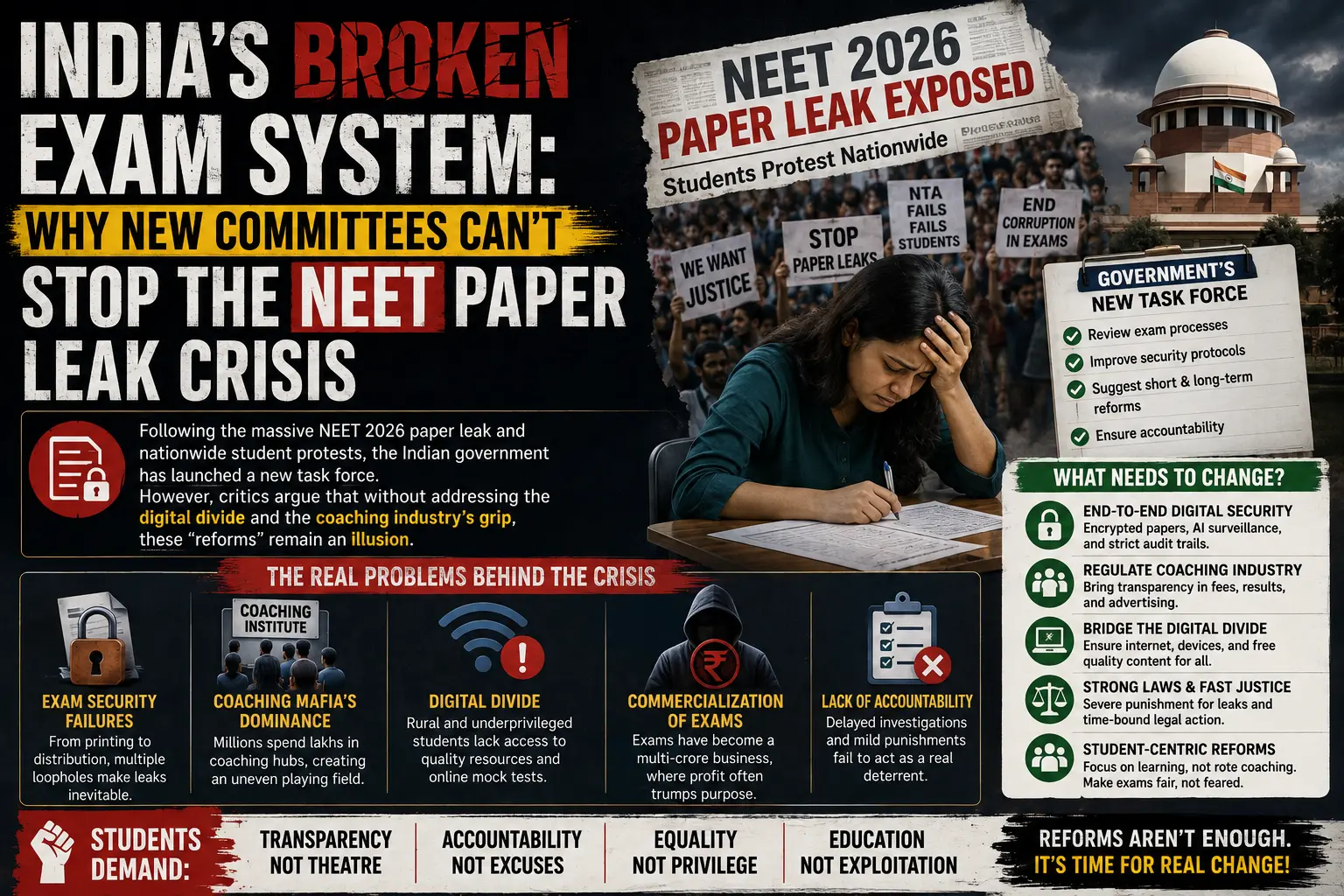
The government’s response to these crises has followed a very familiar pattern. First comes the public anger, then a few arrests, and finally, the formation of a high-level committee. After the 2026 protests, Union Education Minister Dharmendra Pradhan resigned. Shortly after, Prime Minister Narendra Modi announced a new task force led by Nandan Nilekani, the man behind Aadhaar.
The task force is supposed to suggest institutional reforms and better digital systems. But many students and experts are sceptical. Why? Because just two years ago, another committee—the K. Radhakrishnan Committee—was formed for the exact same reason. That committee held 23 meetings and looked at 37,000 responses from parents and students. It suggested using secure digital systems to stop paper leaks.
The fact that the government is forming a second committee before even finishing the work of the first one feels like a "band-aid" fix. It looks like a move to calm the public rather than a real attempt to fix the problem.
The Digital Divide and the Coaching Monster
The new task force is pushing for more digital testing. While this sounds modern, it ignores the reality of many Indian students. Government data from 2024-25 shows that 40% of government schools do not have working computers. Even worse, 42% of schools have no internet connection at all.
If exams become fully digital, students in rural areas or from poor families will be left behind. This creates a divide between the rich and the poor. Furthermore, the NEET exam has fueled a coaching industry worth thousands of crores. Parents often start sending their children to these centres as early as the 8th grade.
These exams don't just test medical knowledge anymore; they test how much money a family has to pay for special coaching. A report from Tamil Nadu, led by Justice A.K. Rajan, showed that NEET unfairly hurts students from rural areas and government schools. It has turned medical education into a privilege for the wealthy.
Are Fast-Track Courts the Answer?
In late July 2026, the government passed a new bill to stop "paper leak mafias." It promises tougher penalties and shorter trials. It also directs states to set up fast-track courts to finish cases within three months.
However, experience shows that more courts don't always mean more justice. For example, India already has hundreds of fast-track courts for cases involving crimes against children. Yet, those courts currently have a backlog of over two lakh cases. Simply making new laws or setting up new courtrooms doesn't help if the existing ones are already overwhelmed.
The Real Issue: Institutional Accountability
The problem with the national testing system isn't just about a few bad people or a lack of computers. As opposition leader Rahul Gandhi recently said, the system has been "hollowed out by termites." There is a lack of transparency and accountability within the NTA.
Instead of expert panels dominated by technocrats, many believe we need educators and teachers who understand the daily struggles of students. We need a system that isn't just about security but also about fairness.
The current response of more committees and tougher penalties is like painting a house that has a broken foundation. It might look better for a while, but it won't stop the leaks. Real reform will only happen when the government stops looking for temporary solutions and starts building a fair, transparent, and student-focused institution. Until then, for the millions of young people waiting for their results, the promise of a better future remains an illusion.