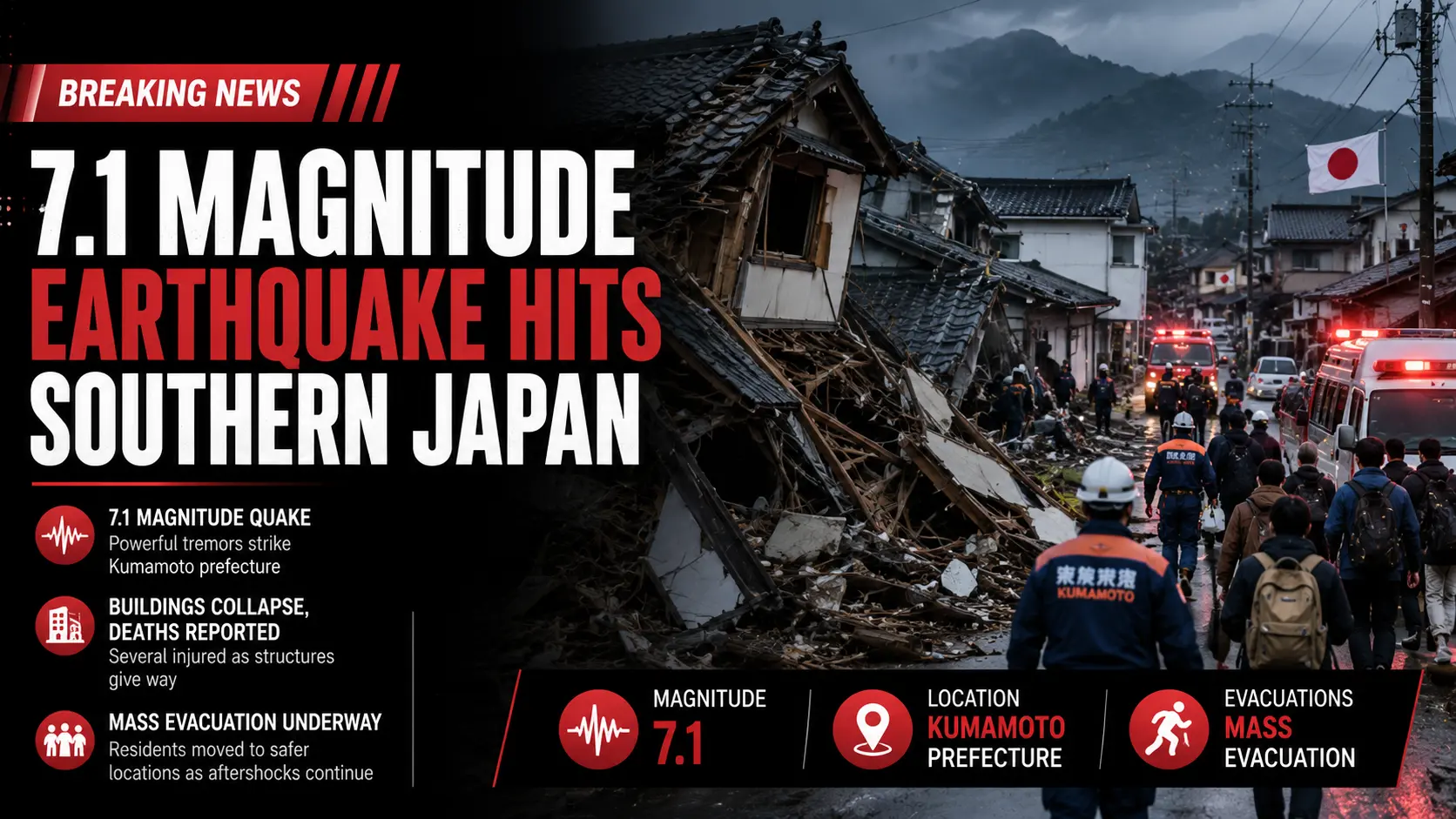
7.1 Earthquake Hits Southern Japan, Forces Mass Evacuation
A powerful earthquake struck southern Japan on Tuesday, July 28. The quake, with a preliminary magnitude of 7.1, collapsed several buildings — including a shopping mall — and forced hundreds of thousands of people to evacuate.
What Happened
Japanese officials told around 300,000 people in Kumamoto prefecture to move to evacuation centers. The Japan Meteorological Agency said the quake struck at the highest end of its seismic intensity scale, at a depth of just over 6 miles. Its center was about 12 miles south of Kumamoto city, home to roughly 700,000 people.
The earthquake hit around 4:27 PM local time. A tsunami advisory was issued for nearby seas a few minutes later, but it was lifted soon after.
A Mall Collapse and Reported Deaths
An unknown number of people were trapped inside a shopping mall after an explosion was heard on its second floor. Around 20 to 30 mall employees were unaccounted for.
Local broadcasters gave different accounts of casualties: one cited police saying "quite a few" people are believed to have died, while another reported that multiple deaths had been confirmed at the mall. Exact numbers have not yet been officially confirmed.
Fire trucks were seen at the mall, and footage showed collapsed ceilings, a damaged building front, and debris scattered on nearby roads.
Damage Beyond the Mall
The earthquake caused damage well beyond the shopping center:
- At least 12 houses collapsed
- At least 50 people were injured
- A chimney partially collapsed at a paper mill, where several workers could not be reached
- A section of a major expressway ruptured, trapping vehicles
- Train services across the region were suspended
Nuclear Plants Reported Safe
Given Japan's history with nuclear safety concerns, officials moved quickly to check nearby power plants. Japan's nuclear regulator told the International Atomic Energy Agency that the Sendai nuclear plant was undamaged. A regional power company also reported no abnormalities at two other nearby nuclear stations, and said radiation levels around them had not changed.
Government Response
Japan's Prime Minister said 300 service members were being sent to the disaster area. Officials said saving lives and supporting rescue efforts remain the top priority, and warned that strong aftershocks could continue for about a week.
Why Japan Is Especially Vulnerable
Japan sits on the "Ring of Fire," a region where several tectonic plates meet — making it one of the most earthquake-prone countries in the world. Nearly 20% of the world's earthquakes of magnitude 6.0 or higher happen there.
Kumamoto has been hit hard before: a series of earthquakes in 2016 killed nearly 300 people in the region. Japan has also significantly strengthened its earthquake warning systems since the 2011 earthquake and tsunami that caused the Fukushima nuclear disaster and killed nearly 20,000 people.
This is a developing situation. Casualty figures and damage reports may change as officials continue assessing the area.