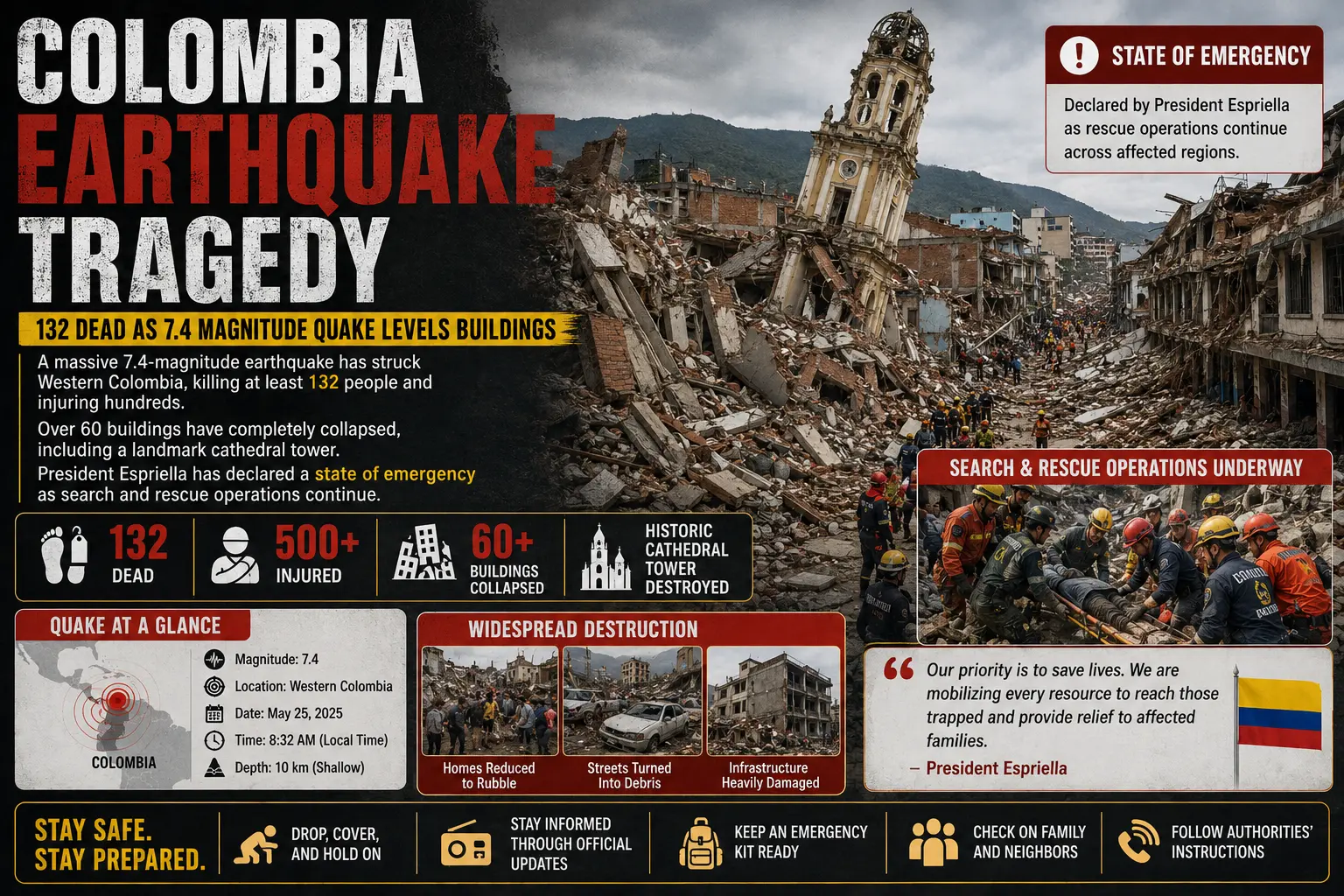
Tragedy in Colombia: 7.4 Magnitude Earthquake Claims 132 Lives; Massive Destruction Reported in Major Cities
The South American nation of Colombia is reeling from its deadliest natural disaster in decades. On Monday, a powerful 7.4-magnitude earthquake struck Western Colombia, tearing through cities, collapsing infrastructure, and leaving a trail of destruction. At least 132 people have been confirmed dead, and over 570 individuals have sustained injuries. With hundreds still missing under the debris of flattened buildings, the death toll is expected to rise sharply in the coming days.
The Strongest Tremor of the Century
The Colombian Geological Service has classified this earthquake as the strongest recorded in the country in the 21st century. The initial massive jolt was followed by at least 21 significant aftershocks, which hampered rescue efforts and sent panicked residents fleeing into the streets. The earthquake’s epicenter was located in the seismically volatile Pacific region, a zone that has seen frequent tremors but rarely of this magnitude. Residents in cities like Cali and Pereira reported feeling the ground shake for nearly a minute.
Cities Turned to Rubble
The visual evidence of the disaster is staggering. In the city of Pereira, a four-story apartment complex collapsed into a pile of twisted metal and concrete within seconds. In Manizales, the city’s historic neo-Gothic cathedral—a symbol of local pride—saw one of its side towers crumble, raining debris onto the streets below.
One of the most miraculous stories of survival emerged from the city of Cali. Video footage broadcast locally showed rescuers carefully pulling a six-month-old baby girl, covered in thick grey dust, from the ruins of a five-story building. Her mother was also rescued alive shortly after. In other parts of Cali, specialized rescue teams were seen rappelling patients out of hospital windows as the building’s internal staircases had become too dangerous to use.
A Baptism by Fire for the New President
The disaster struck at a time of political transition. President Abelardo De La Espriella had taken office just days before the quake. This tragedy marks the first major crisis for his administration. Acting swiftly, the President declared a national state of emergency to bypass bureaucratic hurdles and expedite funding for recovery and relief.
"We are not going to leave our people alone," President Espriella stated during a televised address. "They are in our hearts, and the government will act with full determination to provide food, shelter, and medical care to every affected citizen."
The Extent of the Damage
Early assessments from the disaster management division provide a grim picture:
At least 1,575 homes have been significantly damaged or destroyed.
61 large buildings have completely collapsed.
18 health centers and 52 schools have sustained structural damage.
The Choco region, one of the poorest and most remote parts of the country, remains a major concern. Accessible only by air or water, officials fear the casualties in these isolated communities could be higher than initially thought.
The Science Behind the Shaking
Colombia sits on the "Ring of Fire," a massive horseshoe-shaped belt in the Pacific Ocean where the majority of the world's earthquakes and volcanic eruptions occur. While Colombia is accustomed to seismic activity, this specific quake was unusual. Seismologists noted that the quake occurred deep below the Earth's crust, which theoretically should have lessened the shaking on the surface. However, due to the specific "strike-slip" motion of the tectonic plates, the vibrations were amplified across the populated valleys, leading to massive structural failures.
The Road to Recovery
Rescue crews are working against the clock. Heavy machinery, search dogs, and thermal imaging equipment are being used to locate those trapped in air pockets within collapsed structures. The international community has begun pledging support, with neighboring nations offering search and rescue specialists. For many Colombians, this event brings back the trauma of the twin earthquakes that struck nearby Venezuela in June. As the dust settles, the focus will shift from rescue to rebuilding, but for now, the nation remains on high alert.