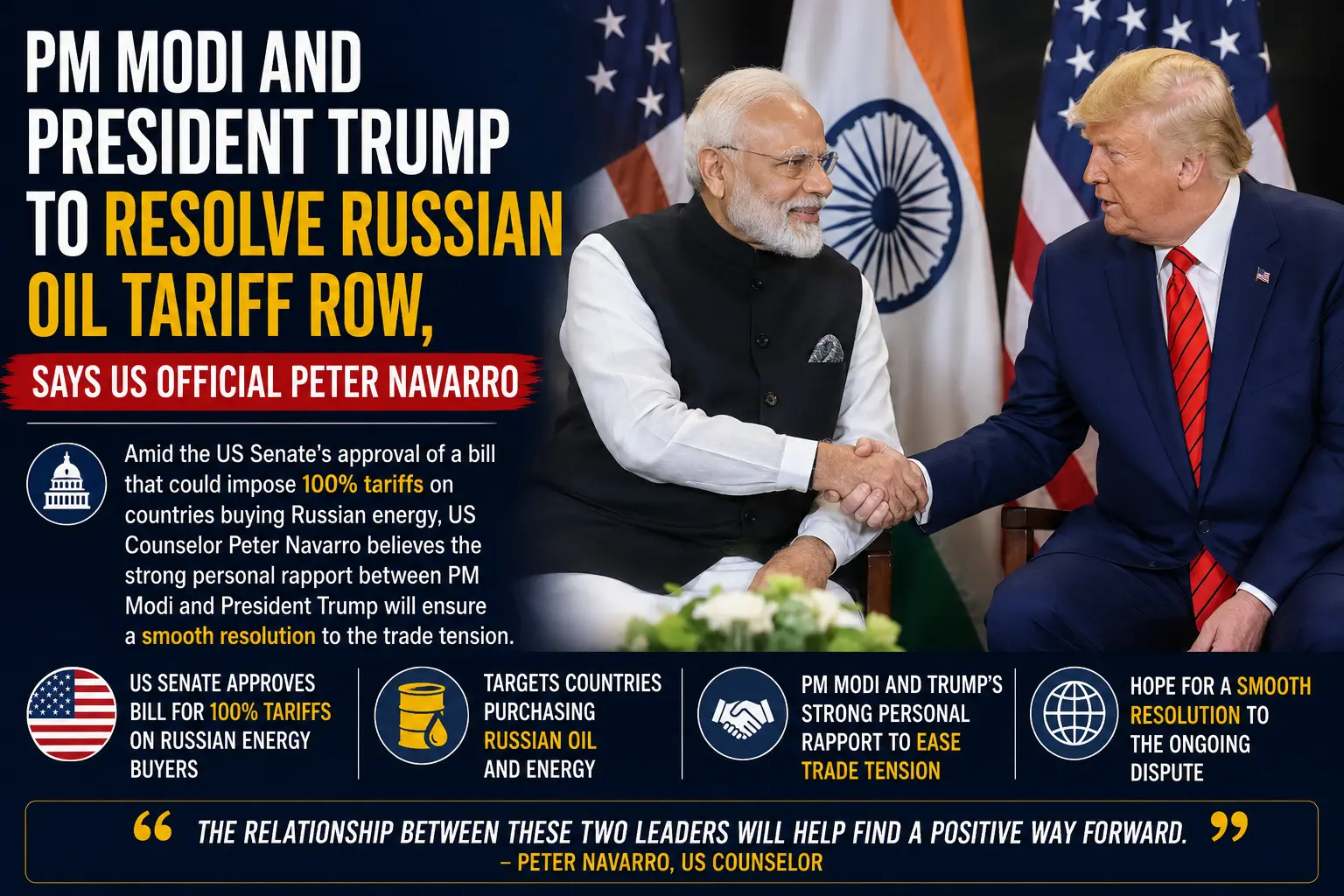
Bypassing the Blockade: How the Modi-Trump Rapport is Expected to Settle the India-US Russian Oil Conflict
In the high-stakes arena of international diplomacy, personal relationships between world leaders often act as the ultimate safety valve. This is currently the case as India and the United States navigate a tricky period in their trade relations, specifically concerning India’s continued import of discounted Russian crude oil. While legislative measures in Washington threaten to impose severe penalties, a senior advisor to the U.S. President has offered a reassuring perspective on the future of the bilateral partnership.
The Legislative Storm: 100% Tariffs
On August 7, 2026, the U.S. Senate passed the "Lindsey O. Graham Sanctioning Russia and Iran Act of 2026" with an overwhelming majority. The core objective of this bipartisan legislation is to choke the financial pipelines that sustain Russia's military activities in Ukraine. However, the bill carries a provision that has caused significant concern in New Delhi: it authorizes the U.S. President to impose discretionary tariffs of up to 100% on goods from countries that remain among the top five buyers of Russian oil or gas.
Since India has become one of the primary importers of Russian crude since 2022, it sits squarely in the crosshairs of this act. A 100% tariff would effectively double the price of Indian exports like pharmaceuticals, IT services, and textiles in the American market, potentially leading to an economic standoff between the two strategic partners.
Navarro’s Confidence in the Leadership
Despite the looming threat of the new law, Senior U.S. Presidential Counsellor Peter Navarro has voiced confidence in a diplomatic resolution. In a recent interaction, Navarro emphasized that President Donald Trump and Prime Minister Narendra Modi share a "very good working relationship."
Navarro noted that while there are disagreements regarding India's energy trade with Moscow, these are matters that the two leaders can and will resolve directly. "It is not for me or any group to interfere in these bilateral discussions," Navarro stated, underscoring that the strength of the leaders' personal rapport is the best tool for reconciling strategic cooperation with economic realities. He urged against hostile social media exchanges, noting that complex problems between allies are best solved through high-level dialogue.
The Indian Dilemma: Energy Security vs. Market Access
India’s position is a delicate balancing act. Before the Russia-Ukraine conflict, India’s oil trade with Moscow was negligible. However, as global energy prices surged, Russia offered crude at significantly discounted rates. For a country that imports over 80% of its oil, these discounts were vital for controlling domestic inflation and ensuring energy security.
Furthermore, Indian refineries have optimized their costs by processing this crude and exporting refined products globally. The U.S. views this as a loophole that allows Russian oil wealth to circulate back into the global economy. For India, however, it is a matter of national economic necessity, especially given the volatility in other supply routes like the Strait of Hormuz.
The Strategic "Checkmate"
While the U.S. wants to limit Russia’s revenues, it also views India as an indispensable partner in the Indo-Pacific region. Washington realizes that alienating India through aggressive trade wars could push New Delhi closer to other blocs and weaken the shared objective of countering regional hegemonies.
Historically, when trade tensions have arisen—whether over H-1B visas or agricultural tariffs—the direct intervention of PM Modi and the U.S. President has often resulted in a "middle path." Navarro's comments suggest that a similar pragmatic approach will be taken this time. The U.S. might look for concessions in other areas or set specific caps rather than implementing the maximum 100% tariff allowed by the new bill.
Conclusion: Trust Over Tariffs
The assurance from a high-ranking official like Peter Navarro indicates that the White House is not in a hurry to penalize its strategic ally. The focus remains on the "multifaceted partnership" that spans defense, space, and technology. As PM Modi and President Trump prepare for upcoming summits, the Russian oil issue will undoubtedly be on the table.
Ultimately, the India-US relationship has proven to be resilient enough to survive trade friction. By relying on the mutual respect and personal friendship between the two heads of state, both nations are likely to find a way to maintain their economic interests without compromising their strategic bond. In the world of geopolitics, sometimes a phone call between friends is more powerful than a hundred-page bill.