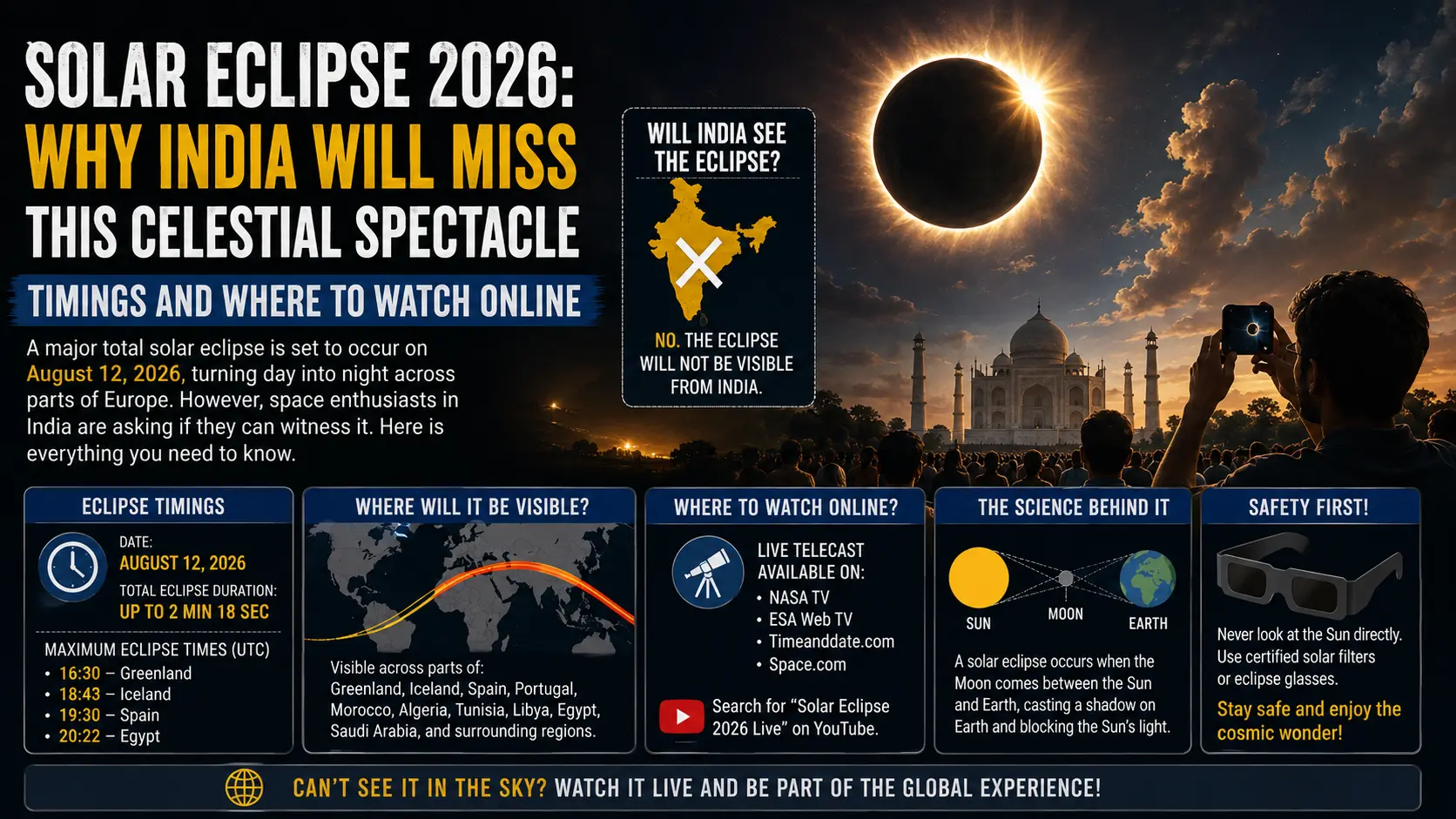
Day Turns to Night: The Great Solar Eclipse of 2026 is Here – But Can India See It?
Astronomy fans across the globe are circling August 12, 2026, on their calendars. It marks one of the most anticipated celestial events of the decade—a total solar eclipse. While parts of Europe are preparing for a total blackout during the daytime, the big question remains for people in the Indian subcontinent: will the shadow of the moon reach India?
As excitement builds, scientific communities and skywatchers are sharing crucial details about the path, the timing, and the best ways to experience this event safely.
What is a Solar Eclipse?
At its core, a solar eclipse is a game of shadows played on a cosmic scale. It occurs when the Sun, Moon, and Earth align in a perfectly straight line. The Moon passes directly between the Sun and our planet, casting its shadow onto Earth’s surface. For those standing in the darkest part of that shadow (the umbra), the Sun is completely blocked out, resulting in a total solar eclipse.
There are three main types of solar eclipses:
Total Solar Eclipse: The Moon covers the Sun's disk entirely.
Partial Solar Eclipse: Only a part of the Sun is hidden.
Annular Solar Eclipse: The Moon is too small to cover the Sun completely, leaving a "Ring of Fire."
Will India Witness the Eclipse?
Unfortunately for those in India, the August 12, 2026, solar eclipse will not be visible. The reason is straightforward geographical timing. The eclipse is scheduled to peak at approximately 9:04 PM Indian Standard Time (IST). Since the Sun will have already set across all of India by that time, the eclipse will occur under the cover of night for the country.
While Indians will miss the direct view, the event will be a massive spectacle for those in the Western Hemisphere and Europe.
The European Extravaganza
For the first time since 1999, mainland Europe will experience a total solar eclipse. The "path of totality"—the narrow track where the Sun is 100% covered—will pass through northern Spain, Portugal, Iceland, Greenland, and parts of Russia.
Spain is expected to be the primary hub for "eclipse chasers." Cities like Bilbao and Valencia will see clear skies, while Madrid and Barcelona will witness over 99% coverage. The totality in Spain will last for about 1 minute and 40 seconds, during which the temperature will drop, birds might stop chirping, and the stars will become visible in the middle of the day.
Scientific Phenomena to Watch For
During the few minutes of totality, two rare sights become visible to the naked eye (only when the Sun is 100% covered):
The Corona: This is the Sun’s outer atmosphere, looking like a shimmering pearly-white crown. It is usually invisible due to the Sun's overwhelming brightness.
The Chromosphere: A thin, pinkish-red ring just above the solar surface that becomes visible for just a few seconds at the start and end of the total eclipse.
Safety First: How to Watch
Even if you are traveling to a region where the eclipse is visible, or watching a partial eclipse, safety is paramount. Looking directly at the Sun, even when it is partially covered, can cause permanent retinal damage.
Certified Glasses: Use only ISO-certified solar eclipse glasses. Regular sunglasses are useless against solar radiation.
Solar Filters: If you are using a camera, telescope, or binoculars, you must use a professional solar filter.
Pinhole Projection: A safe and fun way for children is the pinhole method. Punch a small hole in a card and let the sunlight pass through it onto a white sheet of paper held a few feet away. You will see a mini-projection of the crescent Sun.
A Double Cosmic Treat
Interestingly, the eclipse coincides with the peak of the Perseid meteor shower. While it is unlikely to see a meteor during the brief darkness of the eclipse, the darkened skies in the path of totality offer a unique window for those with sharp eyes. NASA and other space agencies will be live-streaming the entire event for global audiences who cannot be there in person.
Looking Ahead
Solar eclipses are reminders of our place in the solar system. While India misses out this time, the digital age allows us to join the global community in celebrating this wonder. For those in the UK, the next time the Sun will be as obscured as this will be in 2081, with the next total eclipse in 2090. As we wait for the next one to grace Indian skies, we can still marvel at the high-definition feeds from the beaches of Spain and the icy plains of Greenland.